Latin Honors Ranking Explained: Cum Laude vs Magna vs Summa
- Home /
- Digital Hall of Fame Insights & Resources /
- Latin Honors Ranking Explained: Cum Laude vs Magna vs Summa

The Easiest Touchscreen Solution




Live Example: Rocket Alumni Solutions Touchscreen Display
Interact with a live example (16:9 scaled 1920x1080 display). All content is automatically responsive to all screen sizes and orientations.
Graduation day represents the culmination of years of academic effort, but for students who’ve maintained exceptional performance throughout college, commencement brings an additional honor—Latin distinctions that formally recognize sustained academic excellence. Yet confusion surrounds these prestigious designations, with students and families frequently uncertain about what separates cum laude from magna cum laude and summa cum laude, how institutions calculate eligibility, what GPA thresholds qualify, and what these honors mean for future opportunities.
Latin honors ranking follows a three-tiered system designating graduates who achieved academic performance substantially exceeding standard graduation requirements. These distinctions appear on diplomas, transcripts, and commencement programs, signaling to graduate schools and employers that recipients demonstrated not just adequate competence but exceptional intellectual achievement throughout their undergraduate education. Understanding the nuances between levels, institutional variations, and strategic paths to earning these honors helps students maximize academic potential while pursuing meaningful recognition.
This comprehensive guide clarifies Latin honors ranking completely—explaining each designation’s meaning and requirements, comparing institutional policies and GPA thresholds, outlining strategic approaches to achieving these distinctions, and exploring how colleges celebrate and preserve this academic legacy through modern recognition systems.
Latin honors provide formal academic distinction that extends beyond simply completing degree requirements, validating sustained excellence through quantitative performance metrics that institutions have recognized for centuries. While specific criteria vary substantially across colleges and universities, the fundamental three-tier structure remains consistent, creating universally recognized achievement categories that transcend individual institutional contexts.

Modern recognition displays celebrate Latin honors recipients alongside other academic distinctions throughout institutional history
Understanding the Latin Honors System: Origin and Structure
Before examining specific distinctions and requirements, understanding the historical context and fundamental structure of Latin honors provides important foundation.
Historical Background
European University Origins
Latin honors originated in European universities where Latin served as the academic lingua franca throughout medieval and early modern periods. Institutions designated exceptional graduates with Latin phrases indicating the degree to which they excelled, creating a standardized recognition system transcending language barriers.
American Higher Education Adoption
American colleges and universities adopted Latin honors beginning in the 18th and 19th centuries, with Harvard University among the first institutions implementing the system in 1872. The practice spread throughout American higher education during the late 1800s and early 1900s, eventually becoming standard at most four-year institutions.
Contemporary Prevalence
Today, the majority of American colleges and universities employ some form of Latin honors system, though implementation details, calculation methodologies, and eligibility percentages vary substantially across institutions. Some selective colleges have eliminated Latin honors entirely in recent decades, arguing that all admitted students represent high achievers making distinctions less meaningful, though most institutions maintain traditional systems.
Learn about comprehensive academic recognition programs celebrating various forms of academic excellence.
The Three-Tier Latin Honors Structure
Latin honors employ a hierarchical three-level system designating progressively exceptional achievement:
| Latin Honor | English Translation | Typical GPA Range | Approximate Percentage of Class | Academic Significance |
|---|---|---|---|---|
| Cum Laude | “With Honor” / “With Praise” | 3.5-3.7 | Top 15-30% | Recognizes solid academic excellence above standard achievement |
| Magna Cum Laude | “With Great Honor” / “With Great Praise” | 3.7-3.9 | Top 5-15% | Acknowledges substantially higher achievement demonstrating exceptional performance |
| Summa Cum Laude | “With Highest Honor” / “With Highest Praise” | 3.9-4.0 | Top 1-5% | Celebrates the most exceptional academic achievement in graduating class |
Important Caveat: These ranges represent typical patterns across American higher education but individual institutions establish specific criteria that may differ substantially from these general parameters. Always consult your institution’s specific policies for accurate threshold information.

Institutions integrate academic honors recognition within comprehensive celebration of student excellence across all domains
Alternative Honor Systems
While the three-tier Latin system remains most common, some institutions employ alternative or modified approaches:
Four-Tier Systems
Some colleges add a fourth intermediate level:
- Summa cum laude (highest)
- Magna cum laude (very high)
- Cum laude with distinction (high-middle tier)
- Cum laude (standard honors)
Percentage-Based vs. GPA-Based Systems
Institutions employ two fundamental methodologies:
Fixed GPA Thresholds
- Specific minimum GPAs required for each honor level
- Thresholds remain constant year-to-year
- Variable percentage of class receives honors depending on performance distribution
- Allows theoretically unlimited students achieving honors if criteria met
- Transparent criteria enabling students to track progress toward goals
Fixed Percentage Cutoffs
- Top X% of graduating class receives each honor level
- Competitive system where achievement relative to peers determines eligibility
- Consistent honors percentage across graduating classes year-to-year
- More common at highly selective institutions where grade inflation concerns exist
- Students uncertain of exact GPA requirements until final class rankings calculated
Hybrid Approaches
- Minimum GPA requirements combined with percentage limitations
- Must meet threshold GPA and rank within top percentage of class
- Prevents excessive honors distribution while maintaining performance standards
Explore high school end-of-year awards that similarly recognize tiered academic achievement.
Cum Laude: Foundation Honor Level
Cum laude represents the entry-level Latin honor, acknowledging academic performance substantially exceeding standard graduation requirements while remaining accessible to a meaningful portion of high-achieving students.
Meaning and Significance
Latin Translation and Interpretation
“Cum laude” translates literally as “with honor” or “with praise,” indicating that the graduate completed their degree with academic distinction worthy of formal recognition. This designation separates graduates who demonstrated consistent strong performance from those who met minimum requirements without exceptional achievement.
Academic Achievement Indicator
Cum laude designation communicates several qualities to graduate programs and employers:
- Sustained academic performance throughout undergraduate education
- Ability to handle rigorous coursework successfully
- Strong work ethic and time management capabilities
- Intellectual capability beyond minimum competency
- Consistent achievement across multiple years and courses
While the entry-level Latin honor, cum laude still represents significant accomplishment typically placing graduates in the top 15-30% of their graduating class.

Digital recognition systems showcase detailed profiles of graduates earning Latin honors and other academic distinctions
Typical Cum Laude Requirements
Common GPA Thresholds
Institutions most frequently establish cum laude minimums in the 3.5-3.7 GPA range:
Typical Patterns by Institution Type
- Highly selective private colleges: 3.6-3.7 minimum (stricter due to grade compression among high-achieving students)
- Flagship state universities: 3.5-3.65 minimum (moderate selectivity reflected in threshold)
- Regional public universities: 3.5 minimum (accessible threshold encouraging broad participation)
- Liberal arts colleges: 3.5-3.7 minimum (varies by institutional selectivity and philosophy)
Percentage-Based Systems
Institutions using percentage cutoffs typically designate top 15-30% of graduating class as cum laude:
- More selective institutions tend toward lower percentages (15-20%)
- Less selective institutions may recognize top 25-30%
- Exact percentage often established by faculty governance bodies
- May include minimum GPA floor preventing honors with insufficient performance
Institutional Examples (representative, not exhaustive):
- Stanford University: Top 15% of graduating class (approximately 3.5+ GPA)
- University of Michigan: 3.5 minimum GPA
- Boston College: 3.667 minimum GPA
- University of California schools: Top 20% of college graduates (varies by campus)
- University of Florida: 3.5 minimum GPA
Understanding academic recognition structures helps institutions celebrate diverse achievement levels appropriately.
Strategic Path to Earning Cum Laude
Early Planning and GPA Management
Students aspiring to Latin honors should begin strategic planning freshman year:
Foundation Building (Freshman Year)
- Establish strong study habits and time management systems immediately
- Understand your institution’s specific GPA calculation methodology
- Target consistent performance above 3.5 threshold from the start
- Recognize that freshman grades significantly impact cumulative GPA
- Seek academic support resources proactively when struggling with material
Maintaining Consistency (Sophomore-Junior Years)
- Sustain strong performance across all courses, not just major requirements
- Balance course difficulty with realistic workload assessment
- Avoid grade decline during traditionally difficult periods
- Monitor cumulative GPA each semester ensuring trajectory remains above threshold
- Address academic difficulties immediately through tutoring or professor assistance
Senior Year Considerations
- Recognize that most institutions calculate honors using all completed coursework
- Avoid senioritis that could drop cumulative GPA below threshold
- Understand calculation timing (some schools use seven semesters, others include final semester)
- Confirm institution’s specific honors calculation policy and timeline
- Maintain performance through graduation to preserve eligibility
Course Selection Strategy
Strategic course planning supports GPA goals while ensuring intellectual challenge:
- Balance rigorous major courses with achievable electives
- Understand institutional policies about pass/fail courses affecting honors eligibility
- Consider major selection aligned with academic strengths
- Avoid overloading challenging courses in single semesters
- Seek advice from academic advisors about maintaining honors-level performance
Magna Cum Laude: High Distinction
Magna cum laude represents the intermediate Latin honor tier, recognizing substantially exceptional academic achievement beyond standard excellence.
Meaning and Recognition Level
Latin Translation
“Magna cum laude” translates as “with great honor” or “with great praise,” indicating performance significantly exceeding the foundation cum laude level. This designation recognizes graduates who demonstrated not just consistent strong achievement but sustained excellence throughout their undergraduate education.
Competitive Distinction
Magna cum laude typically recognizes the top 5-15% of graduating classes, placing recipients well above average academic performance. This distinction carries particular weight because it separates merely strong students from exceptionally high-achieving ones who maintained rigorous academic standards across all coursework.

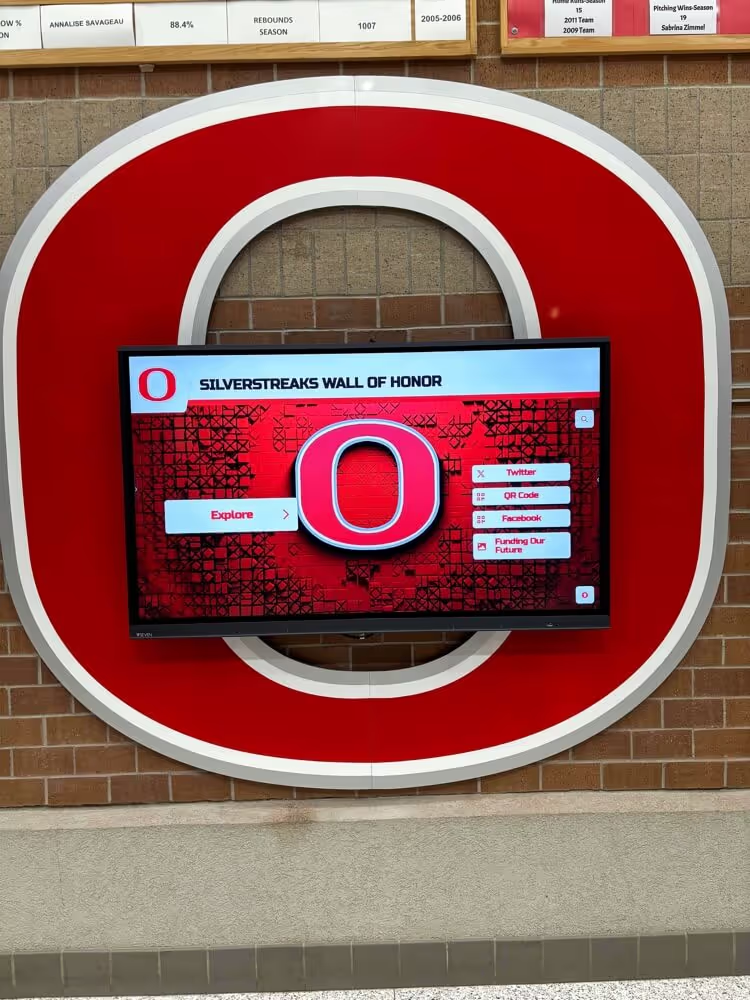
Touchscreen displays enable exploration of detailed academic achievement information including Latin honors designation and context
Graduate School and Employment Significance
Magna cum laude designation provides concrete advantages:
- Graduate school admissions: Signals strong academic capability for rigorous graduate study
- Professional school applications: Law, medical, and business schools view magna cum laude as meaningful achievement indicator
- Employment screening: Competitive employers often use honors designations as initial screening criteria
- Scholarship opportunities: Many graduate fellowships list Latin honors among eligibility requirements
- Professional credibility: Distinction remains on resume throughout career
Learn about digital archiving systems preserving comprehensive academic achievement records including Latin honors.
Typical Magna Cum Laude Requirements
Common GPA Thresholds
Magna cum laude typically requires GPAs in the 3.7-3.9 range:
Institutional Patterns
- Highly selective private universities: 3.8-3.9 minimum (accounting for grade compression)
- Flagship public universities: 3.7-3.85 minimum (moderate selectivity)
- Liberal arts colleges: 3.75-3.85 minimum (varies by institutional culture)
- Regional universities: 3.7-3.8 minimum (accessible but challenging standard)
Percentage-Based Cutoffs
Institutions using ranking systems typically designate top 5-15% as magna cum laude:
- Highly competitive schools tend toward 5-10% range
- Less selective institutions may extend to top 15%
- Often includes minimum GPA requirement preventing honors at lower absolute performance
- May exclude highest performers reserved for summa cum laude designation
Representative Examples:
- Harvard University: Top 20% of class (magna and summa combined—approximately 3.67+ GPA)
- Yale University: Top third of class eligible for Latin honors; magna represents middle tier
- Northwestern University: 3.7 minimum GPA
- University of Texas at Austin: Top 10% of college graduates
- Duke University: 3.7 minimum GPA
Achieving Magna Cum Laude: Advanced Strategies
Sustained Excellence Requirements
Reaching magna cum laude demands consistent high performance across entire undergraduate career:
GPA Recovery Mathematics
- Early strong performance creates GPA buffer for occasional challenging courses
- GPA recovery from lower grades becomes increasingly difficult as credit hours accumulate
- Single B or C in freshman year requires multiple A grades to compensate
- Junior and senior year grade improvements have limited impact on cumulative GPA
- Students must maintain 3.7+ performance from early semesters to reach magna threshold
Academic Planning Approaches
Strategic planning maximizes magna cum laude probability:
Major and Minor Selection
- Choose major aligned with genuine strengths and interests
- Consider that intrinsic motivation correlates with higher performance
- Evaluate major difficulty and average GPAs before committing
- Select minor/concentration areas where strong performance likely
- Balance intellectual challenge with realistic performance expectations
Course Load Management
- Distribute challenging courses across semesters avoiding overload
- Understand optimal personal course load (quality over quantity)
- Strategically use summer courses for requirements where appropriate
- Consider that W (withdrawal) grades don’t affect GPA but delay progress
- Plan senior year workload accounting for thesis, job search, or graduate applications
Study Strategies for Consistent Excellence
- Develop systematic study schedules allocating time proportionate to course difficulty
- Prioritize consistent engagement over last-minute cramming
- Build relationships with professors enabling better learning and stronger recommendations
- Form study groups with similarly motivated high-achieving peers
- Utilize all available academic support resources proactively
Explore teacher recognition programs celebrating faculty who support students achieving academic honors.
Summa Cum Laude: Highest Honor
Summa cum laude represents the pinnacle of undergraduate academic achievement, reserved for graduates who demonstrated truly exceptional performance throughout their college careers.
Meaning and Elite Status
Latin Translation and Significance
“Summa cum laude” translates as “with highest honor” or “with highest praise,” designating the most academically distinguished graduates in each class. This represents the rarest and most prestigious undergraduate academic honor most institutions award, signaling extraordinary intellectual achievement and sustained excellence across all dimensions of academic performance.
Exceptional Achievement Designation
Summa cum laude typically recognizes only the top 1-5% of graduating students:
- At highly selective institutions, even this small percentage represents students who excelled among already exceptional peers
- The designation carries substantial weight precisely because of its rarity
- Employers and graduate programs immediately recognize summa cum laude as meaningful distinction
- Achievement becomes permanent credential distinguishing recipient throughout professional career

Comprehensive recognition systems integrate digital displays with traditional elements celebrating highest academic honors
Professional and Academic Advantages
Summa cum laude designation provides concrete long-term benefits:
Graduate and Professional School Admissions
- Top-tier programs explicitly seek summa cum laude graduates in competitive pools
- Designation offsets other application weaknesses (moderate test scores, limited research)
- Particularly valuable for highly selective PhD programs and professional schools
- Many fellowship programs list summa cum laude among qualifying criteria
- Academic career paths heavily weight undergraduate distinction
Employment and Career Development
- Prestigious employers use Latin honors for initial resume screening
- Consulting, finance, and technology firms particularly value academic distinction
- Distinction remains resume-worthy throughout entire career
- Signals exceptional work ethic, intellectual capability, and achievement drive
- Networking advantages from shared distinction with accomplished alumni
Long-Term Professional Credibility
- Permanent credential appearing on all official transcripts
- Listed in alumni directories and institutional publications
- Recognized globally across academic and professional contexts
- Conversation starter and credibility builder throughout career
Typical Summa Cum Laude Requirements
Common GPA Thresholds
Summa cum laude typically requires GPAs of 3.9-4.0:
Institutional Standards
- Elite private universities: 3.9-4.0 minimum (often requires near-perfect performance)
- Flagship public universities: 3.9 minimum (top tier of already strong students)
- Highly selective liberal arts colleges: 3.9-4.0 minimum (exceptional achievement among competitive peers)
- Comprehensive universities: 3.85-3.9 minimum (recognizing highest achievers)
Percentage-Based Systems
Institutions using ranking methodologies typically limit summa cum laude to top 1-5%:
- Most selective schools restrict to top 1-3% maintaining exclusivity
- Less selective institutions may extend to top 5% ensuring meaningful cohort size
- Often includes minimum GPA threshold preventing honors through ranking alone
- May employ additional criteria beyond GPA (thesis distinction, comprehensive exams)
Institutional Examples:
- Princeton University: Top 5% of graduating class
- Columbia University: 3.9 minimum GPA
- University of Virginia: Top 2% of graduating class with minimum 3.4 GPA
- Cornell University: Top 5% of college and top 30% of major with minimum 3.5 GPA
- MIT: Achieved less than 10% of grades below A- (approximately 3.9+ GPA)
Learn about student recognition awards celebrating diverse forms of academic achievement.
Path to Achieving Summa Cum Laude
Exceptional Performance Requirements
Earning summa cum laude demands near-perfect academic performance:
GPA Reality Check
The mathematical requirements for summa cum laude are stringent:
- 3.9 GPA allows only limited grades below A
- A 4.0 GPA requires perfect A grades in all courses (or A+/A balance where plus/minus system exists)
- Single B grade significantly impacts ability to reach 3.9+ threshold
- Recovery from lower grades nearly impossible at junior/senior level
- Must maintain exceptional performance from freshman year through graduation
Beyond GPA: Additional Excellence Indicators
Some institutions consider factors beyond cumulative GPA:
Thesis or Capstone Distinction
- Outstanding honors thesis receiving highest distinction
- Departmental honors alongside cumulative GPA requirement
- Research contributions or publications during undergraduate years
- Comprehensive examination performance in major field
- Faculty evaluation of overall intellectual achievement
Course Rigor Considerations
- Institutions may weight honors courses, graduate courses, or independent study differently
- Demonstrated intellectual engagement beyond minimum requirements
- Participation in competitive academic programs (honors college, special seminars)
- Consistent enrollment in most challenging available courses
Strategic Approaches for Summa Pursuit
Early Excellence is Non-Negotiable
Unlike lower Latin honors where some GPA recovery remains possible, summa cum laude requires exceptional performance from the beginning:
Freshman Year Foundation
- Target 4.0 or near-perfect performance establishing strong foundation
- Understand that freshman grades count equally with later performance
- Build study systems supporting sustained excellence across four years
- Recognize that recovering from weak freshman performance extremely difficult for summa eligibility
- Establish relationships with faculty that support learning and future opportunities
Consistent Perfection or Near-Perfection
- Maintain A or A- grades across all courses throughout undergraduate career
- Avoid course overload that risks performance decline
- Select major and courses aligned with genuine strengths
- Prioritize learning and mastery over resume building
- Recognize that single semester of B grades may eliminate summa possibility
Course Selection for Maximum Performance
Strategic planning supports highest achievement:
- Choose major where you have strong foundation and genuine interest
- Select professors known for excellent teaching and clear expectations
- Balance challenging courses with realistic workload assessment
- Consider summer courses strategically for difficult requirements
- Engage deeply with material rather than pursuing surface-level grade optimization

Interactive recognition systems enable exploration of exceptional academic achievement including summa cum laude designation and detailed profiles
When Summa Remains Unreachable
Refocusing on Magna Achievement
If early performance makes summa cum laude unrealistic, redirect focus to magna:
- Magna cum laude remains highly prestigious and valuable designation
- Often more meaningful distinction than summa/magna difference suggests
- Graduate programs and employers recognize magna as exceptional achievement
- Pursuing realistic goals reduces stress while maintaining high standards
Alternative Achievement Pathways
- Departmental honors and distinction in major field
- Research publications and presentations
- Leadership in academic organizations
- Prestigious internships and fellowships
- Strong relationships with faculty for recommendation letters
The specific Latin honor level matters less than overall trajectory of intellectual engagement, growth, and genuine learning throughout undergraduate education.
Institutional Variations in Latin Honors Systems
Understanding how Latin honors policies differ across institutions helps students navigate specific contexts and appreciate variability in these recognition systems.
Calculation Methodology Differences
GPA Calculation Approaches
Institutions employ varying GPA calculation methods affecting honors eligibility:
All Coursework vs. Major-Specific
- Most schools calculate Latin honors using cumulative GPA across all courses
- Some institutions use major GPA exclusively or in combination with cumulative
- A few calculate honors separately within each college or school
- Pre-professional programs may have distinct honors criteria
Credit Hour Considerations
- Standard systems weight by credit hours (3-credit A = more impact than 1-credit A)
- Some schools employ unweighted systems treating all courses equally
- Transfer credit policies vary (some include in honors calculation, others exclude)
- Study abroad grades may or may not affect honors GPA depending on policy
Plus/Minus Grading Impact
Schools using plus/minus grading systems create additional complexity:
- A+ (4.3), A (4.0), A- (3.7), B+ (3.3), B (3.0), etc.
- Plus/minus systems create finer achievement distinctions
- Reaching 3.9 GPA requires careful balance of A and A- grades
- Schools without plus/minus (simple A=4.0, B=3.0) create different thresholds
Explore hall of fame tools celebrating academic and other achievements through modern recognition systems.
Timing and Eligibility Considerations
When Honors are Calculated
Timing variations affect final eligibility:
Seven Semester Calculation
- Some institutions calculate honors after seven semesters (excluding final spring semester)
- Used for early honors announcements and graduation program printing
- Students know honors status before final semester concludes
- Final semester performance doesn’t affect honors designation
Full Eight Semester Calculation
- Other schools include all coursework through graduation
- Honors determined after final grades submitted
- Creates uncertainty during final semester
- Recognizes complete undergraduate academic record
Commencement Program Implications
- Early calculation enables honors listing in printed commencement programs
- Late calculation may result in honors appearing only on transcripts and diplomas
- Some schools use tentative honors designations updated post-graduation
Minimum Credit Requirements
Most institutions impose minimum credit hour requirements:
- Typically 60+ credits earned at the institution (roughly half of degree)
- Transfer students may face higher thresholds
- Study abroad credits may or may not count toward residency requirement
- Prevents brief enrollment from qualifying for institutional honors
Schools That Have Eliminated Latin Honors
Notable Institutional Decisions
Several prominent colleges have eliminated traditional Latin honors:
Reed College (never awarded Latin honors)
- Philosophical opposition to academic ranking and competition
- Emphasis on learning for intrinsic value rather than external recognition
- All graduates receive same degree without distinction levels
Stanford University (briefly eliminated 1994-2004, then reinstated)
- Initially eliminated honors arguing all students were high achievers
- Reinstated after student, alumni, and employer feedback
- Current system recognizes top 15% of class
Wellesley College (eliminated 2003)
- Cited concerns about grade inflation and competitive pressure
- Focused on departmental honors instead
- Decision remains controversial among alumni and current students
Arguments for Elimination
- All admitted students already represent high achievement
- Latin honors incentivize grade-focused rather than learning-focused approaches
- Systems create unhealthy competition among peers
- Grade inflation makes distinctions less meaningful
- Alternative recognition (departmental honors, thesis distinction) more substantive
Arguments for Retention
- External constituencies (employers, graduate schools) value clear achievement signals
- Recognition motivates sustained excellence throughout undergraduate years
- Transparent criteria enable students to set and achieve goals
- Tradition connects current students with institutional history
- Most alumni and students support recognition systems
The debate continues, but majority of institutions maintain Latin honors as valuable component of academic recognition.
Latin Honors Comparison Table
This comprehensive comparison clarifies differences across the three Latin honor levels:
| Aspect | Cum Laude | Magna Cum Laude | Summa Cum Laude |
|---|---|---|---|
| Translation | With Honor | With Great Honor | With Highest Honor |
| Typical GPA Range | 3.5-3.7 | 3.7-3.9 | 3.9-4.0 |
| Approximate Class Percentage | Top 15-30% | Top 5-15% | Top 1-5% |
| Achievement Level | Solid academic excellence | Substantially exceptional achievement | Truly elite academic performance |
| Competitiveness | Achievable with consistent strong performance | Requires sustained excellence across all coursework | Demands near-perfect or perfect performance |
| Resume Impact | Positive distinction above standard graduation | Strong achievement signal to employers and graduate programs | Exceptional distinction carrying substantial weight |
| Graduate School Value | Helpful for competitive programs | Valuable for selective programs | Highly advantageous for top-tier programs |
| Rarity | Relatively common among high-performing students | Uncommon but substantial cohort | Rare—small percentage of any graduating class |
| Strategic Accessibility | Realistic goal for dedicated students from early college | Requires strategic planning and consistent excellence | Demands exceptional capability and near-perfect execution |
| Professional Significance | Career-long credential worth including on resume | Meaningful distinction throughout professional life | Elite credential recognized across contexts |
| Typical Challenges | Maintaining consistency across all courses | Avoiding grade slides in difficult semesters | Sustaining near-perfection over four years |
Learn about yearbook digitization preserving records of Latin honors and other academic achievements.
How Colleges Celebrate and Display Latin Honors
Beyond appearing on diplomas and transcripts, forward-thinking institutions create visible, engaging recognition celebrating Latin honors recipients.
Traditional Recognition Approaches
Commencement Recognition
Most institutions incorporate Latin honors into graduation ceremonies:
Ceremony Acknowledgment
- Honor cords or stoles in specific colors designating Latin honor level
- Announcements during diploma conferral recognizing honors recipients
- Special seating sections for Latin honors graduates
- Faculty or administrative remarks highlighting honors achievement
- Commencement program listings identifying each graduate’s distinction
Common Cord/Stole Color Conventions
- Gold cords frequently designate Latin honors (all three levels)
- Some institutions use different colors for each level (gold, silver, bronze)
- Colors vary by institutional tradition and academic regalia policies
- Students wear honors insignia with academic robes during ceremony

Integrated recognition installations celebrate academic honors including Latin distinctions within broader institutional achievement displays
Printed Recognition Materials
Traditional documentation includes:
Diplomas and Transcripts
- Latin honor designation printed on diploma (institutional seal and signature authentication)
- Notation on official transcripts permanently documenting achievement
- Graduation program listings identifying honors recipients
- Senior class yearbook or composite recognitions
Campus Displays
- Honor boards listing annual Latin honors recipients
- Trophy cases showcasing academic achievement
- Dean’s office or department displays recognizing exceptional graduates
- Alumni publications featuring recent honors graduates
Explore trophy shelf display ideas for showcasing academic honors.
Modern Digital Recognition Solutions
Comprehensive Digital Display Systems
Progressive institutions implement digital platforms celebrating Latin honors alongside other academic achievements:
Interactive Touchscreen Displays
Modern recognition solutions like Rocket Alumni Solutions transform how colleges celebrate academic excellence:
Unlimited Recognition Capacity
- Single digital display showcases unlimited Latin honors recipients across decades
- No space constraints requiring removal of historical achievers
- Comprehensive institutional archives preserving academic legacy permanently
- Every honors graduate receives equal visibility and professional presentation
Rich Achievement Profiles
- High-resolution graduation photographs
- Detailed achievement information including specific honor level and GPA (if permitted)
- Major, minor, and concentration details
- Thesis titles or research focus areas
- Graduate school destinations or career placements
- Student reflections on their academic journey
- Faculty or advisor commendations when available
Interactive Exploration Features
- Search functionality enabling quick lookup of specific graduates
- Filter by graduation year, honor level, major, or department
- Sort options showing highest achievers or most recent graduates
- Related content connecting students with similar interests or paths
- QR code sharing enabling graduates to share their profiles
Institutions implementing digital recognition report dramatically increased engagement with academic achievement history compared to static plaques or printed lists.
Learn about digital hall of fame installation processes and considerations.
Web-Accessible Recognition Platforms
Digital systems extend beyond physical campus:
Remote Accessibility
- Web-based platforms viewable globally by alumni, families, and prospective students
- Mobile-responsive design ensuring smartphone and tablet access
- Social sharing enabling graduates to celebrate achievements with extended networks
- SEO-optimized content helping prospective students discover institutional excellence
- Integration with alumni directories and institutional databases
Automated Updates and Management
- Cloud-based content management enabling updates from anywhere
- Bulk import tools for honors recipient rosters each graduation cycle
- Scheduled publishing coordinating with commencement ceremonies
- Template-based profile creation ensuring consistent professional presentation
- Role-based permissions for appropriate administrative access
Analytics and Engagement Tracking
- Visitor analytics showing recognition display usage patterns
- Most-viewed profiles and popular search terms
- Engagement duration and interaction depth metrics
- Geographic distribution of web platform visitors
- Data informing ongoing program improvements
Schools report 80-90% reduction in administrative time maintaining Latin honors displays after transitioning from traditional plaques to digital systems while celebrating 10x more graduates.

Purpose-built recognition kiosks enable intuitive exploration of Latin honors recipients and comprehensive academic achievement history
Strategic Recognition Display Placement
Maximizing Visibility and Impact
Thoughtful placement ensures recognition reaches key audiences:
High-Traffic Campus Locations
- Main academic building lobbies where students pass daily
- Library entrances serving as intellectual community centers
- Alumni centers connecting historical and current achievement
- Admissions office waiting areas showcasing institutional excellence to prospective students
- Student union common areas with maximum visibility
Digital Signage Integration
- Rotating Latin honors profiles on existing campus digital displays
- Integration with wayfinding and information kiosks
- Hallway screens in academic departments celebrating major-specific achievers
- Residence hall displays connecting residential and academic communities
Virtual and Online Presence
- Prominent institutional website placement celebrating current and historical honors
- Alumni website integration enabling graduate exploration
- Social media campaigns highlighting recent Latin honors recipients
- Virtual tour integration showcasing institutional academic culture
- Prospective student recruitment materials featuring honors graduates
Celebrate Academic Excellence with Modern Recognition
Discover how digital recognition solutions help colleges and universities honor Latin honors recipients, celebrate academic achievement, and preserve institutional legacy through engaging displays that inspire current students while honoring distinguished graduates.
Explore Academic Recognition SolutionsFAQ: Common Latin Honors Questions
What is the difference between cum laude, magna cum laude, and summa cum laude?
The three Latin honors represent progressively exceptional academic achievement levels. Cum laude (“with honor”) typically requires 3.5-3.7 GPA and recognizes the top 15-30% of graduates. Magna cum laude (“with great honor”) typically requires 3.7-3.9 GPA and acknowledges the top 5-15%. Summa cum laude (“with highest honor”) typically requires 3.9-4.0 GPA and celebrates the top 1-5% of graduates. Specific thresholds vary substantially by institution.
Do all colleges use the same GPA requirements for Latin honors?
No—Latin honors criteria vary significantly across institutions. Some schools use fixed GPA thresholds (e.g., 3.5 for cum laude) while others use percentage-based systems recognizing top portions of each graduating class. Highly selective universities often have stricter requirements than less selective institutions. Some colleges calculate honors using cumulative GPA while others use major GPA or combination approaches. Always consult your specific institution’s policies.
Can I earn Latin honors if I transfer to a different college?
Transfer students can typically earn Latin honors, but most institutions require minimum credit hours completed at the awarding institution—commonly 60+ credits or roughly half the degree. Transfer credits may or may not count in honors GPA calculation depending on institutional policy. Some schools have stricter requirements for transfer students. Check with your registrar’s office regarding specific transfer student Latin honors eligibility.
Do Latin honors appear on my diploma and transcript?
Yes—Latin honors appear on both official diplomas and transcripts from institutions that award them. The designation becomes permanent part of your academic record. Honors also typically appear in commencement programs and may be recognized during graduation ceremonies through special cords, stoles, or announcements.
How much do Latin honors matter for graduate school and employment?
Latin honors provide meaningful advantages particularly for competitive graduate programs and prestigious employers. Top-tier PhD programs, law schools, medical schools, and business schools explicitly value Latin distinctions. Consulting, finance, and technology employers often use honors for initial resume screening. While not sole determining factors, Latin honors signal sustained academic excellence, strong work ethic, and intellectual capability that remains career-relevant long after graduation.
What if my GPA is on the borderline for a Latin honor?
If your cumulative GPA falls near an honors threshold, several factors may influence your status. Some institutions round GPAs (e.g., 3.498 might round to 3.5), while others do not. Percentage-based systems rank all students precisely with no borderline cases. Some schools consider additional factors like thesis distinction or comprehensive exam performance. Confirm your institution’s specific policies and calculation methodologies. Focus on strong performance in remaining courses to exceed thresholds clearly rather than relying on borderline calculations.
Can I lose Latin honors after they’re awarded?
Once Latin honors appear on your official diploma and transcript following degree conferral, they cannot be revoked under normal circumstances. However, most institutions reserve the right to revoke degrees and honors in cases of academic dishonesty discovered after graduation. During your undergraduate career before final honors calculation, your eligibility can change based on your GPA trajectory.
Do employers really care about Latin honors years after graduation?
Latin honors remain resume-worthy throughout your career, particularly in fields valuing intellectual achievement and academic credentials. While professional accomplishments eventually outweigh undergraduate distinctions, Latin honors serve as permanent credibility indicators. Many accomplished professionals continue listing summa or magna cum laude on resumes decades after graduation, and the distinction remains conversation-worthy in professional contexts.
Conclusion: Understanding and Pursuing Latin Honors
Latin honors ranking provides standardized recognition of exceptional undergraduate academic achievement, creating distinctions that carry meaning across institutions, industries, and decades. Understanding the three-tier system—cum laude recognizing solid excellence, magna cum laude acknowledging substantially higher achievement, and summa cum laude celebrating truly elite performance—enables students to set realistic goals while appreciating the significance of each designation.
While specific GPA thresholds and calculation methodologies vary substantially across institutions, the fundamental structure remains consistent: Latin honors separate graduates who demonstrated sustained academic excellence from those who met minimum degree requirements without exceptional achievement. These designations appear permanently on diplomas and transcripts, providing career-long credentials that signal intellectual capability, work ethic, and commitment to excellence that employers and graduate programs value.
For students aspiring to Latin honors, success requires early planning establishing strong GPA foundations, sustained consistency maintaining high performance across all courses throughout undergraduate years, strategic course selection balancing challenge with realistic achievement, and genuine engagement with learning beyond grade optimization. The specific honor level matters less than the trajectory of intellectual growth and authentic educational engagement these distinctions represent.
For institutions celebrating Latin honors recipients, modern digital recognition solutions transform how colleges acknowledge academic achievement—eliminating space constraints that limited traditional plaques, creating engaging interactive experiences enabling exploration of institutional academic legacy, extending recognition globally through web platforms, and preserving comprehensive historical archives honoring distinguished graduates across decades.
Whether you’re a student working toward Latin honors, a recent graduate understanding your distinction’s significance, or an institution seeking to celebrate academic excellence more effectively, the comprehensive information in this guide provides foundation for appreciating these prestigious designations that have recognized exceptional achievement throughout American higher education history.
Your academic achievements deserve recognition that appropriately honors sustained excellence while inspiring future students to pursue similar distinction. Learn more about comprehensive academic recognition approaches that celebrate Latin honors alongside other forms of intellectual accomplishment, creating cultures where academic achievement receives visibility and celebration it deserves.
Live Example: Rocket Alumni Solutions Touchscreen Display
Interact with a live example (16:9 scaled 1920x1080 display). All content is automatically responsive to all screen sizes and orientations.