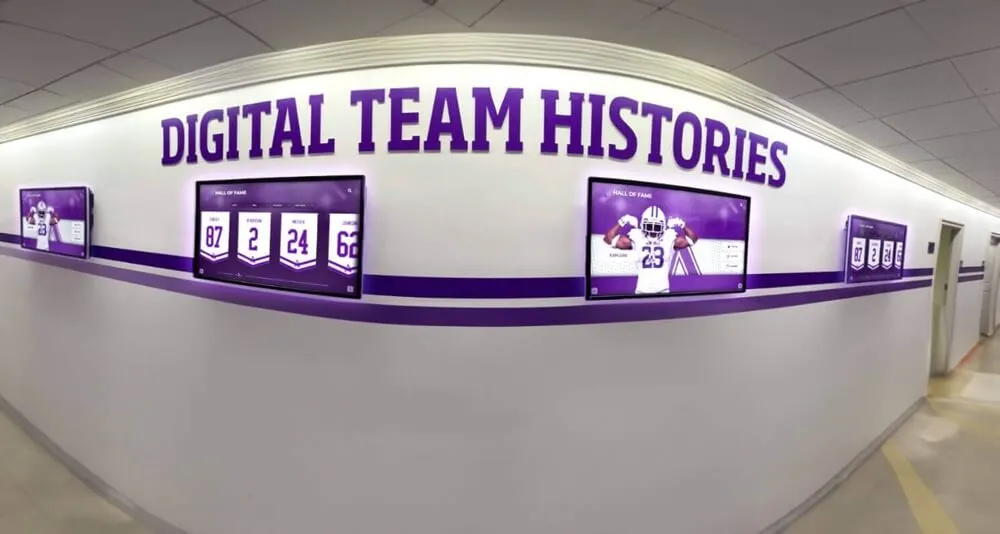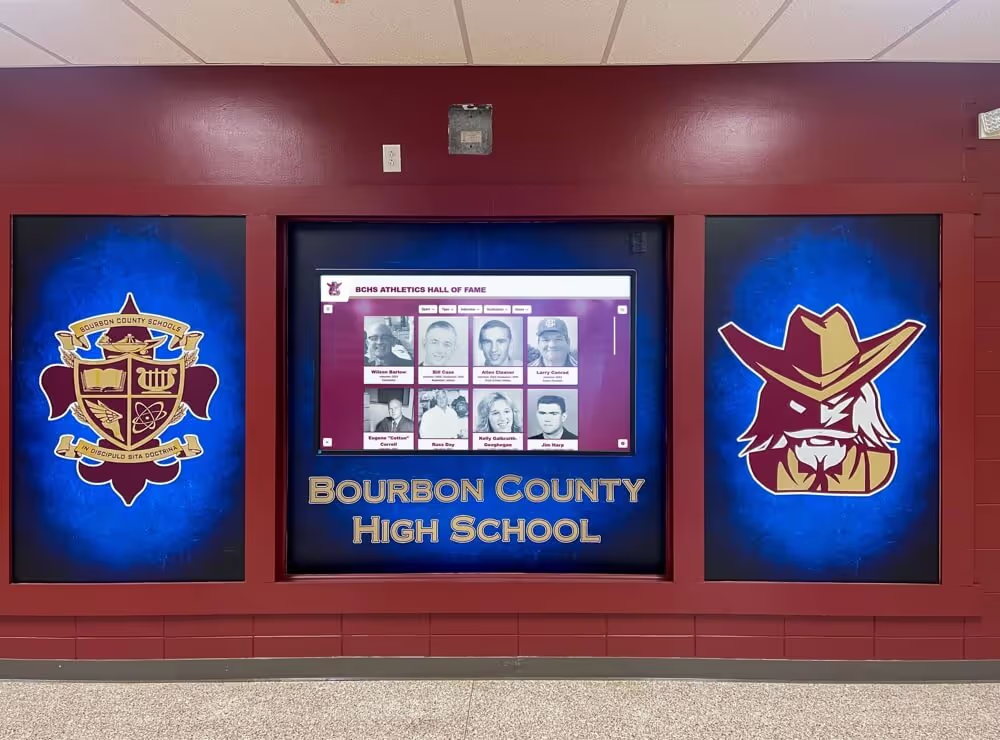




Hall of fame same name inductee disambiguation is the practice of assigning and documenting distinguishing attributes — graduation year, sport, team, position, or era — so that two inductees who share a name are stored as separate, uniquely identifiable records in the recognition platform’s CMS, returned as distinct search results, and displayed to visitors without ambiguity or confusion. When a school’s athletic hall of fame grows across decades, the likelihood of two honorees sharing a first and last name increases substantially. Without a documented disambiguation policy, editors risk merging achievements across two separate individuals, creating search results that return the wrong profile, or inadvertently attributing one inductee’s records to another. This guide gives athletic directors, recognition coordinators, school registrars, and platform administrators a complete framework for identifying name conflicts before they become data errors, choosing the correct disambiguation strategy for each scenario, and encoding the distinguishing information in a form that persists reliably across profile updates, platform migrations, and future inductee additions.
A hall of fame archive that spans thirty or forty induction classes can easily accumulate two athletes named “Michael Johnson,” two coaches named “Patricia Williams,” or two alumni named “David Lee” — particularly in schools that draw from communities where certain surnames are very common. The collision does not need to be exact to cause problems: “Mike Johnson” entered in one decade and “Michael Johnson” entered in another may refer to different people or the same person; without a disambiguation check built into the entry workflow, editors have no reliable way to know at the moment of data entry.
The risk compounds in a digital hall of fame, where the same CMS record powers the web directory profile page, the touchscreen kiosk display, the search index, and any web or mobile interface that retrieves inductee data by name. A duplicate or merged record does not just look wrong — it actively misleads visitors, corrupts the institution’s archival record, and can cause an inductee’s family to discover that their family member’s achievements have been assigned to a different person’s profile.

Every athletic hall of fame display — digital or physical — depends on accurate, unique inductee records. When two honorees share a name, a documented disambiguation process prevents profiles from being merged, misattributed, or returned incorrectly in search results
Program Snapshot: Same-Name Inductee Disambiguation in a School Hall of Fame
Define the scope of the disambiguation policy before auditing existing records or establishing entry rules for new inductees.
| Planning Element | Details |
|---|---|
| Primary Audience | Athletic directors, recognition program coordinators, school registrars, and IT administrators maintaining web-based or kiosk-based inductee profiles for multi-decade recognition archives |
| What the Policy Covers | Name-conflict detection at the point of entry, unique identifier assignment, CMS field strategy for distinguishing attributes, search index behavior for same-name profiles, display label formatting, and visitor-facing disambiguation cues |
| Tools Involved | Hall of fame CMS or data-entry interface, inductee record database, platform search index, web directory display templates, touchscreen kiosk roster interface, school athletic records, yearbook archives |
| Time Investment | 20–45 minutes to detect existing name conflicts and audit affected records; 10–20 minutes per conflict to apply the disambiguation strategy; ongoing enforcement through a documented entry checklist added to the recognition platform’s editorial guide |
| Who Enforces the Policy | Recognition program coordinator (entry review and name-conflict check), athletic director (policy approval and final arbitration), IT administrator or platform vendor (search index configuration for same-name profile retrieval) |
| Failure Consequence — Merged Profiles | Achievements from two separate inductees are stored in a single CMS record; one individual’s records are lost or attributed to the other; cannot be separated without manual reconstruction from primary sources |
| Failure Consequence — Duplicate Profiles | Both inductees are entered separately but with identical primary fields; search returns two profiles with identical display names; visitors and editors cannot determine which profile belongs to which individual |
| Failure Consequence — Wrong Profile Returned | A visitor searching for one inductee consistently receives the other person’s profile because the search index has no way to distinguish them; the affected inductee’s family finds the wrong achievements displayed for their family member’s name |
| Failure Consequence — Broken Cross-References | An inductee appears in a team championship record or a coaching history linked from another profile; the link resolves to the wrong same-name individual because the CMS records were not disambiguated at the time of entry |
| Pass Condition | Every inductee has a unique CMS record with at least one documented distinguishing attribute; search returns the correct profile when the distinguishing attribute is included in the query; display labels include sufficient context to distinguish same-name inductees without confusing visitors |
Why Same-Name Conflicts Occur in Long-Running Recognition Programs
School athletic halls of fame operate on multi-decade timelines. A program that inducts ten to fifteen honorees per year over thirty years builds an archive of three hundred to four hundred fifty individual records — a large enough set that name collisions are probable, not merely possible.
Three structural factors drive same-name conflicts in school recognition archives:
Community name distribution. Schools serve geographically defined communities where certain surnames are statistically common. A school with a large population of alumni from any ethnic, linguistic, or regional background with a concentrated set of common surnames will encounter name conflicts frequently. “Smith,” “Johnson,” “Williams,” “Garcia,” “Lee,” “Kim,” and “Martinez” routinely appear multiple times in archives of any reasonable size.
Common first name patterns. Generational naming trends mean that a school may have inducted a “Michael” or a “Jennifer” or a “David” in every decade across forty years of recognition. Combined with common surnames, these produce exact name matches across generations of inductees.
Nickname variation. An inductee whose legal name is “Robert” may have been universally known as “Bobby” during their playing years and entered as such in the recognition program. A later inductee named “Robert” who used their full given name is entered as “Robert.” A visitor searching “Bobby Smith” finds one profile; a visitor searching “Robert Smith” may find the other — or the same one, depending on the platform’s alias field configuration — without either profile carrying a clear distinguishing label.
Understanding which behavior your recognition platform uses when two records share a primary name field is the first diagnostic step. For context on how search tokenization affects name retrieval in general, the digital hall of fame search tokenization audit published by Hall of Fame Touchscreen explains how the platform’s text processing pipeline determines which records surface for a given query — a directly relevant technical foundation for any disambiguation work.
Numbered Steps: Hall of Fame Same-Name Inductee Disambiguation
Follow these steps in order when adding a new inductee whose name matches an existing record, or when auditing an existing archive for unresolved name conflicts.
Step 1: Run a name-conflict check before creating the new inductee record.
Before entering any new inductee, search the CMS for the exact first name and last name combination. Search both the formal legal name and known nicknames or shortened versions. If no existing record appears, proceed with standard entry. If an existing record appears, move to Step 2 before creating the new record.
Do not assume that a returned record belongs to the same individual. Verify the existing record’s sport, graduation year, and available biographical context against the new inductee’s documentation before concluding whether you have a same-name conflict with a different person or a possible duplicate entry of the same person.
Step 2: Collect distinguishing attributes for both inductees.
Gather the following information for both the existing inductee and the new candidate. The goal is to identify at least one attribute that is objectively different and verifiable from a primary source:
- Graduation year or class year (most reliable single disambiguator for school programs)
- Primary sport or activity
- Position, event, or discipline within the sport
- Induction year or induction class
- Years active as a student-athlete or coach
- Any official school or team identifier (jersey number, program number, roster designation)
At least one of these attributes will differ for two genuinely different individuals. If none of them differ, you may be looking at a duplicate entry of the same person rather than a same-name conflict with a different individual — treat this as a possible duplicate and verify with a primary source before proceeding.
Step 3: Select the primary disambiguation attribute and encode it in the CMS.
Use the decision table in the next section to select the most appropriate disambiguation strategy for the specific scenario. Once you have selected the distinguishing attribute:
- Enter it in the dedicated field the platform provides (such as a “class year,” “sport,” or “notes” field)
- If no dedicated field is available, add the attribute to the profile’s subtitle or display-name suffix field
- Do not alter the primary name fields to embed the distinguishing attribute (for example, do not enter “John Smith 1987” in the surname field — this corrupts alphabetical sort, search retrieval, and display formatting)
Step 4: Assign or verify a unique CMS identifier or URL slug for each profile.
Most recognition platforms assign a unique internal identifier to each CMS record automatically. Confirm that the platform has not attempted to auto-complete the new record from the existing record using the shared name. If the platform provides a URL slug field, verify that each same-name inductee has a distinct slug that incorporates the distinguishing attribute — for example, john-smith-1987 and john-smith-2003 rather than john-smith and john-smith-1 (the latter being an auto-generated collision suffix that carries no meaning for visitors or editors).
Step 5: Update the display label on both profiles to include the disambiguation context.
For each profile involved in the name conflict, update the visible display label — the name shown in search results, the roster browse, and the profile page heading — to include the disambiguation attribute. The format should follow the convention established in the decision table: typically the full name followed by a parenthetical class year or a sport label. Apply the disambiguation label to both profiles simultaneously; a visitor who finds one profile through search should be able to see immediately that there is a same-name inductee, find the cross-reference, and determine which profile is the correct one.
Step 6: Add a cross-reference note to each profile.
In the profile’s notes, description, or a dedicated “related inductee” field, add a brief note referencing the same-name inductee: for example, “Note: A second inductee named John Smith was honored in the Class of 2003 — see John Smith (Class of 2003).” This cross-reference serves both visitors who may have found the wrong profile and future editors who encounter the records and may not know that two same-name inductees exist in the archive.
Step 7: Test search for both profiles using the full name and the distinguishing attribute.
After saving both records, run the following search tests:
- Search for the full name alone: confirm that both profiles appear in the results, each with its disambiguation label visible
- Search for the full name plus the distinguishing attribute (for example, “John Smith 1987” or “John Smith basketball”): confirm that the correct profile appears as the primary result
- On the touchscreen kiosk, if the recognition system uses a separate search layer, run the same tests
For schools whose touchscreen platforms use autocomplete, the governance and testing guide for search autocomplete in digital halls of fame from Touch Hall of Fame explains how autocomplete suggestion logic should behave when two same-name inductees exist — specifically how the suggestion list should present both options rather than arbitrarily surfacing one.
Step 8: Document the disambiguation rule in the editorial guide.
Record the conflict and the chosen resolution in the recognition program’s editorial documentation. Include the names of both inductees, their distinguishing attributes, the disambiguation format applied, and the date the records were updated. This documentation ensures that future editors who encounter these records understand why the display labels are formatted as they are and do not inadvertently remove the disambiguating information during routine profile updates.

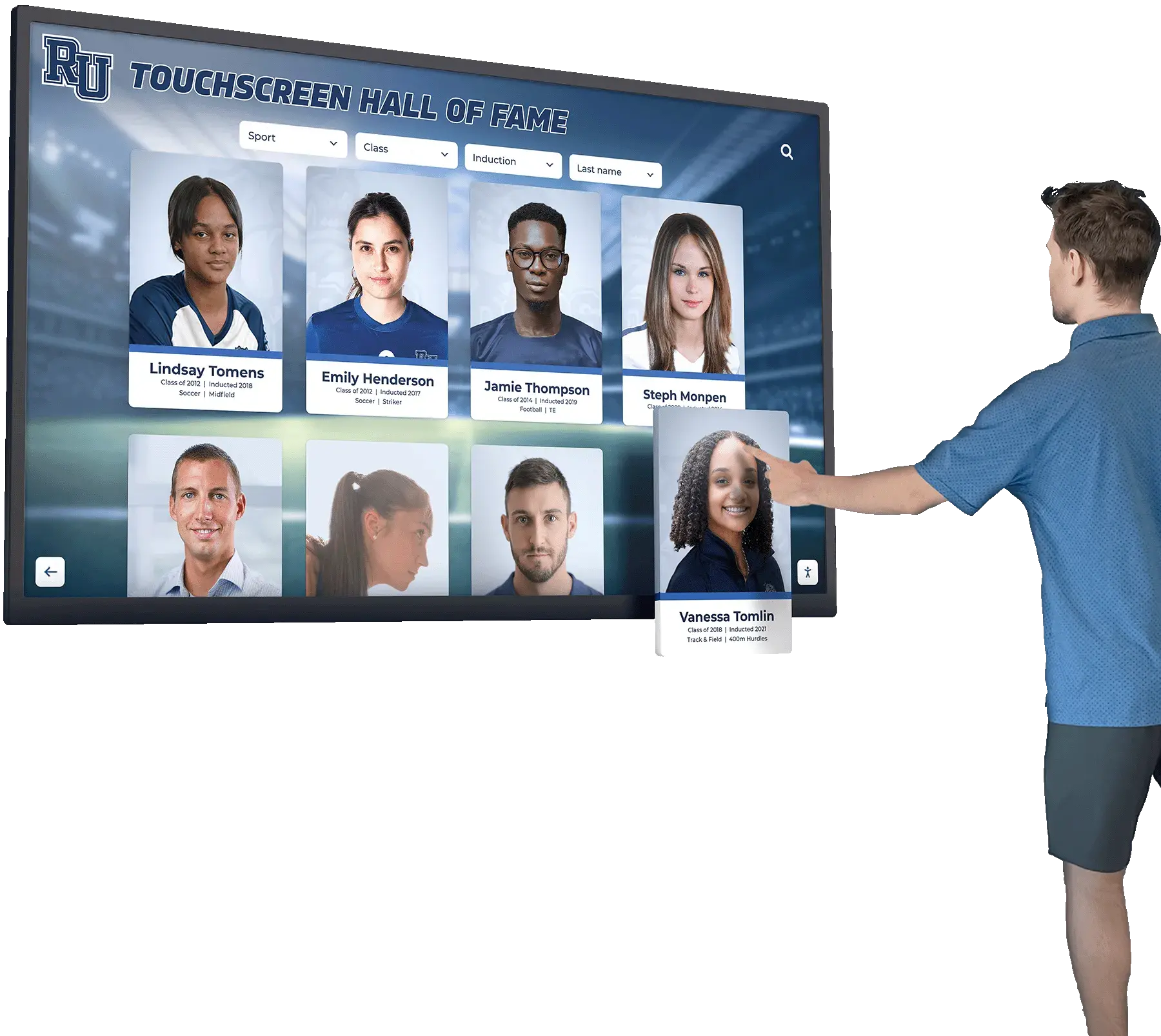
Disambiguation labels must display consistently across every interface — web directory on desktop, tablet, mobile, and touchscreen kiosk — so that visitors find the right profile regardless of how they access the recognition archive
Decision Table: Choosing the Right Disambiguation Strategy
Use this table to select the correct approach for each name-conflict scenario. When multiple strategies apply, prefer the strategy highest on the list that produces a label recognizable to visitors who knew the inductee during their athletic career.
| Name-Conflict Scenario | Recommended Disambiguation Strategy | Display Label Example |
|---|---|---|
| Same first and last name, different graduation or class years | Append class year in parentheses after the name | “John Smith (Class of 1987)” and “John Smith (Class of 2003)” |
| Same full name, same approximate era, clearly different sports | Append primary sport after an em dash | “Maria Garcia – Soccer” and “Maria Garcia – Volleyball” |
| Same full name, same sport, different positions or events | Append position, event, or weight class | “Kevin Williams – Linebacker” and “Kevin Williams – Defensive End” |
| Same full name, athlete and coach from different eras | Append role and approximate years | “Patricia Lee (Athlete, 1990s)” and “Patricia Lee (Coach, 2010s)” |
| Same full name, same sport and same era, verified different individuals | Use middle name or middle initial if documented | “David R. Kim” and “David T. Kim” |
| Possible nickname variant of the same individual (not a conflict) | Consolidate into one record; add nickname to alternate-name field | One profile for “Robert Smith” with “Bobby Smith” as an alternate name entry |
| Confirmed duplicate entry of the same individual (data error) | Merge the records; transfer any unique content to the surviving record; delete the duplicate | Single profile for “Jennifer Lopez (Class of 1995)” |
| Same name conflict involving a name change after induction | Link both the historical and current name to the single canonical record | See name-change policy guidance below |
For inductees whose names changed after induction — through marriage, legal name change, or personal preference — the disambiguation approach overlaps with a broader name-change policy. The hall of fame name change policy framework published by Touch Hall of Fame explains how to handle the historical name alongside the current preferred name without creating a second record or breaking existing search links.
Practical School Recognition Examples
The following scenarios illustrate how the disambiguation process applies in common school athletic hall of fame contexts. These examples use generic descriptors to illustrate the decision framework; apply the same logic to actual inductee records using primary source documentation.
Scenario A: Two athletes from different decades, same name
An athletic hall of fame inducts a standout cross-country runner from the early 1990s and a basketball player from the mid-2000s who share the same first and last name. The graduation years are approximately fifteen years apart. The recommended strategy is to append the class year in parentheses to both display names. Both profiles receive the class-year label at entry time, and a cross-reference note is added to each profile. Search for the shared name returns both profiles; search for the name plus the year narrows to the correct individual.
Scenario B: Two coaches inducted from overlapping eras, same name
A school inducts a longtime varsity baseball coach and, several years later, a former track coach who share the same first and last name and whose coaching tenures overlap by several years. Class year is not a useful disambiguator because both are staff rather than student-athletes. The recommended strategy is to append the sport: “James Anderson – Baseball” and “James Anderson – Track & Field.” Both display labels are applied, and both profile notes reference the other same-name inductee.
Scenario C: An existing profile may be a duplicate
During an archive audit, an editor discovers two CMS records for what appears to be the same individual — same name, same sport, graduation years one year apart, and nearly identical biographical notes. Before applying a disambiguation strategy, the editor checks primary source documents: original induction program from the relevant year, school athletic records, and yearbook photos. The audit confirms that the records represent the same individual entered twice under slightly different graduation year assumptions. The correct action is a record merge, not disambiguation: retain the more complete profile, transfer any unique content to it, and delete the second record.
Scenario D: Same name, same sport, same era — confirmed different individuals
Two inductees share the same first and last name, both played the same sport, and their active years overlap. The editor gathers both induction letters and yearbook photographs, confirming these are definitively two different people. Neither has a documented middle name. The recommended strategy is to use the most locally meaningful differentiator available — in this case, one was a varsity starter known by a distinct jersey number, and the other was an all-state selection in a different class year. The editor adds the class year to both display labels, confirms the year difference with the source documents, and adds a cross-reference note in each profile explaining the shared-name situation.
When name conflicts affect how search result pages display and highlight inductee information, reviewing how your platform surfaces results for ambiguous queries is a useful parallel step. The digital hall of fame search result highlighting audit published by Digital Wall of Fame covers how search result pages should render name matches in context — directly relevant when two same-name profiles both appear in results and the highlighting logic must help visitors distinguish between them.
Reusable Checklist: Same-Name Inductee Disambiguation at the Point of Entry
Copy this checklist into the recognition program’s editorial guide and complete it whenever a new inductee’s name matches an existing CMS record.
Pre-Entry Name Conflict Check
- Searched CMS for exact first name + last name combination before creating new record
- Searched CMS for known nicknames or alternate spellings of the same name
- Confirmed whether the returned record is the same individual (possible duplicate) or a different individual (same-name conflict)
Distinguishing Attribute Collection (if confirmed same-name conflict)
- Graduation or class year documented from a primary source
- Primary sport or activity documented
- Position, event, or discipline documented (if applicable)
- Induction year and active years documented
- Middle name or initial documented (if available and needed)
CMS Record Setup
- Distinguishing attribute entered in the correct dedicated field (not embedded in the primary name field)
- Unique URL slug assigned incorporating the distinguishing attribute
- Display label updated to include disambiguation context on both the new and existing record
- Cross-reference note added to both profiles
Search Verification (run after saving both records)
- Full name search returns both profiles, each with its disambiguation label visible
- Full name plus distinguishing attribute search returns the correct profile as the primary result
- Kiosk search returns both profiles when the full name is searched (if applicable)
- Autocomplete (if enabled) presents both same-name profiles as distinct options
Documentation
- Conflict and resolution recorded in the editorial guide with the names, distinguishing attributes, and date resolved
Measurement: Indicators of a Well-Maintained Disambiguation Practice
| Verification Check | Method | Pass Condition |
|---|---|---|
| Name-conflict audit | Export full inductee roster; search for duplicate primary name field values | Zero unresolved same-name conflicts — all known conflicts have documented disambiguation attributes and updated display labels |
| Search result count | Search the public web directory for any name known to have two same-name inductees | Both profiles appear in the results with distinct disambiguation labels |
| Distinguishing attribute search | Search for the name plus the disambiguation attribute (class year, sport, etc.) | The correct profile appears as the primary result |
| URL slug uniqueness | Check CMS record slugs for same-name inductees | Each profile has a unique slug incorporating the distinguishing attribute; no auto-generated collision suffixes (e.g., -1, -2) |
| Cross-reference presence | Open each profile involved in a name conflict | Both profiles contain a cross-reference note identifying the same-name inductee |
| Kiosk parity | Run the full-name search on the touchscreen kiosk | Both same-name profiles appear with disambiguation labels |
| Post-update regression | Re-run search tests after any platform update or bulk content import | Same pass conditions; any regression documented immediately |
| Editorial guide currency | Review the editorial guide | All known name conflicts are documented with the chosen disambiguation strategy and the date resolved |
Schools building robust recognition programs should evaluate tools that support structured disambiguation workflows from the start. For an overview of platforms with the features needed for reliable inductee data management, the guide to the ten best hall of fame tools published by Touch Wall provides a structured comparison across key capability dimensions including profile data management and search configuration — useful context when assessing whether your current platform can support the disambiguation policy described in this guide.
See How Rocket Alumni Solutions Handles Same-Name Inductee Records
Request a live walkthrough to see how the platform’s CMS and search index manage same-name inductee profiles — including how disambiguation attributes are structured, how search returns distinct results for each profile, and how display labels are applied consistently across the web directory and touchscreen kiosk.
FAQ: Hall of Fame Same Name Inductee Disambiguation
How many same-name conflicts should a typical school hall of fame expect?
There is no universal answer because it depends on archive size, community surname distribution, and how many induction classes the program has completed. A program with twenty or more induction classes and a community where a handful of common surnames predominate can reasonably expect to encounter at least a small number of same-name conflicts in its existing archive. Running a name-conflict audit — searching the full roster export for duplicate primary name field values — is the most accurate way to assess the scale of the issue in any specific program.
What is the single most reliable disambiguation attribute for school athletic inductees?
Graduation year or class year is the most reliable single disambiguator for student-athlete inductees because it is an objective, documentable fact tied directly to the individual’s enrollment record. It does not change over time, it is available in school records even for inductees from decades past, and it is immediately meaningful to community members who know the school’s history. For coaches and administrators inducted into a school hall of fame, graduation year is not applicable — in those cases, the primary sport or program and the approximate active years are the most useful attributes.
Should the disambiguation label appear in the inductee’s name fields, or elsewhere in the CMS?
The distinguishing attribute should appear in dedicated structured fields — class year field, sport field, or a designated display-label suffix field — rather than embedded in the primary name fields. Embedding the year or sport directly into the surname or given-name field (“Smith 1987” as the surname, for example) corrupts alphabetical sort, search tokenization, and display formatting in ways that are difficult to reverse. If the platform does not provide dedicated fields for this information, use a subtitle or subheading field for the display label and a notes field for the cross-reference, keeping the primary name fields clean.
What should a visitor see when they search for a name that matches two different inductees?
Ideally, the search results page presents both profiles as distinct rows or cards, each with its disambiguation label visible — for example, “John Smith (Class of 1987) — Cross Country” and “John Smith (Class of 2003) — Basketball.” The visitor can immediately identify which profile corresponds to the inductee they are looking for without clicking into either profile first. If the platform’s search results page does not display the disambiguation label, the profile page heading must make the distinction clear, and the cross-reference note in each profile should direct visitors who have landed on the wrong record to the correct one.
How should a same-name conflict be handled if neither inductee has any objectively different documented attribute?
This situation is rare but can occur when records from older induction classes are incomplete. In this case, the priority is to contact the induction program’s historical records, the school’s alumni office, or the inductees’ families directly to recover a distinguishing attribute from a primary source. Do not resolve the conflict by assumption. If primary source documentation cannot be obtained, the conflict should be flagged in the editorial guide as unresolved, both profiles should include a cross-reference note, and the program should use the most specific available biographical detail — even an approximate playing era rather than a specific year — as a temporary disambiguation label until documentation is found.
Does the disambiguation policy affect how the inductees appear in physical recognition displays connected to the same platform?
Yes. If the digital platform drives any printed output — program books, commemorative rosters, physical plaque text, or export files used to generate physical displays — the disambiguation label applied in the CMS will appear in those outputs as well. This is generally desirable: a physical display that distinguishes “John Smith (Class of 1987)” from “John Smith (Class of 2003)” is more useful to visitors than two identical name labels. If the physical display format does not accommodate parenthetical labels, work with the platform vendor to define an output format that incorporates the distinguishing attribute in a typographically appropriate way.