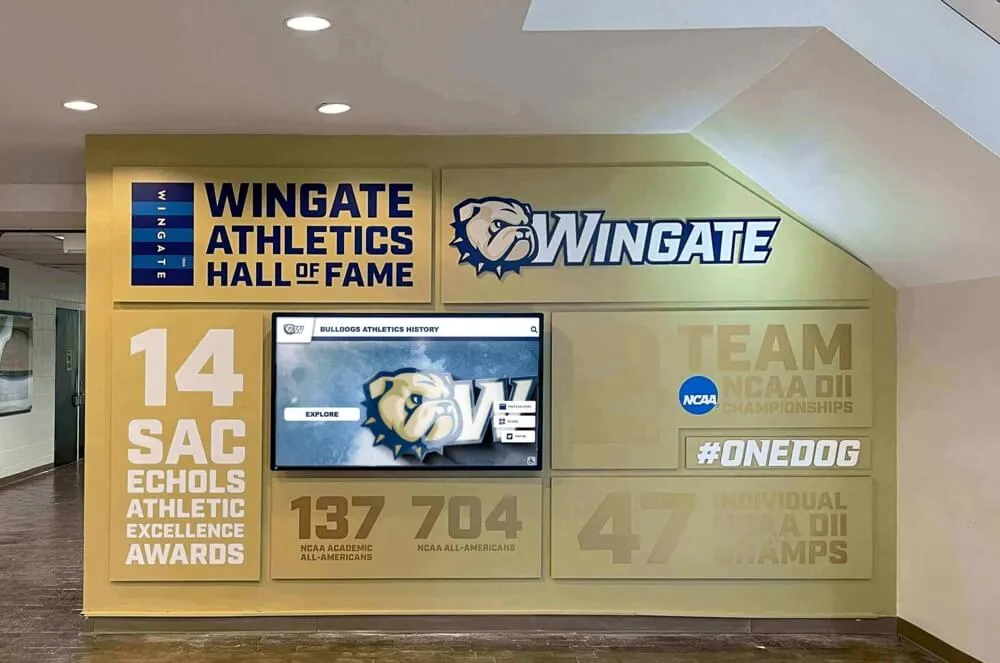
Hall of Fame Editorial Style Guide: Consistent Names, Bios, Dates, and Records
- Home /
- Digital Hall of Fame Insights & Resources /
- Hall of Fame Editorial Style Guide: Consistent Names, Bios, Dates, and Records
The Easiest Touchscreen Solution




Live Example: Rocket Alumni Solutions Touchscreen Display
Interact with a live example (16:9 scaled 1920x1080 display). All content is automatically responsive to all screen sizes and orientations.
A hall of fame editorial style guide is a written document that tells every staff member, volunteer, and platform administrator exactly how to format inductee names, write bios, express dates, and present athletic records—so that every profile looks authoritative, reads consistently, and returns the right results in search whether it lives on a physical plaque, a website, or a touchscreen display.
Without one, small decisions accumulate into large inconsistencies. One staff member writes “Class of ‘98.” Another writes “1998 Inductee.” A third writes “Inducted: Fall Semester 1998.” Three entries describing the same induction year now appear differently in every search, every filter panel, and every printed program. Multiply that variation across two hundred inductees spanning forty years and the archive is effectively unsearchable—even if the underlying data is complete.
This guide explains how to build a hall of fame editorial style guide from scratch, covers the four core domains every program needs to standardize, and shows how consistent editorial decisions connect directly to searchable digital recognition displays.
A complete hall of fame editorial style guide addresses four domains: inductee names, biographical copy, dates and class years, and athletic records. The sections below explain each domain, provide ready-to-adopt standards, and include a quick-reference table programs can copy immediately.

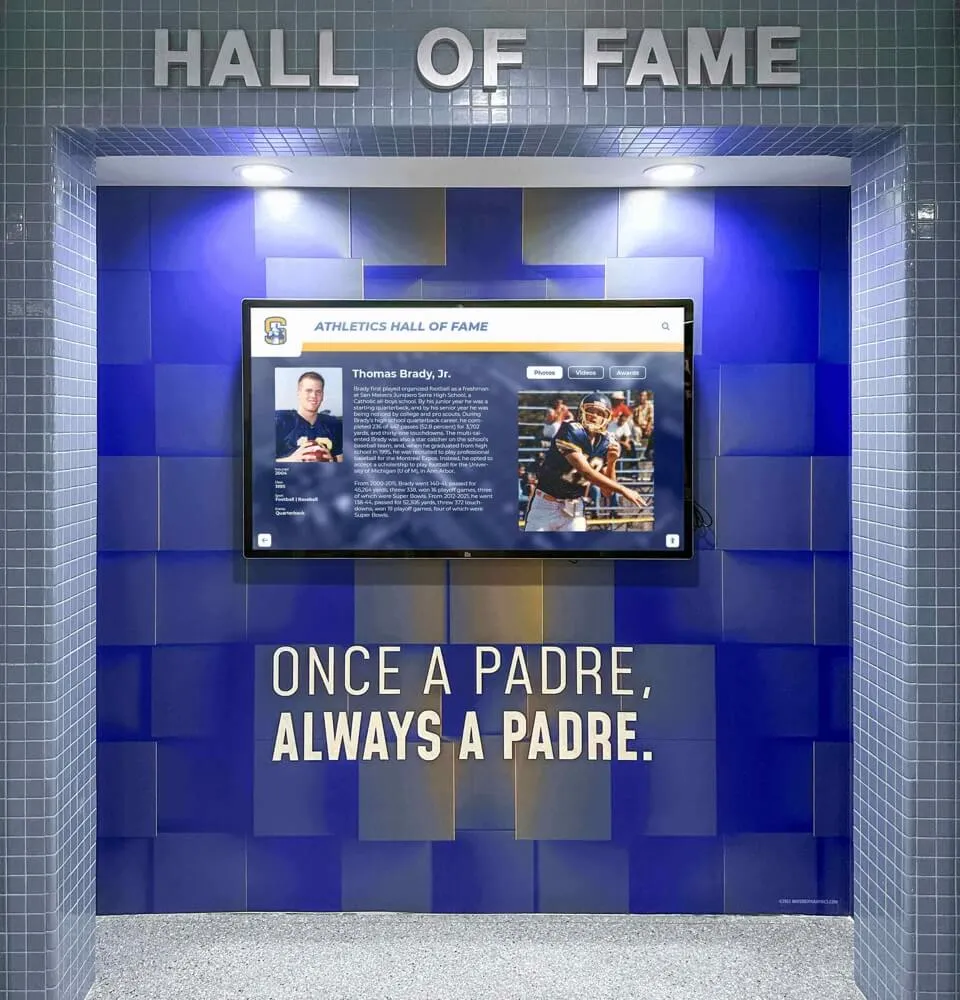
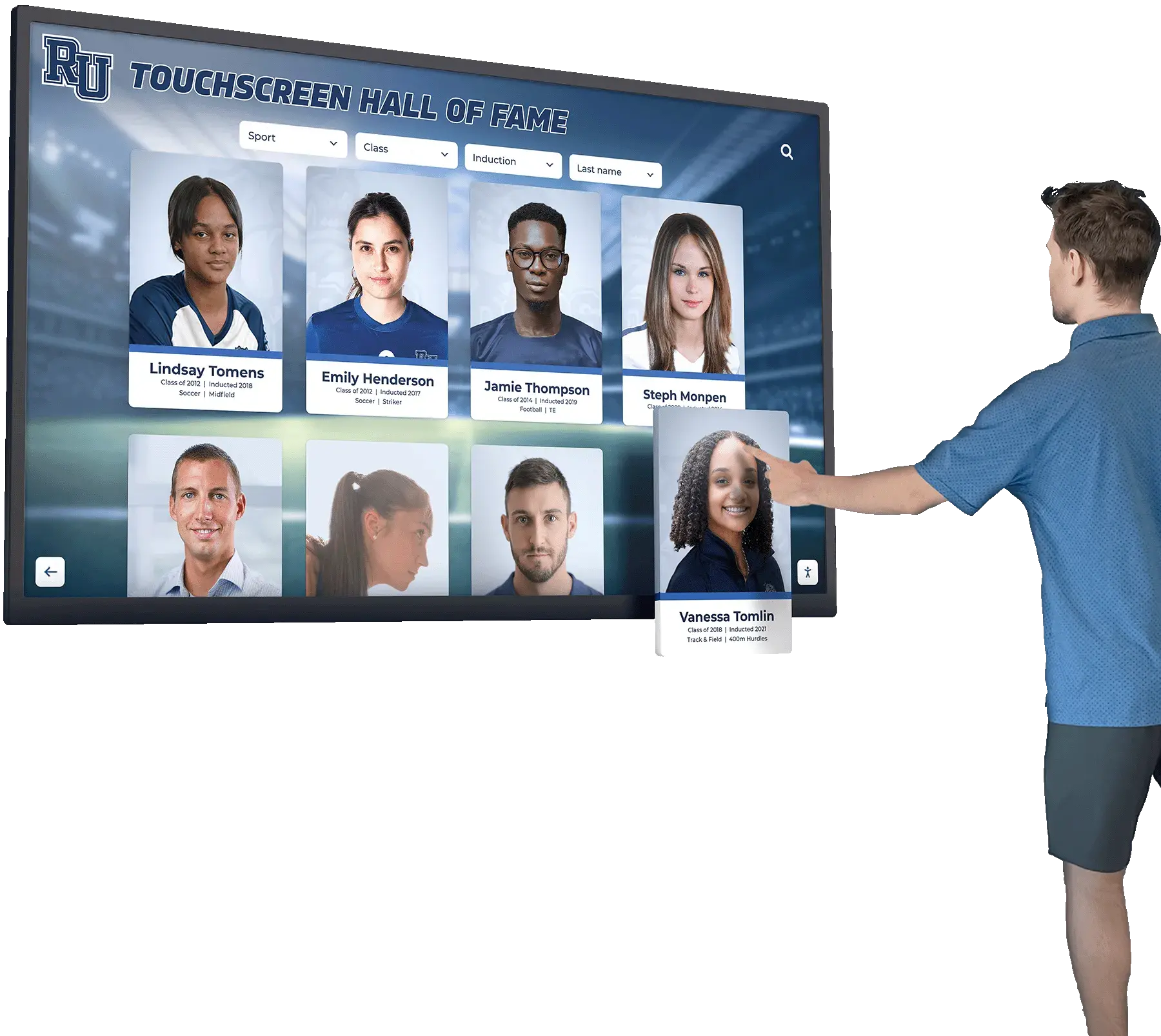
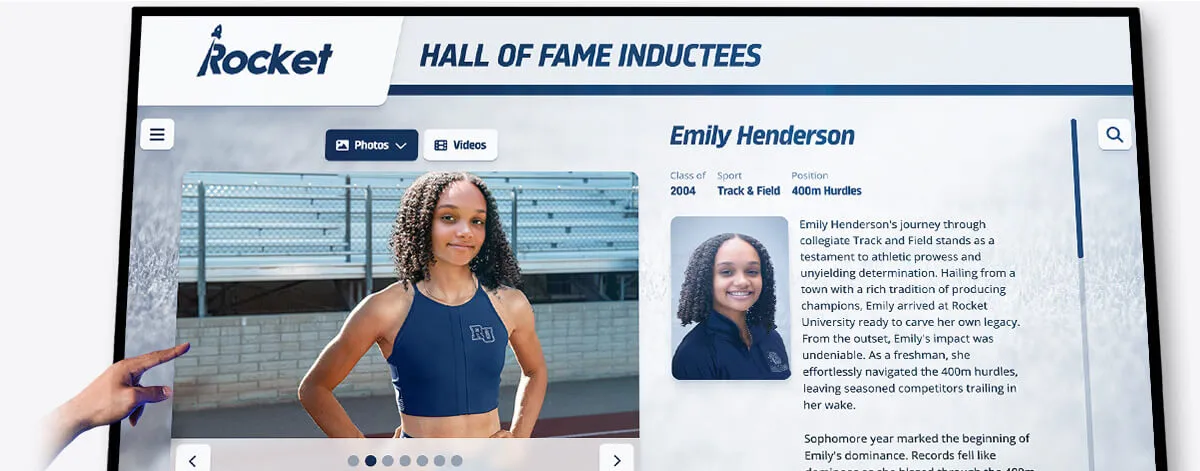
A consistently formatted inductee profile card reflects editorial standards applied at the data-entry stage
Program Snapshot
| Element | Details |
|---|---|
| Audience | Athletic directors, archives staff, recognition committee members, school administrators |
| Outcome | A working style guide that standardizes all inductee profile content across staff and platforms |
| Time to build | 3–5 hours for initial guide; 30-minute annual review |
| Key deliverables | Name format rules, bio template, date conventions, record presentation standards, and a quick-reference table |
| Display payoff | Consistent profiles feed accurate search, browsing filters, and auto-populated display modules |
Why a Hall of Fame Editorial Style Guide Is Essential
Recognition programs are long-lived. A school hall of fame launched in 1985 accumulates content from dozens of staff members, multiple superintendents, successive athletic directors, and various volunteer committees over its history. Without written standards, each contributor imports their own formatting habits.
The downstream consequences include:
- Broken search results. A fan searching “Martinez” finds only profiles where the name appears as “Martinez, Carlos” and misses the ones filed under “Carlos Martinez.”
- Inconsistent display panels. A digital hall-of-fame platform that auto-populates inductee cards shows mismatched bio lengths, varied capitalization, and date formats that clash visually from card to card.
- Import failures. When a school migrates data from a spreadsheet to a new recognition platform, mismatched fields create duplicate entries or blank display panels.
- Credibility gaps. Donors, alumni, and current athletes notice when one profile reads like a press release and the next reads like a yearbook caption—inconsistency signals institutional carelessness, not prestige.
Programs exploring digital showcase platforms consistently identify editorial consistency as a precondition for effective display: the platform can only be as good as the data it presents.
Step 1: Standardize Inductee Name Formats
Name formatting is the most consequential editorial decision a hall of fame makes, because names drive search, alphabetical sorting, and every display module that lists inductees.
The six decisions to make
- Display order. Choose one: First Last (Carlos Martinez) or Last, First (Martinez, Carlos). First Last is recommended for public-facing displays; Last, First for administrative sorting fields only.
- Suffix handling. Decide whether suffixes (Jr., Sr., III) appear in the display name or only in a separate metadata field. Consistency matters more than the choice itself.
- Preferred name vs. legal name. Establish whether inductees may list a preferred or chosen name rather than their legal name, and create a process for updating names upon request.
- Hyphenated and compound surnames. Write a rule for how hyphenated names are alphabetized (treat the full hyphenated surname as one unit) and ensure your platform handles this correctly.
- Name changes. Decide whether an inductee known by a married name is listed under the name they used during their athletic career, their current name, or both with a cross-reference note.
- Special characters. Define how diacritical marks (accents, tildes) are handled in both the display layer and the underlying database field.
Document every decision in writing. Post the decisions wherever data entry happens—in your CMS, your shared drive, and any intake form inductees complete at nomination.
Step 2: Write Bios to a Consistent Template
Biographical copy is the most visible editorial inconsistency in most hall of fame archives. Some bios run four sentences; others run four paragraphs. Some use first person; others use third. Some describe playing career only; others include post-graduation life.
A bio template that works across eras
Use this four-element structure for every inductee bio:
- Athletic achievement sentence. One sentence naming the sport(s), primary position or event, key statistics or titles, and years of competition. Example: "[Name] competed as a midfielder for the girls soccer program from 1991 to 1994, earning three consecutive district titles and setting the program record for career assists."
- Context sentence. One sentence placing the achievement in institutional or competitive context. Example: “Her senior season coincided with the school’s first undefeated regular-season record in program history.”
- Post-athletic note (optional). One sentence on post-graduation activity directly related to the school or sport, kept to verifiable facts the inductee has confirmed. Omit if unknown.
- Induction line. One standard closing: "[Name] was inducted into the [School Name] Hall of Fame in [Year]."
Keep bio length to 75–125 words for digital display compatibility. Longer bios can appear in a printed program but should be summarized to the template for any digital platform.
A consistent bio template matters especially when programs migrate data to new platforms. Resources on alumni engagement through athletic programs show that legible, readable inductee bios are among the strongest drivers of alumni time-on-display—they are the content alumni actually linger over.
Step 3: Present Dates and Class Years Uniformly
Date inconsistencies are among the most common and most correctable editorial problems in hall of fame archives. The fix requires two decisions: a date format standard and a year-of-reference standard.
Date format decisions
| Date Type | Recommended Format | Common Variants to Avoid |
|---|---|---|
| Induction year | 2003 | ‘03, Class of ‘03, 2003–04 |
| Athletic season | 1998–99 | 1998/99, ‘98–99, 1998–1999 |
| Birth year (if displayed) | 1975 | ‘75, born 1975 |
| Record-set date | 1997 (season only) | 4/12/97, Spring 1997 |
| Ceremony date | October 14, 2024 | 10/14/24, Oct. 2024 |
Year-of-reference standard
Decide which year defines an inductee’s class: the year of the induction ceremony, or the academic year the ceremony falls in. Both are valid; pick one and apply it across all inductees. Schools with fall ceremonies sometimes induct a class that straddles two calendar years—document how this is handled (typically the calendar year of the ceremony date).
Step 4: Present Athletic Records Accurately
Records are the high-stakes data in any hall of fame archive. An incorrect statistic, an unverified claim, or a mislabeled record type damages institutional credibility and may require retroactive correction across multiple platforms.
Five rules for athletic records
- Source every record before publishing. Acceptable sources include official scorebooks, state athletic association archives, published newspaper records, or superintendent-certified statistical summaries. Document the source in an administrative field even if it does not appear in the public bio.
- Use a standard label vocabulary. Decide in advance whether your records are labeled “Program Record,” “School Record,” “Conference Record,” or “State Record”—and use the label consistently. Do not use “All-Time Record” unless you can verify it against every preceding season.
- Express records with units. Write “48.3 seconds (400m hurdles)” not “48.3.” Write “312 career points” not “312.” Units anchor the number to its meaning for any reader encountering the profile decades later.
- Mark unverified records. If a claimed record cannot be verified against a primary source, mark it “Reported record—source on file” or hold it from display until verification is complete.
- Include the season or date. Every record should carry a season identifier so future inductees can be compared accurately. “Program record set in the 1994–95 season” is more useful than “program record” alone.
Digital recognition systems designed for college intramural and varsity athletic displays show that records with full labeling and season context drive longer engagement time on display panels—viewers trust and explore data that is specific.
Quick-Reference Style Decisions Table
Copy this table into your shared style guide document and fill in your school’s choices in the right column.
| Editorial Decision | Options | Your Standard |
|---|---|---|
| Name display order | First Last / Last, First | |
| Suffix placement | In display name / metadata only | |
| Preferred name policy | Allowed / Legal name only | |
| Hyphen alphabetization | Full surname as one unit / by first element | |
| Name change policy | Career name / current name / both | |
| Bio length (digital) | 75–100 words / 100–125 words | |
| Bio tense | Third person / first person | |
| Induction year format | Four-digit year (2003) / Class of 2003 | |
| Season format | 1998–99 / 1998–1999 / ‘98–99 | |
| Record source requirement | Required / encouraged | |
| Record label vocabulary | Program / School / Conference / State | |
| Units in records | Always included / optional |
Content Architecture: Mapping Editorial Standards to Display Modules
A hall of fame editorial style guide has maximum impact when it is written with the final display in mind. Each editorial decision maps directly to a module in a digital recognition platform.
| Editorial Element | Display Module It Powers |
|---|---|
| Display name (standardized) | Search index, alphabetical roster, name card |
| Bio (template-length) | Profile card body text, quick-bio preview panel |
| Induction year | Class-year filter, timeline view, auto-sorted roster |
| Sport and position | Sport-category filter, browsing menu |
| Records (labeled, with units) | Stats panel, achievement highlight module |
| Photo alt text | Accessibility layer, screen-reader navigation |
Programs that establish these standards before launching a display eliminate the most common causes of empty search results and broken display panels. A virtual donor wall review shows the same principle applies to donor recognition: clean, consistently formatted underlying data is what separates a functional display from a maintenance burden.
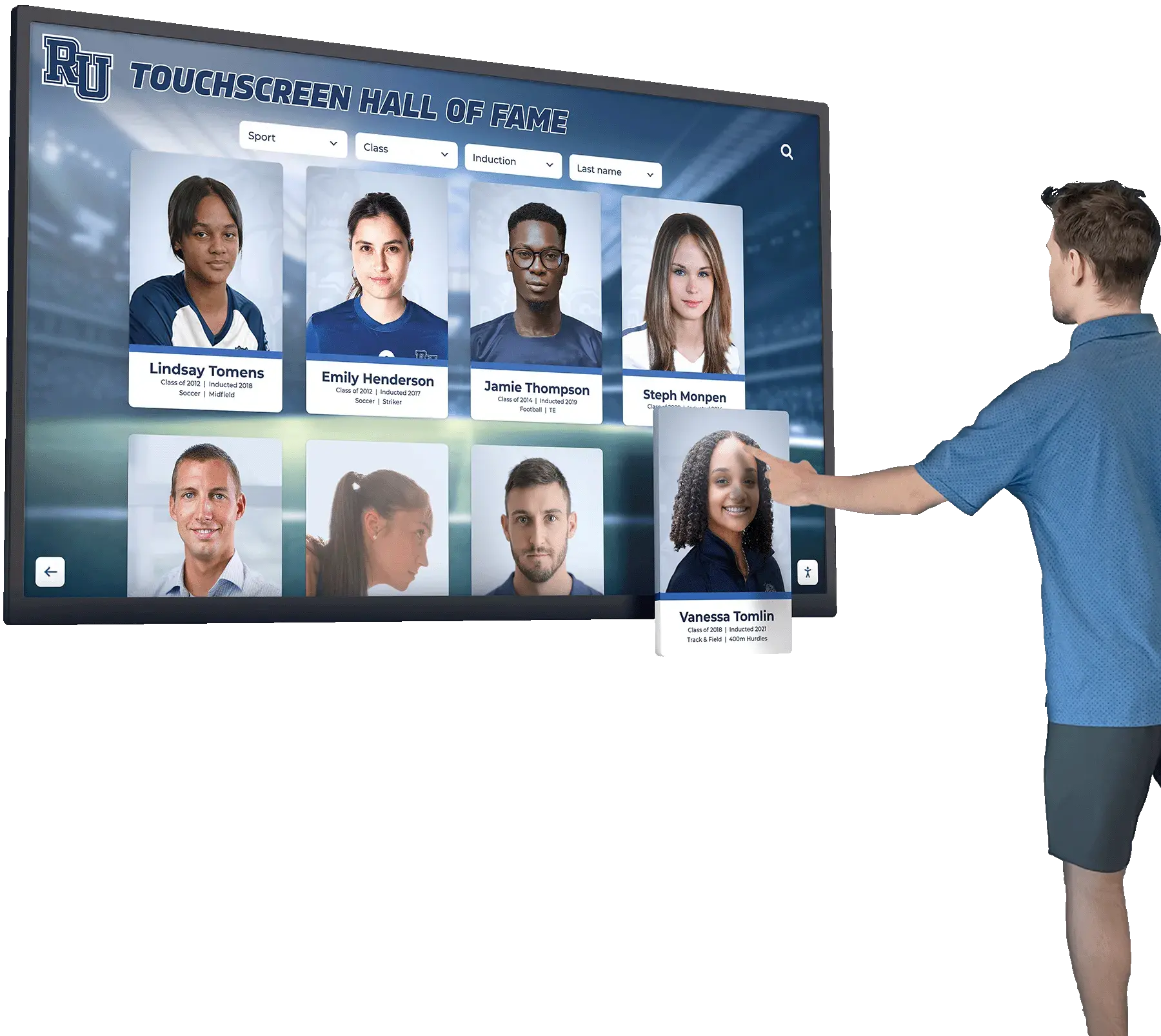
Standardized profile data enables every display module—search, filtering, and profile cards—to work correctly
Execution Timeline: Build, Launch, and Maintain
Phase 1: Plan (2–3 weeks)
- Convene a working group: one representative from athletic administration, one from the recognition committee, one from the data-entry team
- Audit a sample of existing profiles (20–30 entries) to identify current inconsistencies
- Draft decisions for all four domains using the quick-reference table above
- Circulate draft to all data-entry staff for feedback
Phase 2: Build (4–6 weeks)
- Finalize the style guide document and store it in your shared drive and CMS documentation folder
- Retrofit existing profiles to the new standards (prioritize the current induction class and the most-viewed historical profiles)
- Add data-validation rules or drop-down controls at every data-entry point to enforce the vocabulary
- Train all staff and volunteers who enter inductee data
Phase 3: Launch
- Apply the standards to all new inductee profiles before the next ceremony
- Verify that the display platform’s filter panels and search return accurate results with the standardized data
- Publish the induction class using the new template; use this class as the benchmark for all future entries
Phase 4: Refresh (annual)
- Review the style guide every year before nominations open
- Document any new decisions triggered by edge cases encountered during the cycle
- Update the crosswalk of legacy terms and name variants to reflect any name changes or corrections
Programs investing in alumni reconnection—such as events described in class reunion planning guides—find that consistently formatted inductee profiles substantially reduce the research time alumni spend tracking down recognition history from their era.
Display Integration and ADA Considerations
Consistent editorial standards unlock the full capability of cloud-based recognition platforms. When every inductee record uses the same name format, bio length, date syntax, and record labeling, the display system can:
- Auto-populate filter menus from the sport and award fields without manual curation
- Surface inductees in keyword search because every name follows a predictable format
- Generate class-year timeline views because induction years use a consistent four-digit format
- Enable screen-reader navigation because alt text on every inductee photo follows a standard template
ADA compliance adds a sixth editorial standard: every profile photo must carry alt text following the format "[Name], [Sport], inducted [Year]." This single convention satisfies WCAG 2.1 AA image-description requirements and ensures the display remains accessible to visually impaired visitors browsing via assistive technology.
Schools using digital signage mode—where the hall of fame display auto-rotates profiles on a lobby screen—benefit from bio length standards most acutely. A 75-word bio fits a standard profile card layout; a 200-word bio forces a layout override that may not render correctly on every screen size.
Review digital hall-of-fame showcase platforms for platforms that support structured data fields, built-in validation, and ADA-compliant display rendering—features that translate your editorial standards into a reliable public experience.
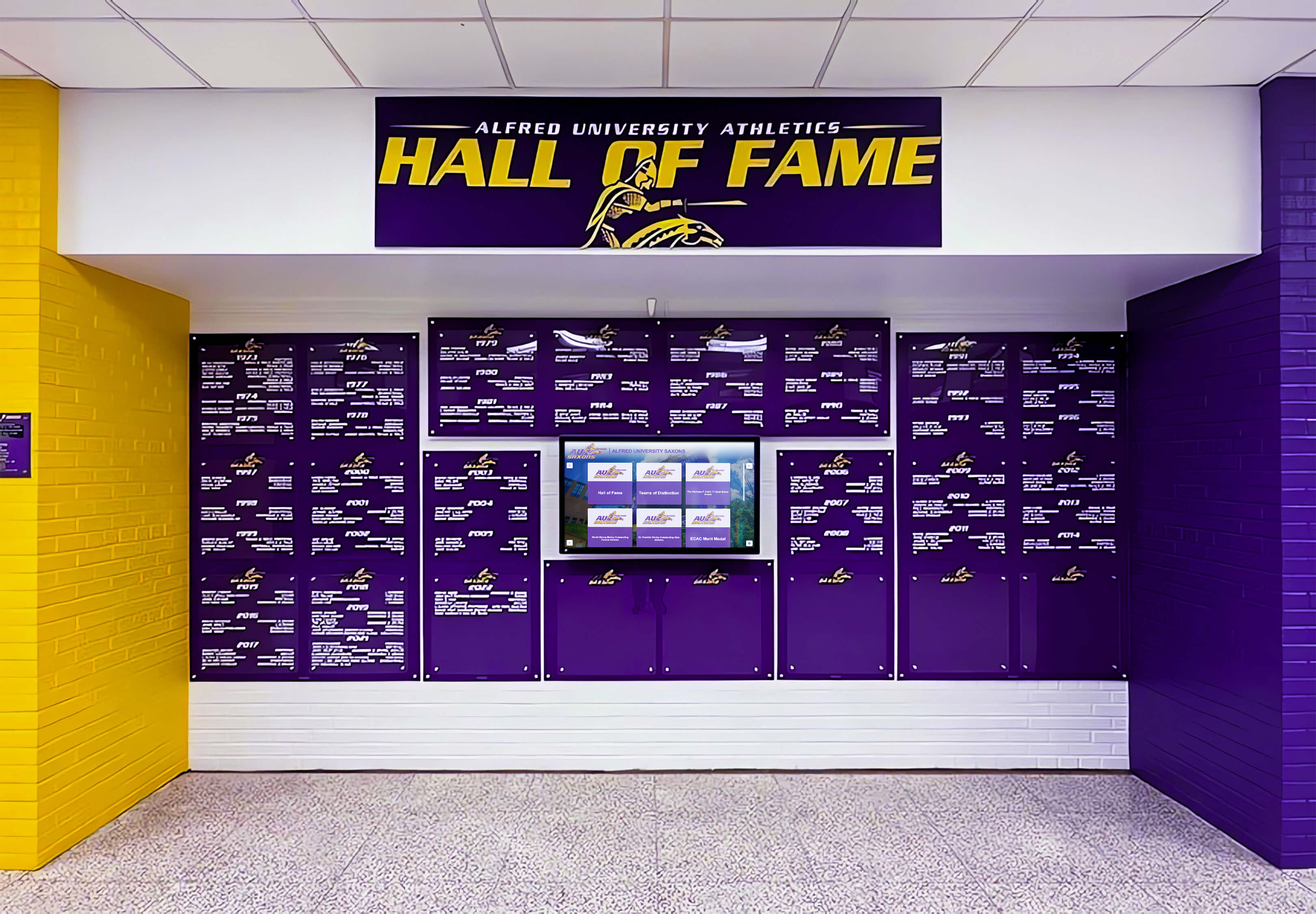
A well-configured display surfaces inductee names, bios, and records accurately when the underlying editorial standards are consistent
Frequently Asked Questions
Do we need a style guide if we only have a physical display—no digital platform?
Yes, and arguably more urgently. Physical plaques are expensive to correct. An engraving error or inconsistent name format on a mounted plaque requires a replacement order; a correction in a digital system takes minutes. Establishing standards before commissioning any physical element prevents costly retroactive corrections.
How detailed does the bio template need to be for a small school with fifty total inductees?
The template can be minimal—four sentences, third person, 75–100 words—but it must be written down and applied to every profile including past ones. The size of the archive is less important than the consistency. A fifty-inductee archive with inconsistent formats is harder to migrate or display than a five-hundred-inductee archive with standardized records.
What happens when an inductee disputes a record or statistic in their profile?
Establish a formal correction process: the inductee submits a written correction with supporting documentation; the recognition committee verifies against primary sources; if verified, the record is updated in the CMS and any physical display is flagged for correction at next replacement. Document the correction history in the administrative record, not the public bio.
How do style guide standards connect to donor recognition?
Inductees who become significant donors appear in multiple display contexts—hall of fame profiles, campaign progress boards, and named-space recognition panels. Consistent name formatting across all these contexts ensures that the same individual is identifiable across every display rather than appearing as two different people under variant name formats.
Should the style guide cover photo standards as well?
Yes. Add a one-page photo section specifying minimum resolution (typically 300 DPI for print, 150 DPI for digital-only), acceptable background types, framing (headshot vs. action shot), file format (JPEG or WEBP), and the alt-text template noted above. Photo inconsistency is as visible to users as text inconsistency—a mix of yearbook headshots, action shots, and scanned newspaper photos communicates the same lack of intentionality as mismatched bio formats.
Measurement: Signals That Your Style Guide Is Working
| Signal | What to Measure | Healthy Target |
|---|---|---|
| Search recall rate | Profiles returned per name search vs. profiles in archive | ≥ 95% match |
| Bio length compliance | % of new profiles within target word count | ≥ 90% |
| Date format consistency | % of profiles using approved date format | ≥ 95% |
| Record sourcing rate | % of records with documented source | ≥ 80% |
| Correction volume | Staff-reported formatting errors per induction cycle | Decreasing each cycle |
| Display panel accuracy | Filter and browse panels returning expected inductee counts | No empty panels |
Review these signals after each induction class and log any recurring errors as candidates for a style guide clarification in the next annual review.
Final Checklist Before Publishing the Next Induction Class
- Style guide is written, approved, and stored in at least two locations
- All four domains are covered: names, bios, dates, records
- Quick-reference table is completed with your school’s specific choices
- Existing profiles have been audited against the new standards
- Data-validation controls enforce standards at every entry point
- Annual review date is calendared with a named owner
- Photo standards are included in the guide
- ADA alt-text template is documented and applied to all profile photos
- Display platform filter panels and search have been tested with standardized data
A hall of fame editorial style guide is the lowest-cost, highest-return infrastructure investment a recognition program can make. The document itself requires a few hours to produce; the payoff is an archive where every inductee surfaces in search, every profile reads with authority, and every display module works as designed—across staff transitions, platform migrations, and decades of new induction classes.
Request your free custom demo to see how Rocket Alumni Solutions supports structured inductee data, built-in style validation, ADA-compliant profile cards, and cloud-based CMS tools that make editorial consistency the default—not the exception—for your school’s hall of fame program.
Live Example: Rocket Alumni Solutions Touchscreen Display
Interact with a live example (16:9 scaled 1920x1080 display). All content is automatically responsive to all screen sizes and orientations.