Hall of Fame Duplicate Profile Merge Policy: Preserve Credits, Photos, and URLs
- Home /
- Digital Hall of Fame Insights & Resources /
- Hall of Fame Duplicate Profile Merge Policy: Preserve Credits, Photos, and URLs

The Easiest Touchscreen Solution




Live Example: Rocket Alumni Solutions Touchscreen Display
Interact with a live example (16:9 scaled 1920x1080 display). All content is automatically responsive to all screen sizes and orientations.
A hall of fame duplicate profile merge policy defines how a recognition program identifies inductee records that represent the same person under different names, spellings, or data-entry sessions—and how the program combines those records without discarding credits, photos, source notes, or inbound web links. Duplicate profiles surface in nearly every searchable hall of fame database: a maiden-name entry exists alongside a married-name entry, a hand-keyed record from an older database import conflicts with a new nomination form submission, or a volunteer created a profile for an inductee who was already in the system under a slightly different spelling. When a merge is handled carelessly, career statistics split across both records, archived photographs end up orphaned, and inbound links from alumni newsletters or newspaper archives point to a profile that no longer exists. This guide gives school administrators, athletic directors, alumni and advancement teams, facilities staff, and school IT personnel a practical framework for merging duplicate records while preserving everything that gives an inductee’s profile its institutional value.
A well-executed merge policy protects the program’s credibility just as much as it protects the inductee’s record. Visitors who find two separate profiles for the same person lose confidence in the database’s reliability. A merge completed without a written policy is a one-time fix; a merge completed with a documented policy is a repeatable process that survives staff turnover and software migrations.
This guide is operational and educational. It does not constitute legal, privacy, or records-management advice. Programs subject to state student records laws, privacy regulations, or institutional data-governance policies should consult qualified staff or legal counsel before implementing any merge procedure.

Every inductee card on a searchable recognition display should resolve to one authoritative record—a written merge policy makes that possible at scale
Program Snapshot
| Element | Details |
|---|---|
| Audience | School administrators, athletic directors, alumni and advancement staff, recognition-program coordinators, school IT |
| Policy scope | All inductee records in the program’s database, website, and digital display system where duplicate entries are identified |
| Core problem | Two or more records represent the same inductee under different names, spellings, import sessions, or data-entry errors—credits, photos, and URLs are split across both |
| Core goal | Every merge produces a single authoritative record that retains all credits, alternate names, photos, source notes, and inbound links from both source records |
| Key deliverable | A written merge policy with a detection checklist, a step-by-step merge workflow, a field-preservation matrix, and a URL-redirect procedure distributed to all staff who manage inductee records |
| Display payoff | Searchable profiles on digital kiosks, hall of fame websites, and touchscreen displays resolve consistently to one complete, accurate record regardless of which name variant a visitor searches |
The Direct Answer: What a Hall of Fame Duplicate Profile Merge Policy Must Cover
A complete hall of fame duplicate profile merge policy answers five questions before any merge action is taken:
- How are duplicates detected? Define the triggers—name-match audits, family correction requests, import deduplication reports—so duplicates surface before a visitor encounters them.
- Which record becomes the primary? Establish a documented rule for selecting the record that survives as the authoritative profile, based on completeness, age, or institutional source rather than arbitrary choice.
- Which fields must be preserved from each source record? Map every data field to a preservation rule: copy, append, supersede, or archive. No field should be silently deleted during a merge.
- What happens to inbound URLs? Every URL that pointed to a now-retired record must be redirected or documented so that incoming links from alumni newsletters, newspaper databases, and external directories continue to resolve correctly.
- Who authorizes the merge and documents it? Merges that are not authorized in writing introduce untracked data loss. Assign a named role—Archivist, Records Coordinator, or similar—and require written authorization for every merge action.
Programs that answer all five questions in writing before their first merge complete the process without data loss and without creating support requests when visitors follow broken links.
Why Duplicate Profiles Form in School Hall of Fame Databases
Understanding the most common causes of duplication helps programs address them structurally—so the merge policy reduces new duplicates rather than only cleaning up old ones.
Name changes over time. An inductee honored under a maiden name may appear under a married name in a later award category, an alumni directory, or a family-submitted profile update. Both records are valid representations of the same person at different points in their life; only one should appear in the public-facing searchable database.
Database migrations and import sessions. When a program moves from a spreadsheet or legacy database to a new platform, import scripts may create records for inductees who were already entered manually. The imported record and the hand-keyed record each carry different subsets of the complete data.
Nomination form submissions and volunteer data entry. As profile update request workflows become more accessible to families and alumni staff, it becomes possible for two people to submit records for the same inductee without knowing the other submission exists. Without a deduplication check at intake, both submissions enter the database.
Spelling variants and diacritical marks. A name with a hyphen, apostrophe, or diacritical character may be indexed differently depending on the data-entry method, creating separate records that a name-match search does not automatically flag.
Multi-sport or multi-award inductees. Some programs track inductions by sport or award category rather than by person. An inductee honored in athletics and separately in academics may appear as two distinct records if the category-level entry was created before a person-level identifier was established.

When duplicates exist, a visitor searching by name may find two incomplete profiles instead of one authoritative record containing the inductee's full career
Identifying Duplicate Profiles: A Detection Checklist
Before a merge can be authorized, duplicates must be identified and confirmed. Run these checks at the start of each induction cycle and after any database import or platform migration.
| Detection Method | What to Check | Frequency |
|---|---|---|
| Exact-name match audit | Query the database for records with identical first and last names | Before each induction cycle |
| Fuzzy-name match review | Query for names within one or two character substitutions (spelling variants, missing hyphens, diacritical differences) | After each database import |
| Shared biographical data check | Compare graduation years, sports, or award years across records with similar names | Annual |
| Inbound link audit | Review web analytics for URLs pointing to records that share a subject with another record | Annual |
| Family or alumni correction requests | Log every correction request that references a name, graduation year, or sport and check for existing records | Ongoing |
| Nomination form deduplication | Cross-reference each new nomination submission against existing records before creating a new profile | At intake |
Assign the detection checklist to a named Archivist or Records Coordinator role. A detection check that relies on any individual’s memory of the database will miss duplicates introduced before that person joined the program.
Step-by-Step Merge Workflow
When a duplicate is confirmed, work through the following steps in sequence. Do not skip the documentation steps—each one protects the program from untraceable data loss.
Step 1: Confirm the Duplicate
Before authorizing a merge, verify that the two records represent the same person rather than two people who share a name or graduation year. Confirm at least two independent data points: graduation year, sport, award category, coach name, or statistical record. If confirmation requires contacting the inductee, their family, or the school’s alumni office, complete that contact before proceeding.
Document the confirmation: who verified the match, what data points were cross-checked, and the date of confirmation.
Step 2: Designate the Primary Record
The primary record is the one that survives the merge as the public-facing profile. Use the following criteria in order:
- Institutional source priority. A record created from an official school athletic records database outranks a record created from a family-submitted form or a third-party import.
- Completeness. The more complete record becomes primary when source priority is equal.
- Age. The older record becomes primary when completeness is equal, preserving the longer inbound-link history.
- Manual review. When automated criteria do not resolve the designation, the Archivist makes the determination and documents the reasoning.
Record the designation decision—primary and secondary record identifiers, designation criteria applied, and the Archivist’s name—before any field is modified.
Step 3: Map Every Field from Both Records
Before any data is moved or deleted, complete a field-by-field comparison of both records. Use the preservation matrix below to assign a rule to every populated field in the secondary record.
| Field Type | Examples | Preservation Rule |
|---|---|---|
| Legal or official name | Current legal name, formal name used in official ceremonies | Use primary record’s value; move secondary to Alternate Names |
| Alternate names | Maiden name, nickname, married name, name at time of induction | Append all variants to the primary record’s Alternate Names field |
| Sport or activity credits | Sport, position, season, award category per induction | Append secondary record’s credits to primary; remove exact duplicates |
| Statistical records | Career stats, records broken, championship titles | Retain all records; flag any discrepancy for Archivist review before merge |
| Induction year and ceremony | Year inducted, ceremony name, induction class | Retain all; if values differ, document both and flag for committee review |
| Photographs | Primary portrait, action photos, ceremony photos | Retain all unique photos in the primary record; do not delete any image without explicit authorization |
| Photo credits | Photographer name, rights holder, license notes | Append all photo credit records to primary; never merge credits in a way that drops a rights holder’s name |
| Biographical narrative | Career summary, personal statement, program notes | Use primary; append unique content from secondary in an archived notes field |
| Source notes and citations | Database sources, newspaper references, family documentation | Append all source notes from secondary to primary |
| External links | Alumni pages, media archives, institutional records | Retain all links; apply the program’s external link vetting standards to any link not already vetted |
| Inbound URLs | URLs in other websites or platforms pointing to this profile | Document every inbound URL from secondary record before deactivating it |
| Custom field data | Award-specific data, donor tie-ins, sponsor associations | Review case by case; never auto-overwrite with a blank field |
Step 4: Execute the Data Transfer
Transfer each field from the secondary record to the primary record according to the preservation matrix. Do not perform this step manually without a written field map completed in Step 3—human error during manual data transfer is the most common cause of post-merge data loss.
For programs using a content management system, confirm whether the platform supports a native merge function or whether transfers must be done field by field. Evaluating platform merge capabilities is part of a broader assessment of what hall of fame tools best fit a program’s scale—this step is where differences between platforms become operationally significant.
Step 5: Preserve Photographs and Media Credits
Every photograph associated with the secondary record must be reviewed before the record is deactivated. Apply the following rules:
- Unique photos: Transfer to the primary record and retain all associated metadata (caption, photographer credit, date, rights notes).
- Duplicate photos: Confirm they are exact duplicates before discarding. A photo that appears identical but was uploaded at a different resolution or with different caption text is not a duplicate.
- Photo credits: Every rights holder and photographer credit attached to a photo in the secondary record must be preserved in the merged record. A merge that drops a photo credit creates a rights-documentation gap that may be difficult to reconstruct later.
- Orphaned photos: If a photo in the secondary record cannot be matched to a specific induction event or attributed to a rights holder, archive it with a flag for follow-up rather than deleting it.
Step 6: Redirect or Document Inbound URLs
Every URL that pointed to the secondary record must either be redirected to the primary record’s canonical URL or documented in a URL registry maintained by the school’s IT or web team.
Inbound links to inductee profiles come from many sources beyond the program’s control: alumni newsletters, newspaper articles, alumni association websites, school reunion pages, and family tributes. A profile URL that disappears without a redirect—even for a record that was merged rather than deleted—produces a 404 error that reflects poorly on the institution and severs a connection that the inductee’s community followed.
For programs whose platform does not support native URL redirects, consult the school’s web or IT team about implementing server-level redirects before deactivating any profile URL. Selecting a platform with robust profile management and URL handling is part of a broader evaluation of digital recognition infrastructure that programs should complete before committing to any CMS for long-term inductee records.
Step 7: Deactivate the Secondary Record
After all fields have been transferred, all photos have been reviewed, and all inbound URLs have been redirected or documented, the secondary record may be deactivated. Do not delete it permanently. Retain the secondary record in an archived state—not publicly visible, but accessible to administrators—so that the merge can be audited or reversed if an error is later discovered.
Document the deactivation: secondary record identifier, deactivation date, staff member who completed the action, and a reference to the primary record it was merged into.
Step 8: Verify the Merged Profile
After the merge is complete, review the primary record end-to-end:
- All credits appear accurately with no duplication
- All photos display correctly with credits intact
- All alternate names are listed in the appropriate field
- All source notes are present
- All external links have been vetted per the program’s link policy
- The profile is publicly visible and searchable under all name variants
- All inbound URLs from the secondary record now resolve to the merged primary record
Assign a second reviewer—not the Archivist who performed the merge—to complete this verification step. A self-reviewed merge has a higher risk of confirming errors introduced during the merge itself.
Institutional records that survive for decades depend on governance decisions made at the time of a merge—a field dropped in 2025 may be unrecoverable in 2035
Data Integrity Considerations
Duplicate profile merges are one of several data governance events—alongside profile updates, photo replacements, and statistical corrections—that can introduce errors if handled without a written policy. Programs that establish merge governance as part of a broader data integrity framework are better positioned to maintain the accuracy of their records over time.
Algorithmic manipulation and misrepresentation risks in digital hall of fame contexts underscore why manual, documented merge procedures matter: a profile produced by an automated deduplication system without human review may suppress credits, reassign statistics to the wrong record, or create a biographical composite that does not accurately represent either source record. Wherever possible, supplement automated tools with human review at the field-mapping and verification stages.
Copy-Paste Merge Authorization and Verification Checklist
Use this checklist for every duplicate merge. Replace bracketed placeholders with program-specific details.
Pre-Merge Authorization
- Duplicate confirmed with at least two independent data points (graduation year, sport, award category, coach name, statistical record)
- Primary record designated with criteria documented (institutional source, completeness, age, or Archivist determination)
- Secondary record identifier recorded alongside the primary record identifier
- Field-by-field preservation matrix completed for all populated fields in the secondary record
Data Transfer
- All credits transferred; no career credits remain only in the secondary record
- All alternate names appended to the primary record’s Alternate Names field
- All photographs reviewed; unique photos transferred with metadata and credits intact
- All photo credits preserved; no rights holder’s name dropped
- All biographical content reviewed; unique content from secondary archived in notes field
- All source notes appended to the primary record
- All external links retained and scheduled for vetting review
URL Preservation
- All inbound URLs associated with the secondary record documented
- Redirects implemented for all documented inbound URLs (or IT team notified with documentation)
- Redirect destinations confirmed as resolving to the primary record’s canonical URL
Deactivation and Archiving
- Secondary record set to archived/non-public status (not permanently deleted)
- Deactivation date, staff member, and primary record reference documented
Post-Merge Verification
- Merged profile reviewed by a second reviewer not involved in the merge
- All alternate name variants confirmed searchable
- All inbound URLs from secondary record confirmed as resolving to primary
- Merge documented in the program’s records with all fields completed
Content Architecture: Mapping Merge Governance to Platform Capabilities
A recognition platform that supports merge governance at the data layer reduces the risk of field loss and simplifies the URL-preservation step. The architecture below describes how merge governance maps to platform features.
| Governance Stage | Action | Ideal Platform Feature | Record Created |
|---|---|---|---|
| Duplicate detected | Staff identifies two records for same inductee | Duplicate-detection report or fuzzy-name search | Detection log entry with both record identifiers |
| Merge authorized | Archivist designates primary and secondary | Merge authorization form in CMS | Written authorization with criteria documented |
| Field mapped | Preservation matrix completed | Side-by-side record comparison view | Field-level merge decision document |
| Data transferred | Fields moved from secondary to primary | Native merge function or field-by-field transfer UI | Transfer log with field-level confirmation |
| Photos reviewed | Unique photos moved; credits confirmed | Photo management panel with metadata display | Photo transfer log |
| URLs documented | Inbound URLs recorded; redirects submitted | URL metadata field on record; IT request workflow | URL registry entry and redirect documentation |
| Secondary deactivated | Record set to archived status | Archival state (non-public but admin-accessible) | Deactivation record with date and reference |
| Merge verified | Second reviewer confirms completeness | Profile preview and search-test mode | Verification sign-off with reviewer name |
Programs building or selecting a CMS for their hall of fame should verify that the platform supports at minimum: alternate-name indexing, photo credit metadata fields, record archival (not only deletion), and either native URL redirect management or documented integration with the school’s web infrastructure. An athletic hall of fame setup guide for school administrators is a useful starting point for understanding what CMS capabilities matter most before a program commits to a platform.
Execution Timeline: Merge Policy Lifecycle Phases
Phase 1 — Plan
- Recognition-program coordinator drafts the merge policy, field-preservation matrix, and URL-documentation procedure
- IT or web team confirms the redirect approach for secondary record URLs
- Policy reviewed by institutional records management staff and, where student records are involved, by qualified legal counsel
- Merge authorization form template created and distributed to Archivist and backup staff
Phase 2 — Build
- Archivist runs the detection checklist against the full database to identify existing duplicates
- Each confirmed duplicate is queued for merge in priority order (most-visited profiles first, based on analytics)
- Backlog of existing duplicates worked through before the next induction cycle opens
Phase 3 — Launch
- New inductee nominations cross-referenced against existing records at intake using the deduplication checklist
- All merges from this point forward follow the documented workflow with written authorization
- URL redirect infrastructure confirmed as operational
Phase 4 — Refresh
- Detection checklist run at the start of each induction cycle and after any database import or platform migration
- Merge documentation reviewed annually to ensure it reflects current platform capabilities and staff roles
- Policy updated when the program migrates platforms, adds new award categories, or changes the CMS data model
Display Integration
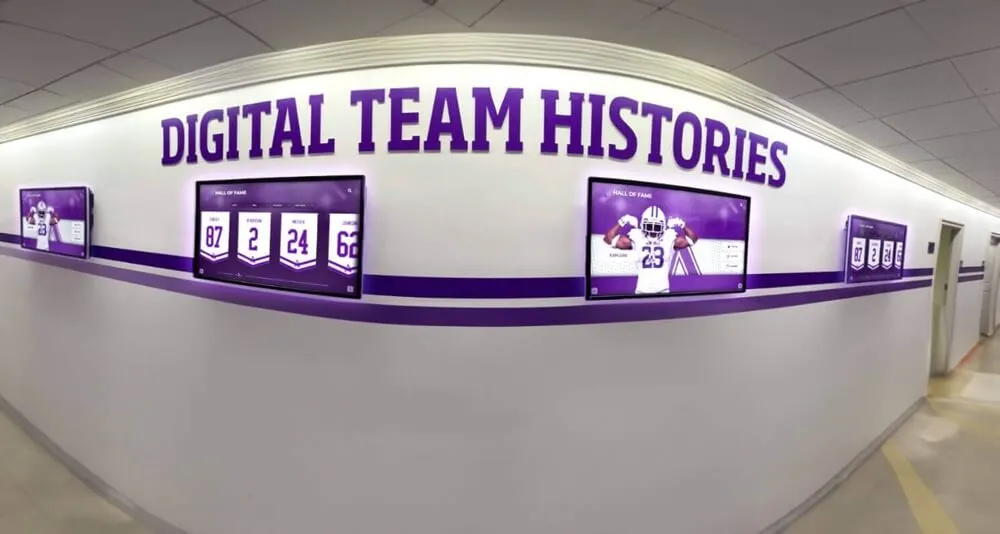
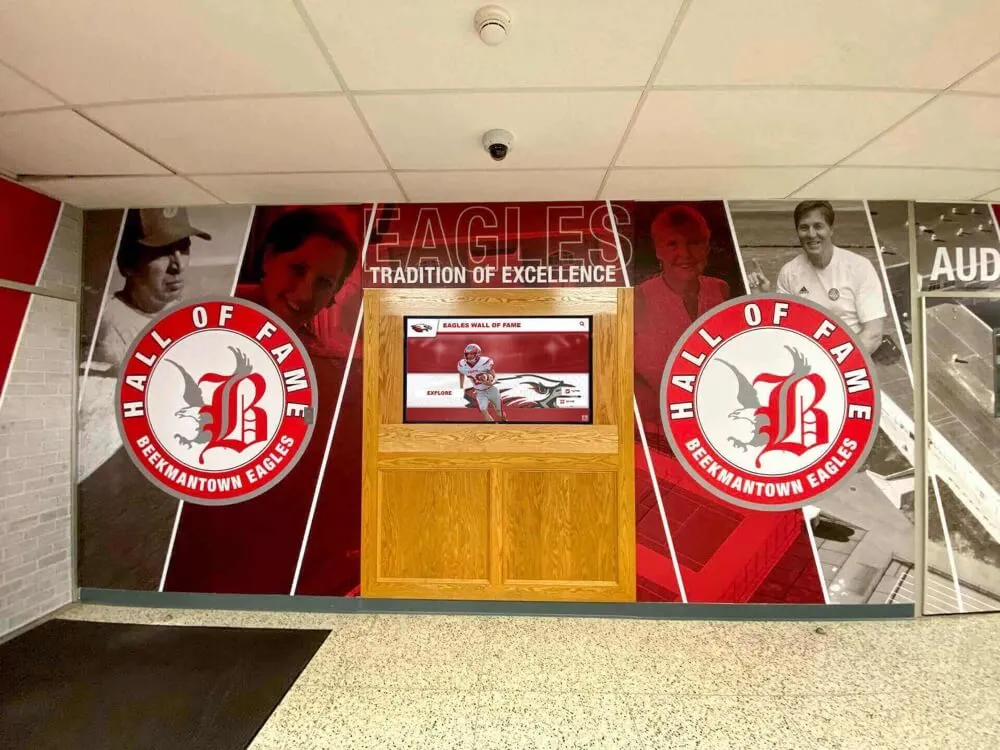
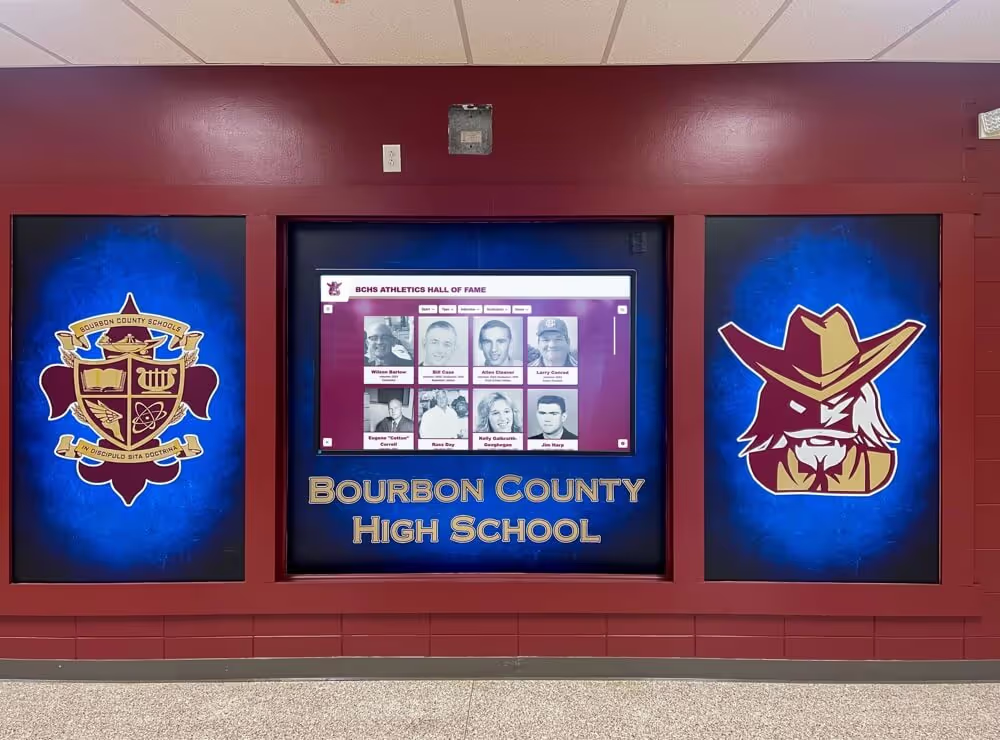
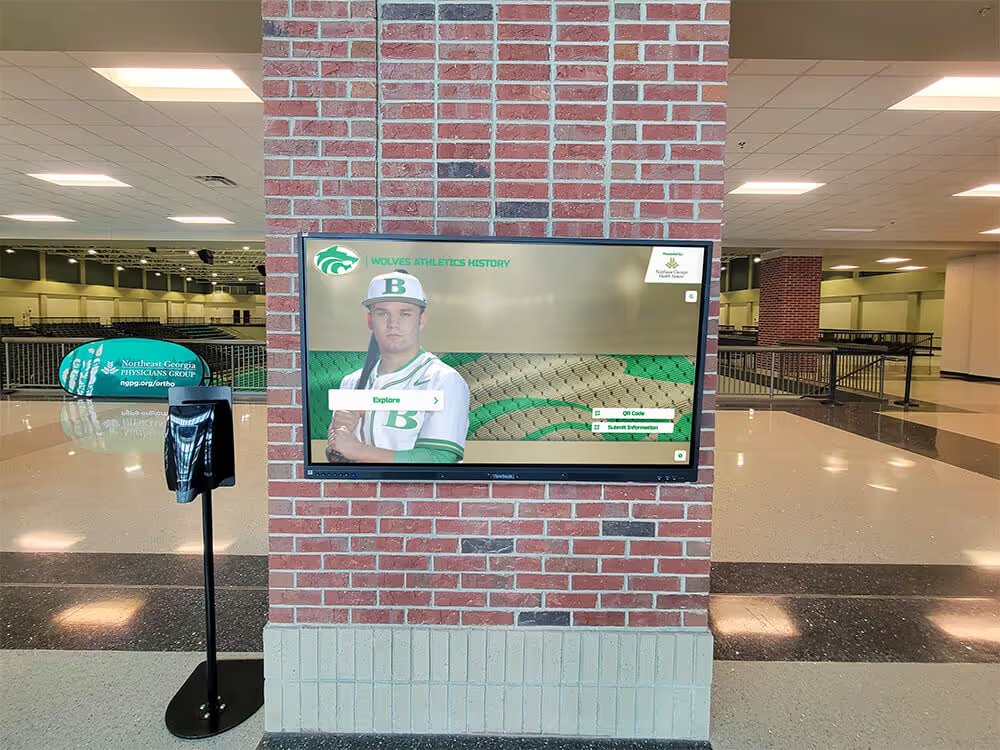
Duplicate profile merges affect every display context where inductee records appear: the searchable website database, digital touchscreen kiosks in school lobbies and gymnasiums, printed ceremony programs with QR codes, and digital signage layouts that surface inductee profile cards. A merge that is complete on the website but not yet reflected on the lobby touchscreen creates a visible inconsistency—visitors who search on both surfaces may still encounter the secondary record on the display that was not yet synchronized.
Platforms that use a single cloud-based CMS to drive both web and touchscreen display content eliminate this synchronization problem: a merge completed in the CMS propagates automatically to every display instance. For programs whose web and display content are managed in separate systems, the merge procedure must include a step to update both systems before the secondary record is deactivated—and the URL documentation step should cover URLs in both environments.
Understanding how hall of fame ballot and voting records should inform profile data is relevant at the display integration stage: when a duplicate merge reveals that two separate ballot submissions credited the same achievement to slightly different records, the merged profile must reflect the committee’s authoritative determination, not whichever record happened to be designated primary.
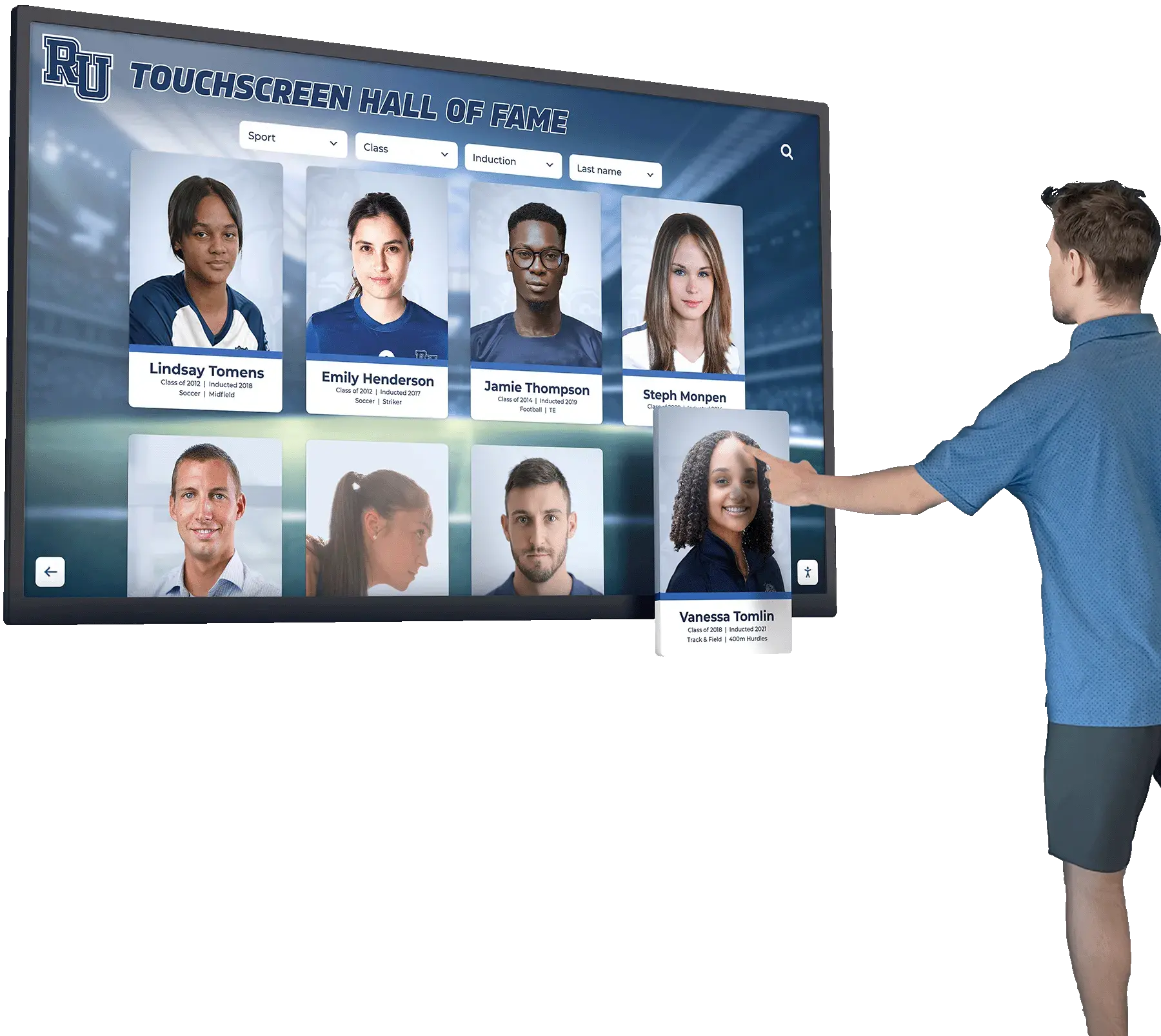
A merge is only complete when every platform—website, touchscreen, and printed materials—reflects the single authoritative record and all inbound URLs resolve correctly
Frequently Asked Questions
What should we do if the inductee or their family disputes which record should be primary?
When an inductee or family member has a preference about which version of the name, biography, or photo appears in the merged record, treat their input as a formal correction request rather than a factor in the merge authorization itself. The primary record designation is an administrative decision based on source priority and completeness—it determines which record identifier survives, not necessarily which version of every field appears in the final merged profile. Once the merge is complete, honor the correction request through the program’s standard profile update request process with appropriate authorization.
Can we permanently delete the secondary record after a merge?
Retain the secondary record in an archived, non-public state rather than deleting it. Permanent deletion removes the ability to audit the merge, reverse it if an error is later discovered, or recover data that was inadvertently missed during the field-transfer step. Archive storage for a text record is minimal; the preservation benefit is significant.
How do we handle a merge when one record has photos and the other does not?
Transfer all photos from the record that contains them to the primary record with their metadata and credits intact. The absence of photos in one record does not affect the designation of primary versus secondary—that decision follows the source-priority criteria described in the workflow. When the primary record has no photos and the secondary does, transfer the photos to the primary and apply the full photo-credit preservation rules.
What if the two records have conflicting statistical data?
Do not resolve a statistical conflict by choosing one record’s value over the other during the merge. Flag the discrepancy, retain both values in a notes or review field, and assign the conflict to the Archivist or recognition committee for resolution against authoritative institutional source records. A merge that silently overwrites one statistical value with another introduces an untracked error that may not be discovered until a future review.
How should we communicate a profile merge to the inductee or their family?
For active inductees who are in contact with the program, notify them that their profiles have been combined and confirm the merged record’s accuracy. Provide the URL of the primary record so they can update any links they have shared. For historical inductees where contact is not possible, document the merge thoroughly so that future communications with family members can reference what was done and why.
Does a profile merge require a policy update to our voting or nomination records?
If your program maintains a separate record of nominations, ballots, or committee votes linked to individual inductees, update those records to reference the primary record identifier after a merge. A vote or nomination linked to a now-deactivated secondary record identifier may appear orphaned in reports or audits. This is primarily an administrative housekeeping step, but it matters for programs that use historical voting data to trace when a recognition decision was made.
Measurement: Tracking Merge Governance Over Time
| Metric | What It Measures | How to Collect |
|---|---|---|
| Duplicate detection rate | Number of confirmed duplicates found per induction cycle or database import | Detection checklist results logged each cycle |
| Merge completion time | Average time from duplicate detection to verified merge | Timestamps on authorization, transfer, deactivation, and verification steps |
| Post-merge link resolution rate | Percentage of documented inbound URLs from secondary records that resolve correctly after merge | Web analytics or IT redirect verification report |
| Photo credit preservation rate | Percentage of photos transferred from secondary records with all credits intact | Photo transfer log audit |
| Family correction requests post-merge | Number of correction requests received within 90 days of a merge | Correction request log filtered by subject and date |
Programs that track these metrics over two or three induction cycles develop an accurate picture of where the merge workflow has friction and where new duplicates are most often introduced—allowing the policy to be refined without waiting for a visible failure.
Ready to manage inductee profiles, alternate names, photo credits, and inbound URLs through a single governed platform? Request your free custom demo and see how Rocket’s cloud-based recognition system supports the merge governance workflows your program needs.
Live Example: Rocket Alumni Solutions Touchscreen Display
Interact with a live example (16:9 scaled 1920x1080 display). All content is automatically responsive to all screen sizes and orientations.