Hall of Fame Copyright Permission Form: Photos, Programs, Articles, and Video
- Home /
- Digital Hall of Fame Insights & Resources /
- Hall of Fame Copyright Permission Form: Photos, Programs, Articles, and Video
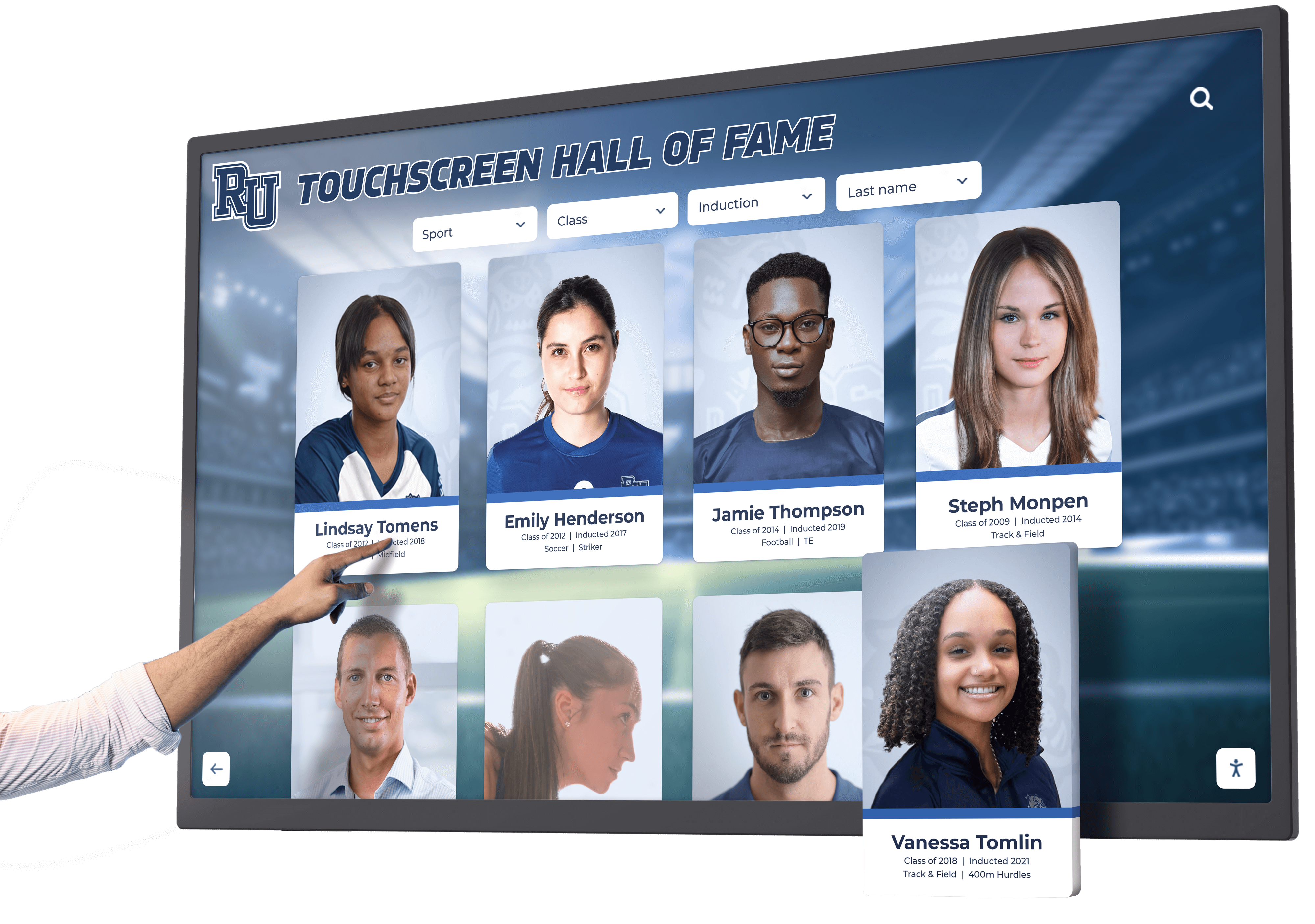
The Easiest Touchscreen Solution




Live Example: Rocket Alumni Solutions Touchscreen Display
Interact with a live example (16:9 scaled 1920x1080 display). All content is automatically responsive to all screen sizes and orientations.
A hall of fame copyright permission form documents the reuse rights a school committee secures before publishing archival media—photographs, game programs, newspaper articles, and video footage—in an online profile, touchscreen display, or printed ceremony program. Without documented permissions, a committee that publishes a decades-old action photograph or scans a program cover for a digital archive is creating a liability that may not surface until long after the display goes live.
The four media categories that require distinct permission language are archival photographs, published game programs and yearbook pages, newspaper and magazine articles, and video or film footage. Each category has different rights holders, different license requirements, and different language that a permission form must capture. This guide covers each category, provides a copy-paste form template and pre-publication checklist, and explains how a digital platform can automate rights-clearance tracking without adding paperwork to the committee’s cycle.
This guide is for general informational purposes only and does not constitute legal advice. Consult your institution’s legal counsel before drafting, adopting, or relying on any copyright permission form or rights-clearance process.
Archival media is the primary content challenge for schools building or modernizing hall of fame programs. A committee can manage its nomination process, selection criteria, and announcement workflow without specialized support—but the moment it begins assembling photographs, scanning game programs, or uploading video clips for a digital display, it encounters copyright questions that require documented answers before any content goes public.

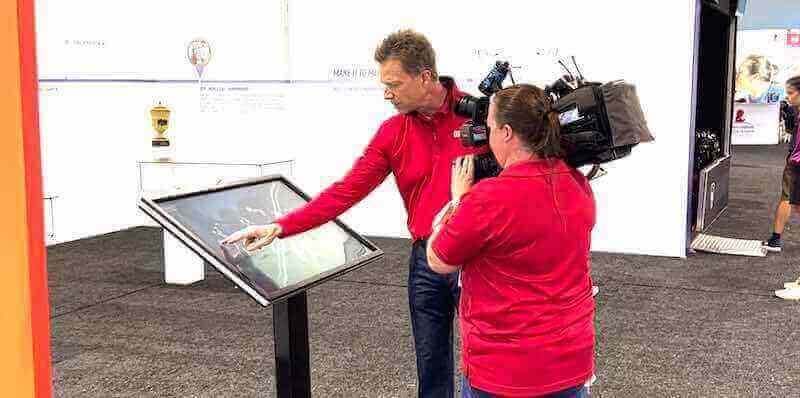
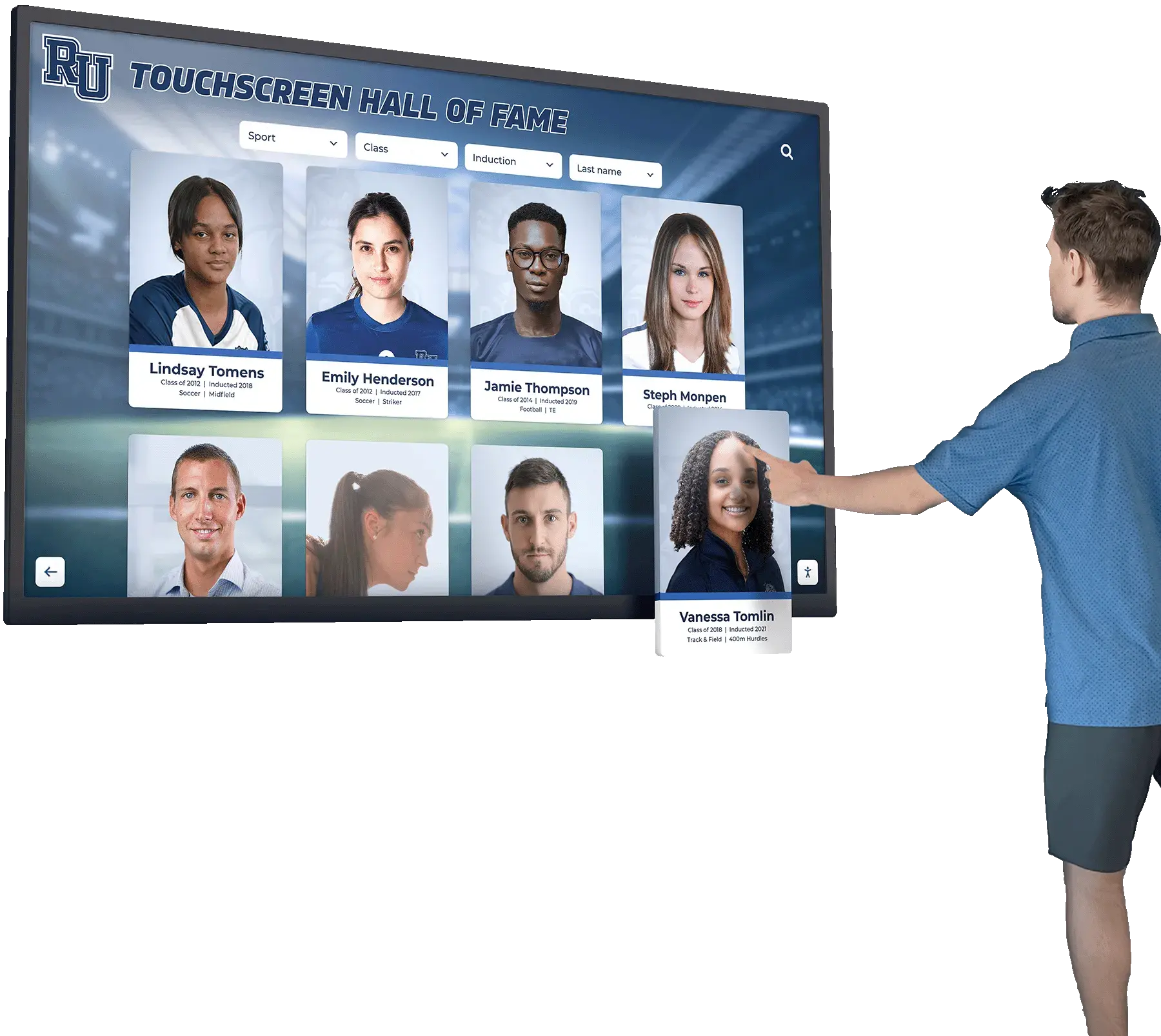
Every photograph displayed on a touchscreen recognition system should trace back to a signed permission form—documentation that authorized its use and defined the scope of that authorization
Program Snapshot
Before drafting your permission form, map each media category to the rights issues it presents and the documentation your committee must collect.
| Media Category | Typical Rights Holder | Rights Issue | Form Element Required |
|---|---|---|---|
| Archival photographs | Photographer or their estate; sometimes the school if staff-taken | Reproduction and display rights | Signed release from rights holder; scope of authorized use |
| Game programs and yearbooks | School or athletic booster organization that published them | Reproduction rights for scanned pages or covers | Written authorization from publisher or successor organization |
| Newspaper and magazine articles | Publishing outlet; sometimes the journalist if freelance | Reproduction and digital display rights | Written license from the publication’s rights or permissions department |
| Video and film footage | Production company, television station, or individual videographer | Synchronization rights, master use rights, and likeness rights for subjects | Dual clearance covering footage rights and any featured subjects |
| Subject likeness rights | The individual depicted (athlete, coach, administrator) | Right of publicity; use of image for institutional promotion | Inductee release covering digital display, web, and print use |
Why Copyright Permissions Matter for Hall of Fame Programs
Copyright protects original works of authorship from the moment of creation. A photograph taken at a 1987 championship game is still under copyright—likely for the life of the photographer plus 70 years under current U.S. law. A newspaper article published in 1995 remains protected. A game program designed by a staff member at the school may be owned by the school or by the individual, depending on the circumstances of its creation.
Schools that have operated recognition programs for decades often have decades of archival media accumulated without any systematic rights documentation. When a committee begins moving that media to a digital display platform, it surfaces a backlog of rights questions that were never formally resolved.
The practical risks of publishing without documented permissions range from a takedown demand from a photographer or their estate, to a dispute with a newspaper that discovers its archived articles are displayed on a public website, to an inductee’s objection to how their likeness is being used in digital promotion. None of these scenarios requires bad faith on the committee’s part—they arise simply because rights were not documented before content was used.
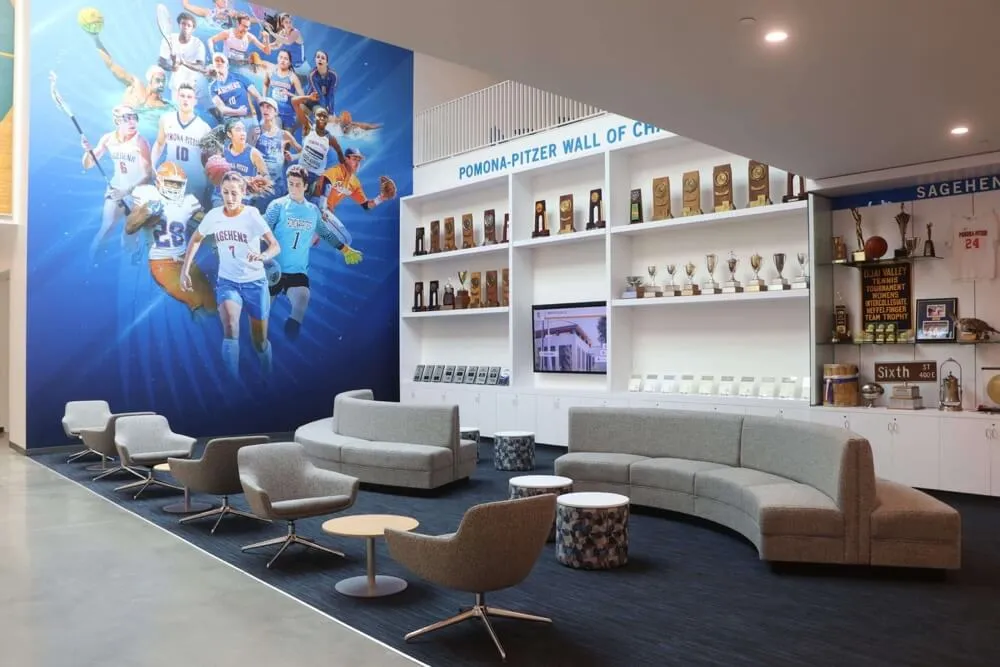
Committees that have worked through building comprehensive hall of fame systems for athletics, donors, and history consistently identify rights documentation as one of the first infrastructure decisions a program must resolve before content can be published at scale.
The Four Media Categories
1. Archival Photographs
Photographs are the most common source of rights exposure in hall of fame programs. A committee assembling an inductee’s profile will typically gather photographs from multiple sources: the school’s own archives, the inductee’s personal collection, local newspaper archives, sports photographers who covered the team, and yearbooks.
Each source has a different rights holder:
- School staff photographs: If the photograph was taken by a school employee acting within the scope of their employment, the school generally holds the copyright as a work made for hire. A written authorization from the current school administration is still worth documenting.
- Inductee-provided photographs: When an inductee or their family provides a photograph from a personal collection, the inductee may not own the copyright—they may hold only a print. Ask who took the photograph. If it was taken by a professional photographer, rights clearance must come from that photographer.
- Newspaper archive photographs: Local papers maintain rights to photographs their staff photographers took. Contact the paper’s permissions or licensing department, explain the educational and non-commercial nature of the use, and obtain written authorization that specifies the display contexts covered.
- Freelance sports photographers: Photographers who covered high school or college athletics as freelancers own their own work. Contact them directly or through their current representative.
What the form must capture: The rights holder’s identity, the specific photograph(s) covered (by file name, negative number, or description), the authorized display contexts (digital touchscreen, website, print ceremony program), the geographic or temporal scope if limited, and whether the rights holder has granted a perpetual license or a term-limited one.
2. Game Programs and Yearbook Pages
Printed game programs and yearbooks are institutional publications that may contain photographs, biographical copy, statistics, and design elements—each of which may have its own rights chain. The program itself, as a compiled work, is typically owned by whoever published it: the school, the athletic department, or the booster organization that funded and produced it.
For programs produced by a third-party vendor—a printing company that designed and printed programs on behalf of the school—the vendor’s contract may have transferred rights to the school, or it may not have. Older contracts rarely addressed digital reproduction rights because digital display platforms did not exist when the programs were printed.
When a committee wants to reproduce a program cover or scan interior pages for a digital inductee profile, it must identify who currently holds the rights to that publication and obtain written authorization for the specific reproduction use intended.
What the form must capture: The publication name, the specific issue (date, season, game), the specific pages or elements to be reproduced, the authorized use contexts, the name of the rights holder and their relationship to the publication, and confirmation that the rights holder has authority to grant the requested license.
3. Newspaper and Magazine Articles
A newspaper article profiling an inductee—a feature written at the time of a championship, a retirement piece, a career retrospective—is owned by the publication that commissioned it, not by the athlete it describes or the school it covers. Using that article’s text in a digital display, linking to it from an inductee profile, or reproducing it in a ceremony program each raises a distinct rights question.
Most regional newspapers and local publications have a permissions process. Contacting the paper’s editorial or rights department with a description of the intended use—displaying the article in a non-commercial educational recognition context—often results in a written authorization. Some publications grant these permissions at no cost; others charge a modest licensing fee.
For articles published by outlets that have since ceased operations, identifying the current rights holder requires tracing the publication’s corporate history. Rights may have been acquired by a successor publication, a media company, or in some cases returned to the journalist through a reversion clause.
What the form must capture: The publication name, the article title, the author, the publication date, the authorized reproduction contexts, any restrictions on modification or excerpt length, and the identity and authority of the rights holder granting the permission.
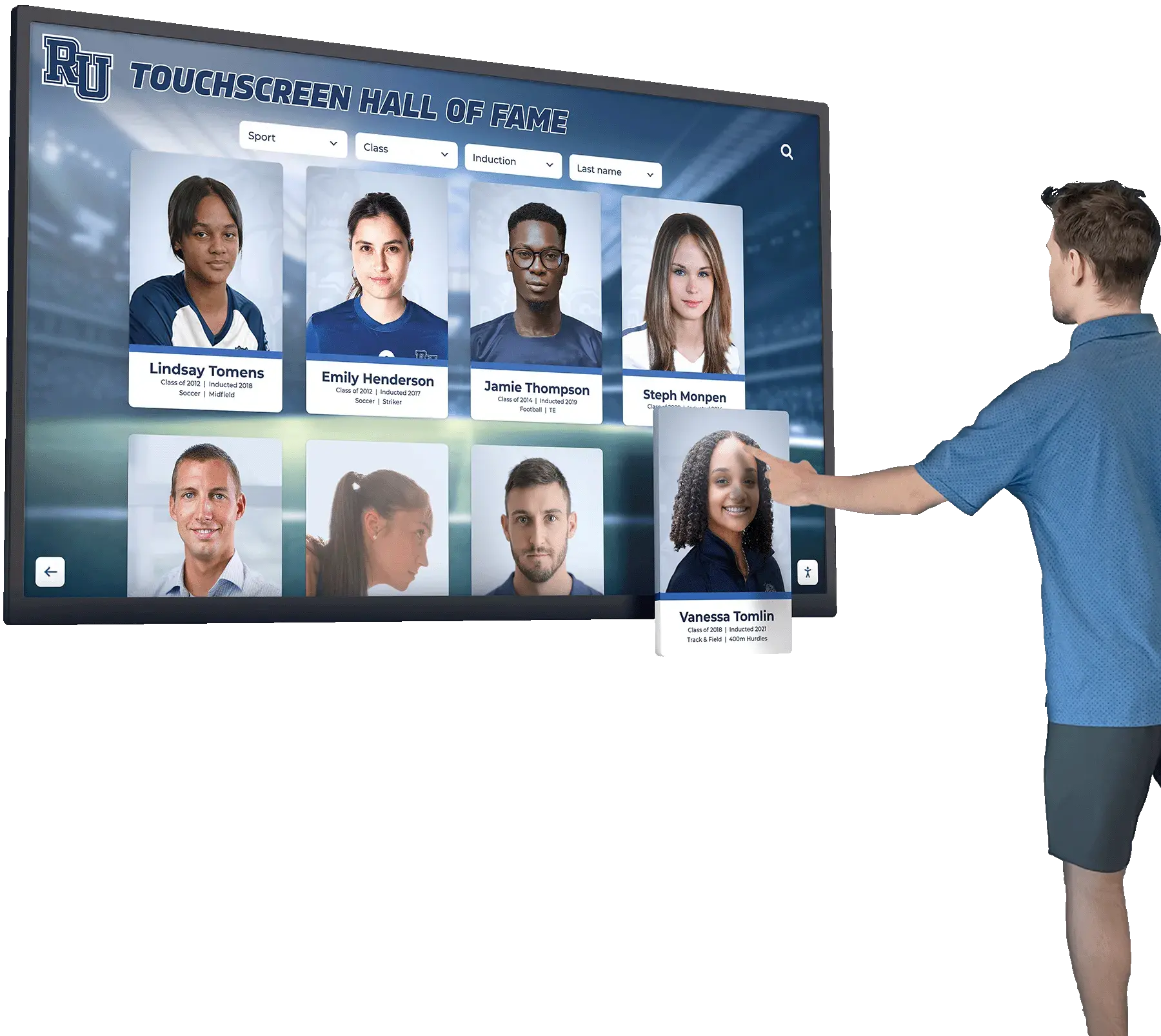
Digital hall of fame displays that include video, photographs, and archival articles must link each asset to a documented rights clearance—the form is what makes the display defensible
4. Video and Film Footage
Video footage presents the most layered rights questions because it combines multiple rights in a single asset: the footage itself (owned by the production company or the person who filmed it), any music on the soundtrack (owned by the composer and the recording artist), and the likeness rights of everyone who appears on screen.
For school athletic programs, the most common video sources are:
- Local television broadcasts: If a game was broadcast by a regional television station, that station holds the rights to the broadcast footage. Contact the station’s news or licensing department. Broadcast rights agreements from the era when the game was played may limit what the station can license.
- Independently produced highlight videos: Videographers hired by booster organizations, parent groups, or the school itself may own their footage depending on how the engagement was structured. Locate the original agreement if one exists.
- Inductee or family recordings: Home video recordings and parent-shot footage are generally owned by the person who made the recording, not the school or the subject.
- Professionally produced team videos: If a production company was hired to produce a season recap or highlight video, rights belong to that company unless contractually transferred.
Music clearance is a separate issue. If video footage includes a copyrighted song—either as a soundtrack or incidentally audible in the background—that song requires separate synchronization and master use clearances from the music publisher and the record label. Many schools find it simpler to mute background music from archival video clips before publishing than to pursue clearances for incidental soundtrack content.
What the form must capture: The production entity, the specific footage identified (by date, event, or file reference), the rights covered (video only vs. video with audio), any music clearance status, the authorized display platforms (touchscreen kiosk, website, projected at ceremony), and a separate inductee likeness release if the video features the inductee in a promotional capacity.
Content Architecture: Mapping Media Types to Display Modules
A digital recognition platform organizes inductee content into display modules—biography panels, photograph galleries, video players, statistics sections, and archival document viewers. Each module type requires a different clearance status before content can be published.
| Display Module | Media Type It Contains | Rights Required | Clearance Status to Track |
|---|---|---|---|
| Profile photograph | Inductee headshot or action photo | Photo rights + subject release | Signed photo permission + signed inductee release |
| Photograph gallery | Multiple archival images | Per-image photo rights | One permission form per unique rights holder |
| Video player | Highlight reel or interview clip | Footage rights + music clearance (if applicable) + subject release | Footage license + music status confirmed + inductee release |
| Archival document viewer | Scanned program cover or article | Publication reproduction rights | Written authorization from publisher |
| Biography text | Quotes or excerpts from published sources | Quotation rights (brief excerpts may qualify as fair use; full reproduction does not) | Legal review if reproducing more than brief excerpts |
| Statistics and records | Career statistics, records, rankings | Facts are not copyrightable; compilations may be | No permission required for raw statistics; verify if sourced from a proprietary database |
Administrators evaluating digital hall of fame tools for athletics, donors, arts, and history programs should assess whether a platform’s content management system allows committees to link permission forms directly to individual media assets—so the clearance status of every photograph and video clip is documented alongside the content itself, not maintained in a separate spreadsheet.
Execution Timeline: Permission Clearance Phases
Phase 1 — Plan (Before Content Collection Begins)
- Identify every media asset the committee intends to publish for each inductee’s profile
- Classify each asset by media type using the four-category framework
- Identify the rights holder for each asset; document the identification process
- Prepare the permission form templates for each category (photo, publication, video)
- Designate an Archivist or committee member responsible for tracking clearance status for each asset
- Establish a clearance deadline: no asset is uploaded to the CMS without a completed permission form on file
Phase 2 — Build (Active Rights Clearance)
- Contact rights holders for each asset; log contact date, method, and response
- Follow up within ten business days on unanswered requests; document follow-ups
- For assets where rights holders cannot be identified or do not respond, consult legal counsel before deciding whether to publish, substitute, or remove the asset from the inductee’s profile
- Collect signed inductee releases from every inductee before content collection begins
- File completed permission forms by inductee name and asset description; link each form to the specific asset in the content management system
Phase 3 — Launch (Pre-Publication Review)
- Archivist confirms clearance status for every asset scheduled for publication
- No profile goes live with an asset lacking a completed permission form
- Clearance documentation exported and backed up to institutional storage before publication
- Published profiles reviewed against clearance records for accuracy
Phase 4 — Refresh (Annual Clearance Review)
- Permissions granted for limited terms (as opposed to perpetual licenses) are flagged for renewal before they expire
- New assets added during annual profile updates go through the same clearance workflow before upload
- Rights holder contact information updated for any assets with pending or recently renewed permissions
- Platform backup confirmed to include all linked permission documentation alongside media assets
Committees building recognition programs across multiple honoree categories apply identical clearance workflows regardless of whether the inductee is an athlete, a donor, an artist, or an academic honoree—the media type determines the form, not the honoree category.
Display Integration: From Cleared Asset to Published Profile
A rights-clearance workflow that is not connected to the publishing workflow does not protect a program—it creates a false sense of compliance. The connection between a permission form and the asset it covers must be enforced at the platform level, not left to individual compliance.
Step 1: Assets are uploaded only after clearance is confirmed Configure your content management system so that media assets cannot be assigned to a published profile without a clearance status field completed. Platforms that support custom metadata fields can use a “Rights Status” tag (e.g., “Cleared,” “Pending,” “Restricted”) to enforce this at upload.
Step 2: Permission forms are linked to assets, not filed separately A permission form that exists in a filing cabinet or a separate folder in a shared drive is not visible to the person publishing the profile. Link permission form documents directly to the asset record in the CMS—so any administrator accessing the asset can immediately see its clearance status and the documentation behind it.
Step 3: Profile publishing requires clearance confirmation Build a pre-publication checklist into your workflow: the Archivist confirms that every asset in a draft profile has a completed clearance form before the profile is moved to the publishing queue. Platforms with staged publishing workflows let a Chair or designated approver review this confirmation before the profile goes live.
Step 4: Clearance records survive platform transitions When an institution changes display platforms, migrates to new hardware, or updates its recognition system, it must transfer clearance documentation alongside the media assets. A photograph that has moved to a new platform without its permission form has lost its compliance trail. Export all clearance records to institutional storage annually, and confirm that migration procedures include permission documentation as well as media files.
Committees reviewing tools for building and managing hall of fame programs should ask vendors whether their platform supports linked clearance documentation, role-based publishing controls, and data export that includes metadata associated with each asset.
For programs that also recognize academic achievement alongside athletic honorees, the clearance workflow applies equally—any photograph, certificate image, or newspaper article used in an academic achievement recognition display requires the same documentation as an athletic inductee’s profile assets.
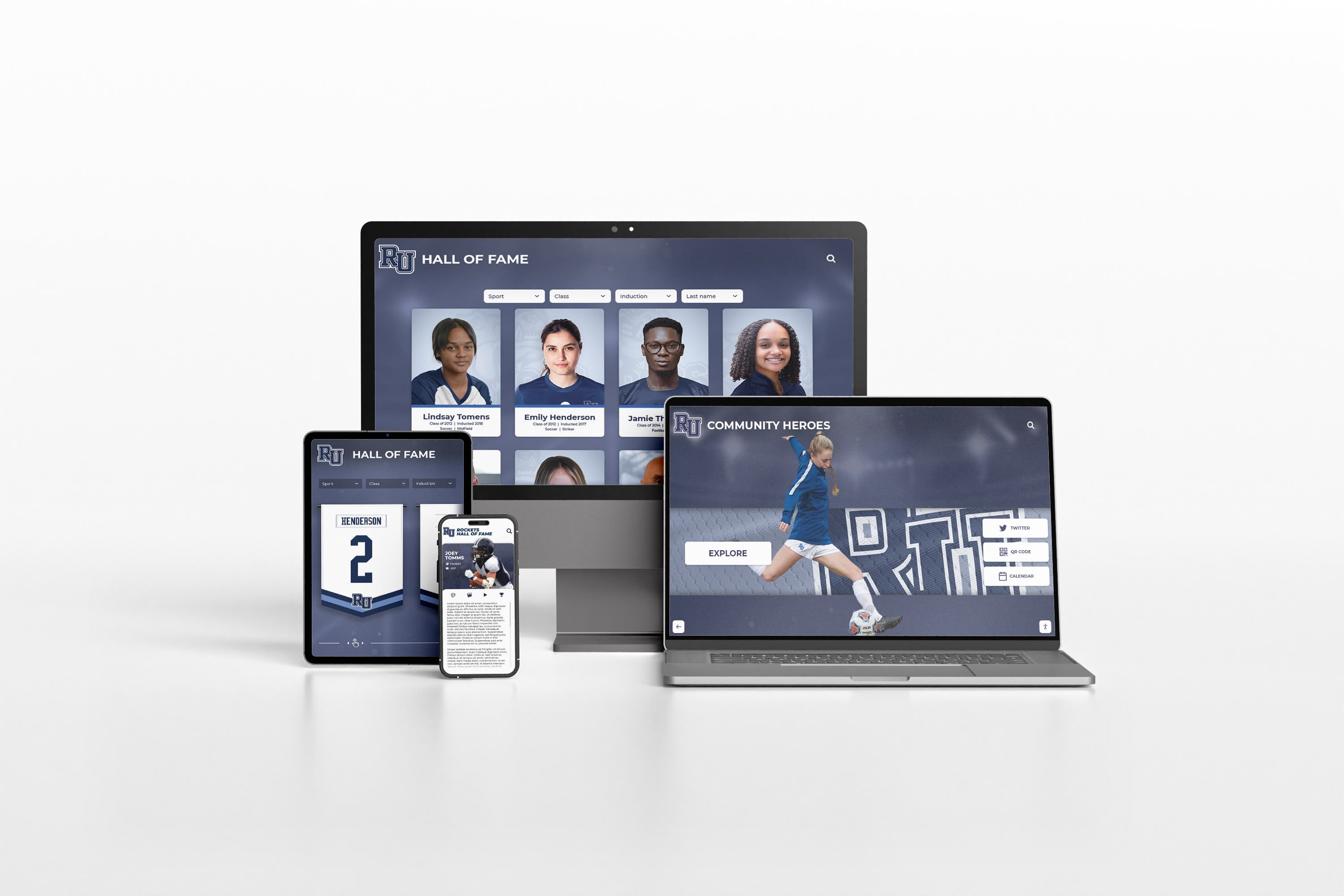
A recognition platform accessible across web and touchscreen requires that every displayed asset carry documented clearance—device and platform proliferation increases, not decreases, the rights compliance obligation
Copy-Paste Hall of Fame Copyright Permission Form
Use this template as the basis for each media category. Adapt language with your institution’s legal counsel before use.
HALL OF FAME MEDIA REUSE PERMISSION FORM [School/Program Name] Hall of Fame
Section 1 — Rights Holder Information
Name of rights holder: ___________________________ Organization (if applicable): ___________________________ Mailing address: ___________________________ Email address: ___________________________ Telephone: ___________________________ Relationship to the asset (e.g., photographer, publisher, production company): ___________________________
Section 2 — Asset Description
Description of asset (title, date, subject, unique identifier if available): ___________________________ Media type (select one): ☐ Photograph ☐ Game program/publication ☐ Newspaper/magazine article ☐ Video/film footage ☐ Other: ___________________________ Original publication or creation date (if known): ___________________________
Section 3 — Authorized Uses
I, the undersigned rights holder, grant [School/Program Name] a non-exclusive license to reproduce, display, and distribute the asset described above for the following purposes (select all that apply):
☐ Digital touchscreen display within school facilities ☐ Public-facing website or online inductee profile ☐ Hall of fame printed materials (ceremony programs, brochures) ☐ Social media posts on school-owned accounts ☐ Digital signage visible to school visitors and alumni
Section 4 — License Term
☐ Perpetual (no expiration) ☐ Term-limited: expires on _______________ (date)
Section 5 — Compensation
☐ No compensation required ☐ Compensation agreed upon separately (attach written agreement)
Section 6 — Warranty and Representation
The undersigned represents and warrants that they are the holder of the rights described above, that granting this permission does not violate any agreement with a third party, and that no additional permissions are required from any other party for the authorized uses identified in Section 3.
Signature: ___________________________ Date: _______________ Printed name: ___________________________ Title (if signing on behalf of an organization): ___________________________
INDUCTEE LIKENESS AND BIOGRAPHICAL CONTENT RELEASE [School/Program Name] Hall of Fame
I, [Inductee Name], grant [School/Program Name] a non-exclusive, perpetual license to use my name, likeness, photograph, biographical information, and career statistics in connection with my recognition in the [School/Program Name] Hall of Fame, including but not limited to:
☐ Digital touchscreen display within school facilities ☐ Public-facing website or online inductee profile ☐ Hall of fame printed materials (ceremony programs, brochures) ☐ Social media posts on school-owned accounts ☐ Digital signage visible to school visitors and alumni
This release covers photographs provided by me or collected by the committee on my behalf, as well as biographical content I have reviewed and approved.
Signature: ___________________________ Date: _______________ Printed name: ___________________________
Pre-Publication Rights Clearance Checklist
Use this checklist before publishing any inductee profile to a digital display or public website.
For Each Inductee Profile
- Signed inductee likeness and biographical content release on file
- Every photograph in the profile has a completed permission form linked in the CMS
- Source of each photograph documented (school archive, inductee-provided, newspaper, photographer)
- Rights holder identified for every photograph where copyright is held by a party other than the school
For Photographs
- Rights holder contact made; permission form returned and signed
- Authorized uses on the signed form match the actual intended display contexts
- Photographs where rights holders could not be identified reviewed by legal counsel before publication
For Game Programs and Publication Scans
- Publisher of original program or yearbook identified
- Written authorization obtained from current rights holder covering the specific pages to be reproduced
- Photographs within scanned pages evaluated separately if they were taken by a third-party photographer
For Newspaper and Magazine Articles
- Publication rights department contacted; response documented
- Written authorization obtained specifying the article and the display contexts covered
- Full-text reproduction confirmed to be within the scope of the license (excerpts, fair use, or full license)
For Video Footage
- Rights holder of footage identified and contacted
- Music clearance status confirmed for any video containing copyrighted audio
- Subject release obtained for any individual featured prominently in the footage
- Video upload blocked from CMS until all clearances confirmed
Before Profile Goes Live
- Archivist confirms all assets have completed clearance forms
- Chair or designated approver signs off on pre-publication review
- Clearance documentation exported to institutional storage alongside the media asset backup
- Profile publication scheduled simultaneously with official announcement
Frequently Asked Questions
Does a school own copyright in photographs taken by its staff photographers?
Generally, yes—if the photograph was taken by a school employee acting within the scope of their employment, the school typically holds the copyright as a work made for hire under U.S. copyright law. However, “work made for hire” analysis depends on the specific employment relationship and applicable state law. If a photograph was taken by a contractor, a parent volunteer, or a student, the analysis changes. When in doubt, obtain a signed release from the individual who took the photograph regardless of the underlying ownership analysis. A signed release costs nothing to collect and eliminates ambiguity.
An inductee provided a photograph from their personal collection. Do we need a separate permission form?
Yes. Providing a photograph and owning the copyright to that photograph are different things. An inductee may have a print or a scan of a photograph without holding the reproduction rights. Ask who took the photograph. If it was taken by a professional photographer—a school photographer, a newspaper staff photographer, or a sports photographer hired for the game—rights clearance must come from that photographer or their current representative. Collect the inductee’s likeness release separately as a matter of course, but use it to cover the inductee’s permission to use their name, likeness, and biographical content—not to authorize a third party’s photograph.
Our school wants to use a newspaper article from 1992. The newspaper no longer exists. Who holds the rights?
When a newspaper ceases operations, its assets—including its copyright portfolio—are typically acquired by a successor entity, sold to a media company, or distributed through bankruptcy proceedings. Research the paper’s corporate history to identify who currently holds its intellectual property. Regional newspaper archives and state press associations sometimes have records of publication acquisitions. If no successor can be identified after a reasonable search, the situation becomes an “orphan works” problem—the rights exist but the holder cannot be found. Consult your institution’s legal counsel for guidance on how to proceed, as the applicable risk analysis depends on jurisdiction and the specific intended use.
Is it enough to credit the photographer rather than getting written permission?
No. Attribution and permission are separate requirements. Copyright law does not create an exception for unauthorized use simply because the original creator is credited. A credit line acknowledges the source; it does not constitute authorization to reproduce the work. Collect a signed permission form and display attribution—do not treat one as a substitute for the other.
Do we need to renew photo permissions when we upgrade our display platform?
It depends on the license language. A permission form that grants a “perpetual, non-exclusive license for digital display” generally covers migration to a new platform because the authorized use—digital display—continues. A permission form that grants use on a specific platform or system may not cover migration. Review the scope language on each permission form when planning a platform upgrade. For narrowly scoped permissions, contact the rights holder for confirmation or an updated license before migrating the asset.
Can we use brief excerpts from newspaper articles without permission under fair use?
Fair use is a nuanced legal doctrine that depends on the purpose, nature, amount, and market impact of the use. Brief quotations used for commentary or identification may qualify; reproducing a full article does not. Educational and non-commercial contexts weigh in favor of fair use, but non-commercial use alone does not guarantee it. Given that hall of fame profiles often live on public-facing websites that also serve promotional purposes for the institution, the fair use analysis is not straightforward. Consult legal counsel before relying on fair use for reproduction in a hall of fame context—a rights holder communication requesting authorization is a far more defensible approach than an unsupported fair use assumption.
What happens if we publish media without a permission form and receive a takedown demand?
Remove the content immediately and respond to the demand through your institution’s legal counsel. Keep a complete record of the demand, the content at issue, the date it was removed, and all correspondence. In most cases, removing the content promptly and demonstrating good faith by responding through counsel resolves the immediate dispute. Going forward, implement the clearance workflow in this guide before uploading any additional archival media. Programs that have dealt with rights disputes consistently report that documented permissions—even imperfect ones—provide substantially more leverage than published content with no clearance trail at all.
Protect Every Profile with Documented Permissions
A hall of fame copyright permission form is not a bureaucratic obstacle—it is the document that makes a school’s recognition program defensible. Every photograph, program scan, newspaper article, and video clip displayed without documented clearance is a rights exposure that exists indefinitely as long as the content remains published.
The four-form framework in this guide—photo permission, publication authorization, article license, and video clearance—covers the rights landscape that most school committees will encounter when building or modernizing a recognition program. Pair it with the inductee likeness release and the pre-publication checklist, and a committee can move from unmanaged archive to documented display without needing to build a rights-clearance operation from scratch.
Committees evaluating how leading hall of fame tools compare on rights management and publishing controls will find that platforms with linked clearance documentation, role-based publishing, and annual export capabilities reduce the ongoing administrative burden substantially. For programs assessing data integrity and documentation practices in digital hall of fame implementations, rights clearance documentation is a central part of what makes a program’s published content trustworthy.
Request your free custom demo to see how Rocket Alumni Solutions supports rights-clearance tracking, linked permission documentation, role-based publishing controls, and cloud-backed archives that keep every asset connected to its authorization—so your committee’s recognition program stays defensible from launch through every platform upgrade.
Live Example: Rocket Alumni Solutions Touchscreen Display
Interact with a live example (16:9 scaled 1920x1080 display). All content is automatically responsive to all screen sizes and orientations.