Hall of Fame Application: What Schools Should Collect Before Reviewing Nominees
- Home /
- Digital Hall of Fame Insights & Resources /
- Hall of Fame Application: What Schools Should Collect Before Reviewing Nominees
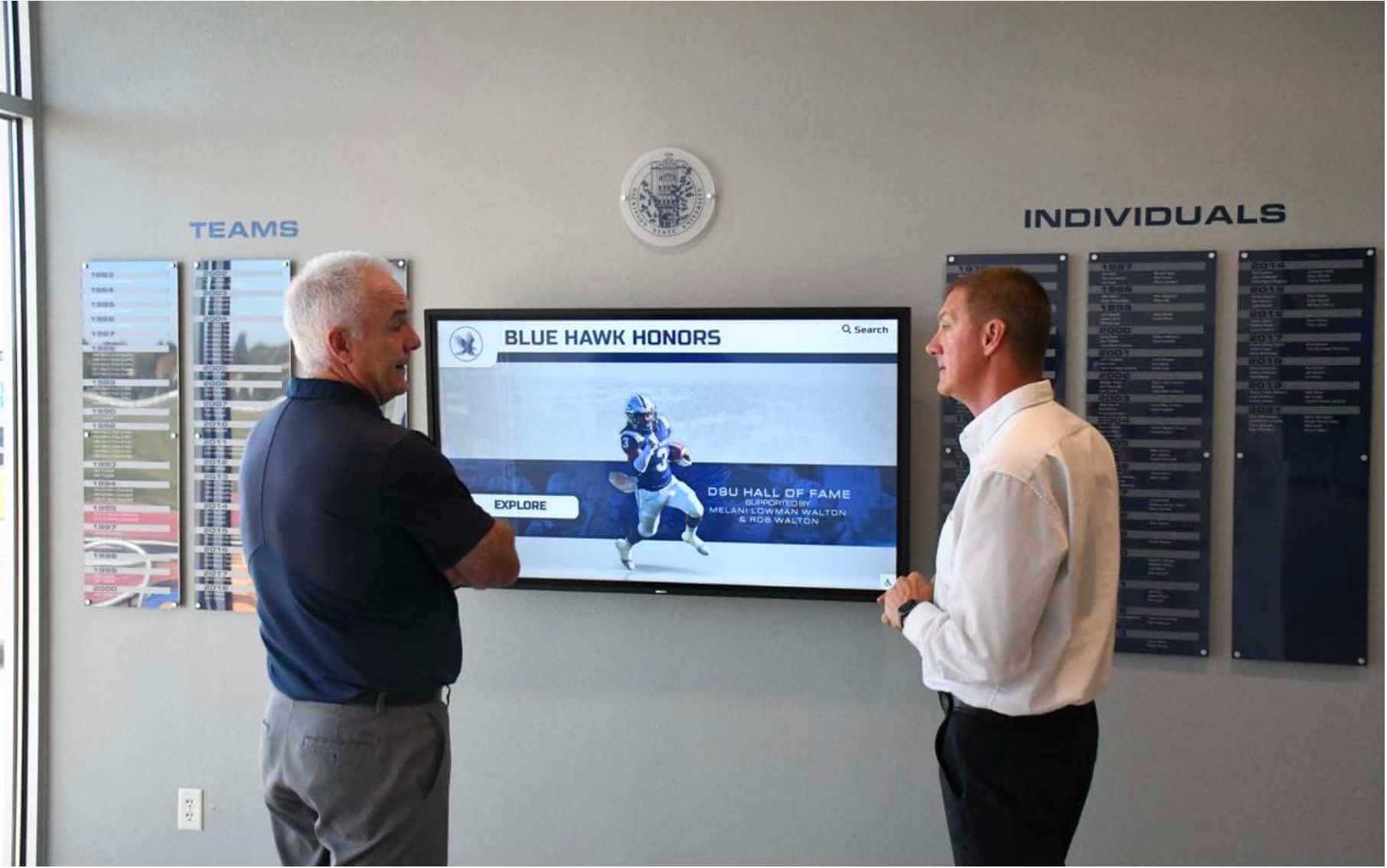
The Easiest Touchscreen Solution




Live Example: Rocket Alumni Solutions Touchscreen Display
Interact with a live example (16:9 scaled 1920x1080 display). All content is automatically responsive to all screen sizes and orientations.
A complete hall of fame application packet should include eight items: a completed submission form with basic identifying information, a career achievement summary, verifiable statistics or records, character and service documentation, two to three letters of support, a high-resolution photograph, nominee contact information, and official eligibility verification. Committees that collect all eight materials before opening review sessions reduce incomplete-packet adjournments, protect against disputed decisions, and build the digital profile assets the inductee display will need at induction.
Most selection problems trace back to a single root cause: the committee began evaluating nominees before the application packet was complete. A nominee with a compelling achievement summary but no supporting statistics, or strong letters but no eligibility documentation, forces the committee to either delay the review or make a decision with incomplete evidence. Standardizing what schools collect—and enforcing a completeness check before review opens—is the most practical improvement any hall of fame committee can make to its annual process.
Schools that run effective hall of fame programs treat the application packet as a formal document with defined fields, not a loose collection of whatever the nominator chose to submit. The packet serves two purposes simultaneously: it gives the committee the evidence it needs to evaluate the nominee fairly, and it provides the raw material the recognition display team will need if the nominee is inducted. Collecting for both purposes from the start eliminates a second round of information gathering after selection decisions are made.

Review committees that require complete application packets before opening deliberations make faster, better-documented decisions—and arrive at induction day with display-ready profiles already assembled
Why Application Completeness Determines Committee Quality
Selection committees are only as credible as the evidence they review. When one nominee arrives with a detailed statistical record, three letters from coaches, and a verified eligibility history, while another arrives with a one-paragraph summary and a single letter from a parent, the committee cannot evaluate the two candidates on equal terms. The stronger application often wins not because the underlying achievement was superior, but because the documentation made a more compelling case.
Establishing a required application standard levels that playing field. It also protects the committee: when a decision is later questioned, the school can point to a complete, consistent packet for every candidate reviewed rather than defending a judgment that rested on uneven evidence.
A well-structured hall of fame application also shortens review sessions. Committees that must chase down missing statistics, request additional letters, or defer nominees due to eligibility questions spend meeting time on administration instead of evaluation. Schools that enforce a completeness gate before review opens typically cut session time by a third while improving the documentation behind every final decision.
For a broader look at how application standards fit within a full recognition program framework, the Athletic Hall of Fame complete guide for school administrators covers committee structure, eligibility development, and selection procedures end to end.
The Eight Required Materials in a Complete Hall of Fame Application
Every school’s hall of fame application checklist will reflect its specific program—whether it honors athletes, alumni, coaches, contributors, or all four. The eight categories below apply across all recognition types and provide a standard that any school committee can adapt.
1. Submission Form (Identifying Information)
The application begins with a structured form that captures basic facts: nominee’s full name, preferred name or nickname if different, graduation year or years of affiliation, primary sport or program category, and the name and contact information of the person submitting the nomination. These fields anchor every other document in the packet and establish the basic eligibility question—was this person actually affiliated with this institution during the relevant period?
Fields to include on the submission form:
- Full legal name
- Preferred display name (for trophy, plaque, or digital profile use)
- Graduation year(s) or years of institutional affiliation
- Primary recognition category (athlete, coach, contributor, team)
- Sport or program
- Name and contact information of nominator
- Submission date
The submission form is not the place for achievement narrative—that belongs in the summary document described next. Keep the form to factual, verifiable fields only.
2. Career Achievement Summary
The achievement summary is a 300–600 word written narrative describing why the nominee merits induction. It should be written by the nominator—not the nominee—and should address specific accomplishments rather than general character praise. Effective achievement summaries answer three questions directly: What did this person accomplish? How did those accomplishments compare to peers and predecessors? Why does the legacy matter to the school community?
Summaries that consist primarily of adjectives (“dedicated,” “inspirational,” “beloved”) without specific supporting evidence give the committee very little to evaluate. Summaries that cite specific seasons, records, championships, or contributions give the committee anchors it can verify against other materials in the packet.
The achievement summary also becomes the starting draft for the inductee’s official hall of fame bio if the nominee is selected. Collecting a well-written summary at the application stage eliminates the need to draft from scratch after induction decisions are made.
3. Verifiable Statistics or Records
For athletic nominations, this means documented competitive performance data: win-loss records, scoring statistics, individual event times or distances, championship appearances, all-conference or all-state recognitions, and any school records held. The key word is verifiable—statistics should trace to an identifiable source (yearbook, official program records, newspaper coverage, state athletic association database) that the committee can cross-reference.
For academic or alumni nominations, equivalent evidence might include grade point averages, scholarship awards, professional honors, published work, or institutional recognition records.
Do not accept nominator-provided statistics without a source notation. When statistical evidence is incomplete due to institutional record gaps, note the gap explicitly rather than leaving it blank or estimating. The committee needs to know whether the absence of data reflects an unremarkable record or simply missing archives.
4. Character and Service Documentation
Most school hall of fame programs require nominees to have demonstrated character and service consistent with the institution’s values, not just competitive achievement. This section of the packet is where that evidence lives.
Character and service documentation might include:
- Community service records or volunteer documentation
- Leadership positions held (team captain, student council, program mentor)
- Post-graduation professional or civic contributions
- Academic achievement records (where relevant to the program’s criteria)
- Faculty or administrator character attestations
- Documented conduct record (some programs require a clear record during affiliation)
The committee’s bylaws should specify exactly what this section must contain so that nominators know what to include rather than guessing. Vague guidance (“demonstrate character”) produces inconsistent submissions; specific field requirements (“include documentation of at least one community service commitment of twelve months or longer”) produce comparable evidence across nominees.
5. Letters of Support
Two to three letters from individuals who can speak directly to the nominee’s achievement and character provide the committee with perspectives outside the nominator’s own. Effective letters of support come from coaches, teachers, teammates, administrators, or community figures who had direct knowledge of the nominee during the qualifying period—not from current colleagues or family members who primarily know the nominee’s post-graduation life.
Letters should be addressed to the selection committee, specify the letter-writer’s relationship to the nominee and the relevant time period, and include at least one specific example of the achievement or character being attested. Form letters that could apply to any nominee add nothing to the packet. Letters that describe a specific game, season, moment, or contribution add real evidentiary weight.
Cap the letter requirement at three. Committees that allow unlimited letters see submission packets weighted toward nominees with extensive personal networks rather than nominees with the strongest records.
6. High-Resolution Photograph
A print-quality photograph (minimum 300 dpi, minimum 1,200 × 1,600 pixels) is required in the application packet for two reasons: it allows the committee to identify the nominee, and it provides the display-ready asset the recognition program will need if the nominee is inducted.
Photo requirements to specify:
- Minimum resolution: 300 dpi
- Minimum dimensions: 1,200 × 1,600 pixels
- Format: JPEG or PNG
- Preferred content: action photo from qualifying period, headshot, or both
- Acceptable alternatives: verified historical photo sourced from yearbook, program, or news archive
Specify whether you prefer a photograph from the nominee’s active period, a current headshot, or both. Programs that display both an era photo and a current photo on inductee profiles—a common format on touchscreen hall of fame displays—should request both at the application stage rather than chasing current photos after induction.
7. Nominee Contact Information
Current contact information for the nominee—email address, phone number, and mailing address—is required even when the nomination is being submitted by someone else. The committee or program administrator will need to notify the nominee of selection decisions, request corrections to the draft profile, obtain signature on an induction agreement, and coordinate ceremony logistics.
For deceased nominees, collect contact information for the primary family representative who will serve as the point of contact for induction and display purposes.
8. Eligibility Verification
The final required element is formal documentation confirming that the nominee meets the program’s written eligibility requirements. Depending on your program, this might mean:
- Transcript or enrollment record confirming the nominee attended the institution
- Athletic department records confirming competitive participation
- Staff records confirming years of coaching or administrative service
- Alumni office records confirming graduation status
Eligibility verification is the administrative checkpoint that prevents the committee from investing deliberation time in a nominee who ultimately does not qualify. Build this check into the completeness gate: no packet advances to committee review until eligibility is confirmed by the program administrator.
Complete Application Checklist
Use this table as a completeness gate before opening review. Every field in the “Required” column must be present before the nominee’s packet enters deliberation.
| Application Component | Required | Format | Used For |
|---|---|---|---|
| Submission form (identifying fields) | Yes | School-provided form | Eligibility confirmation, display name, category assignment |
| Career achievement summary | Yes | 300–600 words, written by nominator | Committee evaluation, inductee bio draft |
| Verifiable statistics or records | Yes | Documented with source citations | Comparative evaluation, display profile |
| Character and service documentation | Yes | As specified in bylaws | Character criteria review |
| Letters of support | Yes (2–3) | Addressed to committee, signed | Corroborating evidence |
| High-resolution photograph | Yes | 300 dpi minimum, JPEG or PNG | Display profile, ceremony program |
| Nominee contact information | Yes | Email, phone, address | Notification, profile review, ceremony coordination |
| Eligibility verification | Yes | Institutional record or attestation | Eligibility gate before review |
| Additional media (video, news coverage) | Optional | Link or digital file | Display enrichment |
| Historical artifacts or memorabilia | Optional | Description and availability | Physical display or archive |
Supporting Evidence: What Strengthens a Packet Beyond the Minimum
Meeting the eight required fields is the floor, not the ceiling. Packets that include well-documented supplementary evidence give the committee more to work with and tend to produce inductee profiles that are richer and more compelling on display.
News Coverage and Media Archives
Newspaper articles, broadcast clips, and yearbook coverage from the nominee’s active period provide third-party documentation that is more credible than nominator claims alone. Links to digitized newspaper archives or scanned clippings from school archives belong in the packet as supplementary materials—not as a substitute for the achievement summary and statistics, but as corroboration.
Video Documentation
For athletic nominees, game footage, highlight clips, or ceremony recordings add depth that statistics alone cannot convey. Most programs do not require video, but accepting it as optional encourages nominators to include it when it exists. On digital displays, embedded video significantly increases visitor dwell time and engagement with inductee profiles. Touchscreen hall of fame displays built for schools and universities handle video natively, making this asset immediately usable after induction.
Historical Artifacts and Memorabilia
Some inductees have physical artifacts associated with their recognition period—championship trophies, game equipment, programs, jerseys, or awards. These belong in the supporting evidence section as an availability note rather than a required submission (you cannot require someone to mail a trophy). If artifacts exist and the nominee is willing to loan or donate them to the school’s archive or display, document that arrangement in writing as part of the induction process.
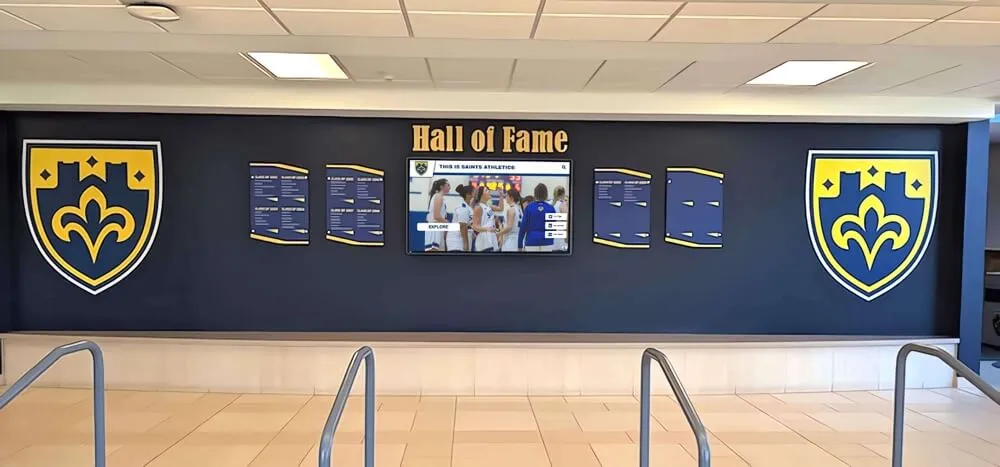
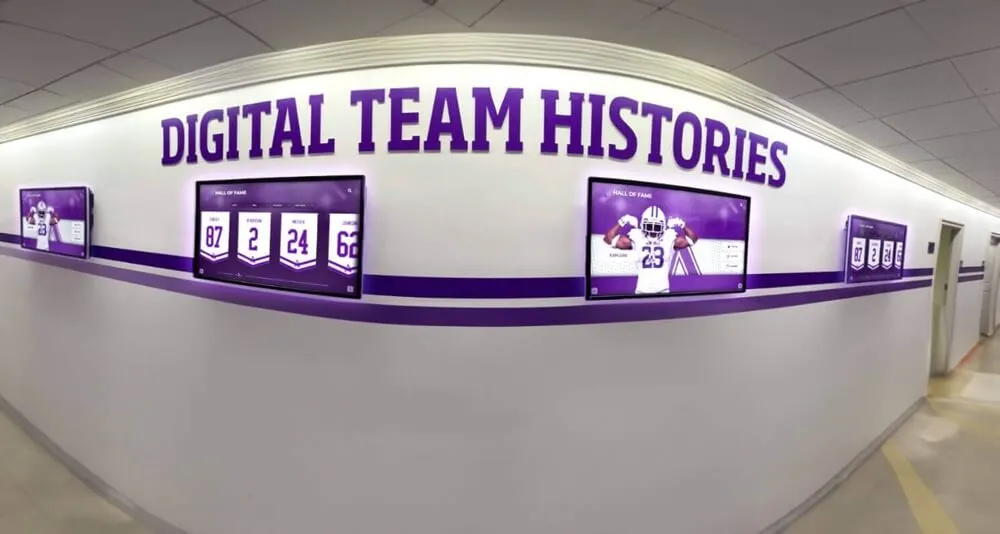
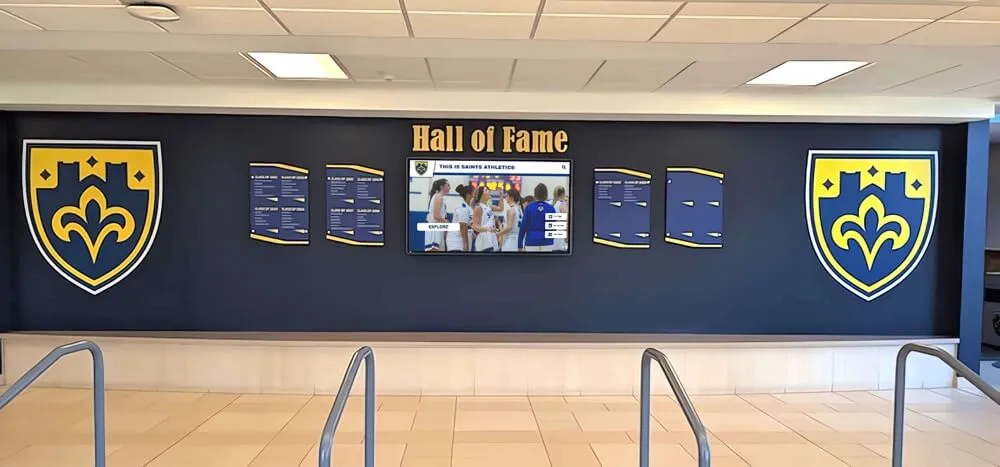
Every shield or profile panel on a hall of fame display should correspond to a complete application packet in the program's archives—the packet is the permanent record behind the recognition
Photo and Media Requirements: Preparing Assets for Display
The photograph requirement deserves more attention than most schools give it at the application stage. Committees that collect only a social media screenshot or a low-resolution scan from a forty-year-old yearbook will face a production problem at induction: a digital or printed display that looks inconsistent because the technical quality of assets varies widely across inductees.
Set photo standards in writing before the first application cycle opens:
Resolution: Minimum 300 dpi for print, minimum 1,200 × 1,600 pixels for digital display. This excludes most social media screenshots, which are optimized for screen viewing at 72–96 dpi and will appear pixelated when enlarged for a display panel.
Orientation: Specify whether your display uses portrait or landscape orientation so nominators know which to provide. Most inductee profile cards use portrait orientation.
Content guidelines: For active-period photos, action shots and posed team photos are both acceptable. For current headshots, a plain or neutral background with the subject clearly in frame is standard. Avoid group photos cropped to isolate the nominee—quality degrades when a face is cropped from a team photo taken at distance.
Historical photos: For nominees inducted long after their active period, high-quality historical photos may not exist in digital form. Accept scanned originals and note the resolution limit in advance; most committees allow an exception for documented historical nominees when original digital assets genuinely do not exist.
For schools building or expanding digital recognition displays, photo quality standards set at the application stage pay dividends across every future induction class—every profile that goes on the display will meet the same minimum standard from the start.
Organizing the Review-Ready Packet
Once all eight required materials have been collected and the eligibility check has been confirmed, the program administrator should organize the packet into a consistent format before distributing it to committee members. Reviewers who receive packets organized identically for every nominee can move through comparative review more efficiently than those receiving ad hoc submissions in varying formats.
A standard packet order:
- Submission form (cover page)
- Eligibility verification confirmation
- Career achievement summary
- Statistics and records with source citations
- Letters of support (alphabetical by author last name)
- Character and service documentation
- Photograph(s) — thumbnail in packet, full resolution filed separately
- Nominee contact information (committee chair only, not distributed to full committee)
- Supplementary materials, if any
Distribute the packet digitally where possible—a shared drive folder per nominee, or a review tool that tracks which committee members have accessed each packet. Paper distribution is harder to audit and creates version-control problems when materials are updated between distribution and the review session.
From Application Packet to Induction Display
The application packet’s second function—providing raw material for the induction display—becomes relevant immediately after selection decisions are made. Schools that have collected complete, display-ready materials in the application can move directly to profile production. Schools that collected only evaluation evidence must go back to inductees for photos, updated contact information, and additional narrative detail.
The achievement summary submitted at application becomes the first draft of the inductee’s official bio. The high-resolution photograph goes directly to the display team. The statistics and records populate the profile data fields. Letters of support provide quotable material for the ceremony program and display caption.
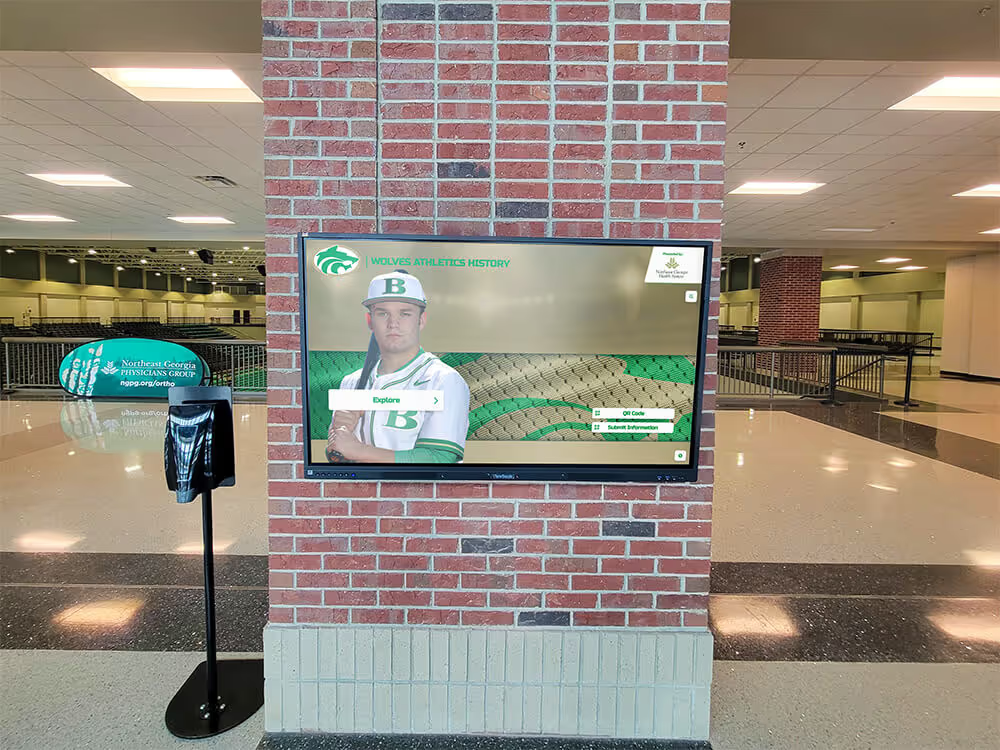
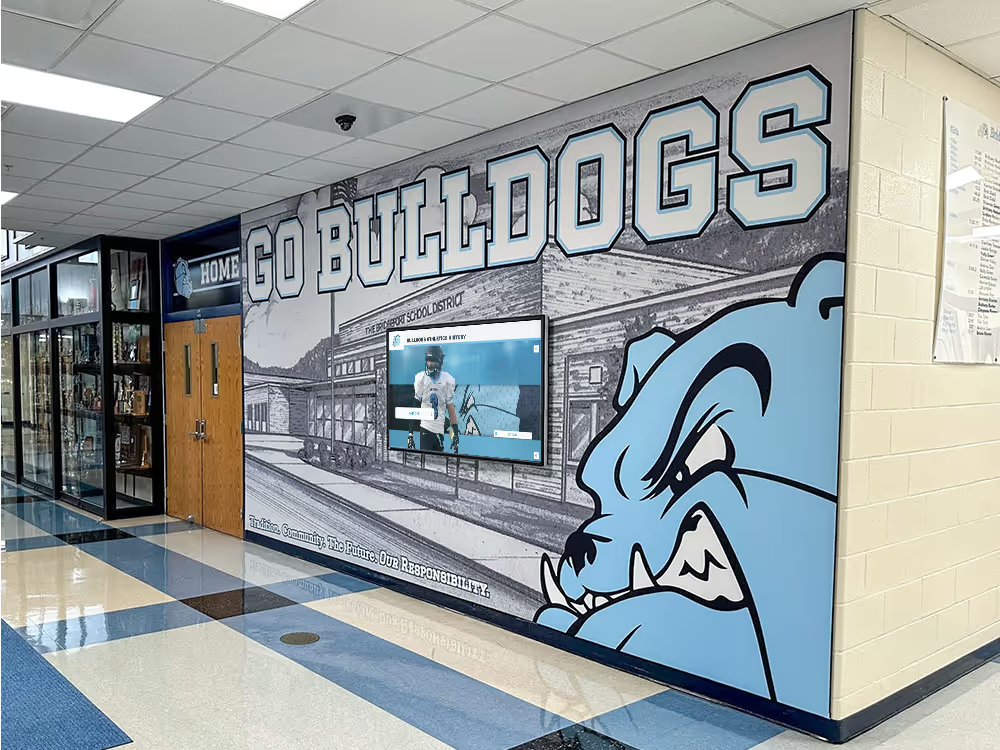
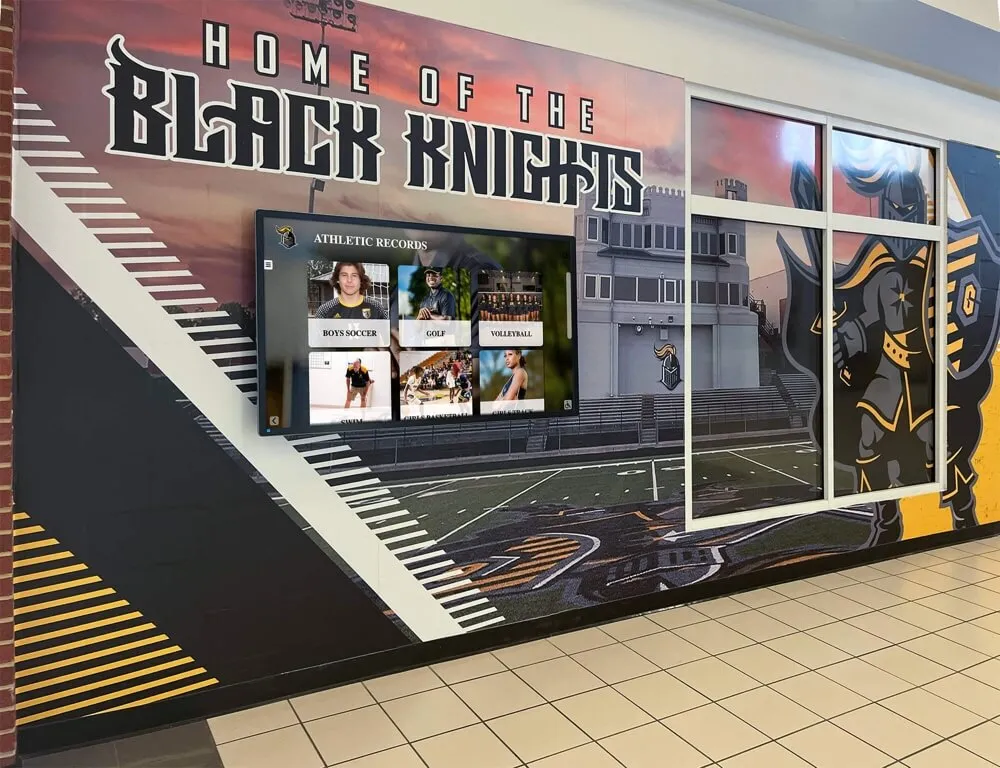
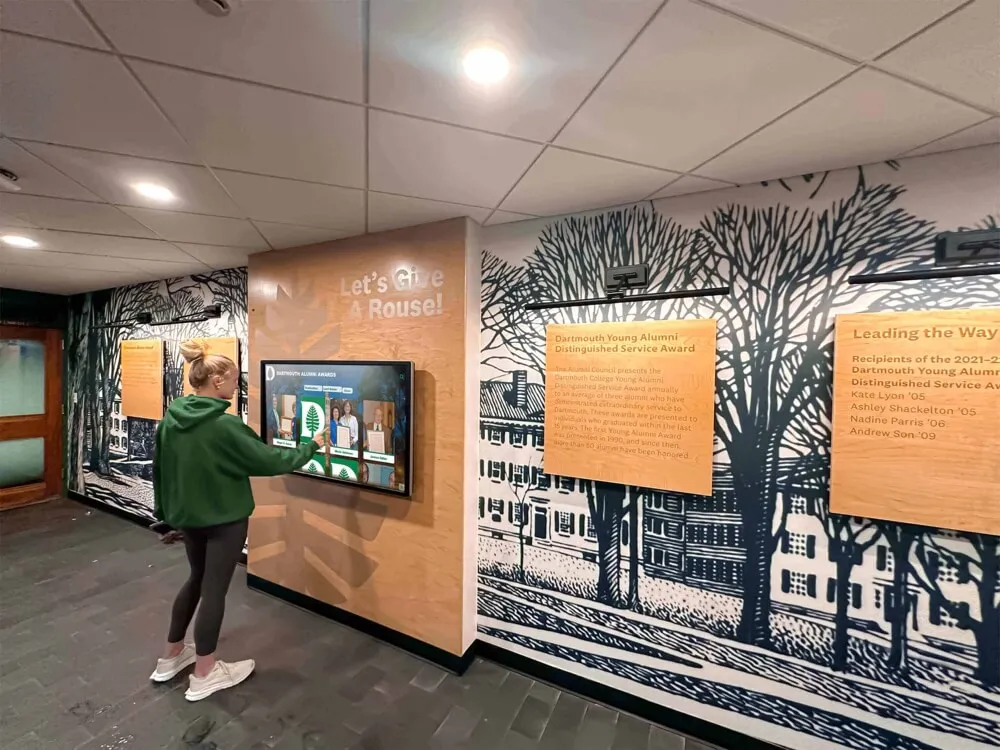
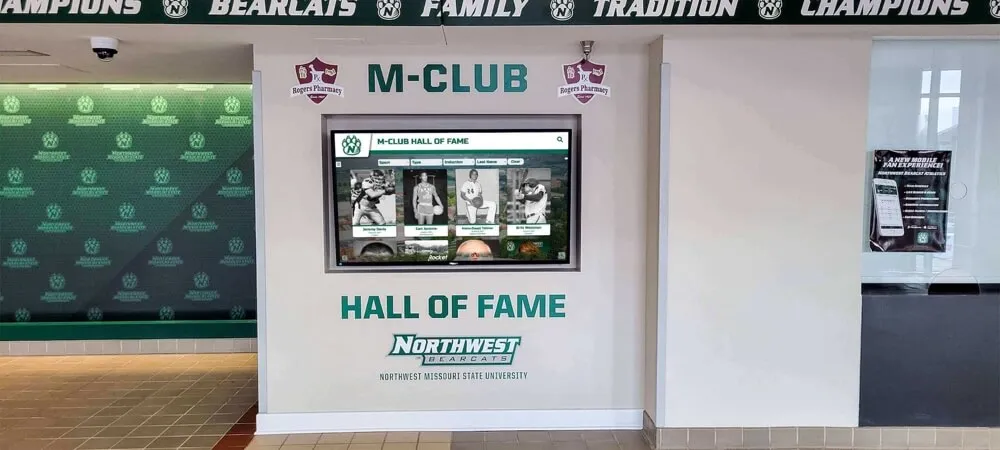
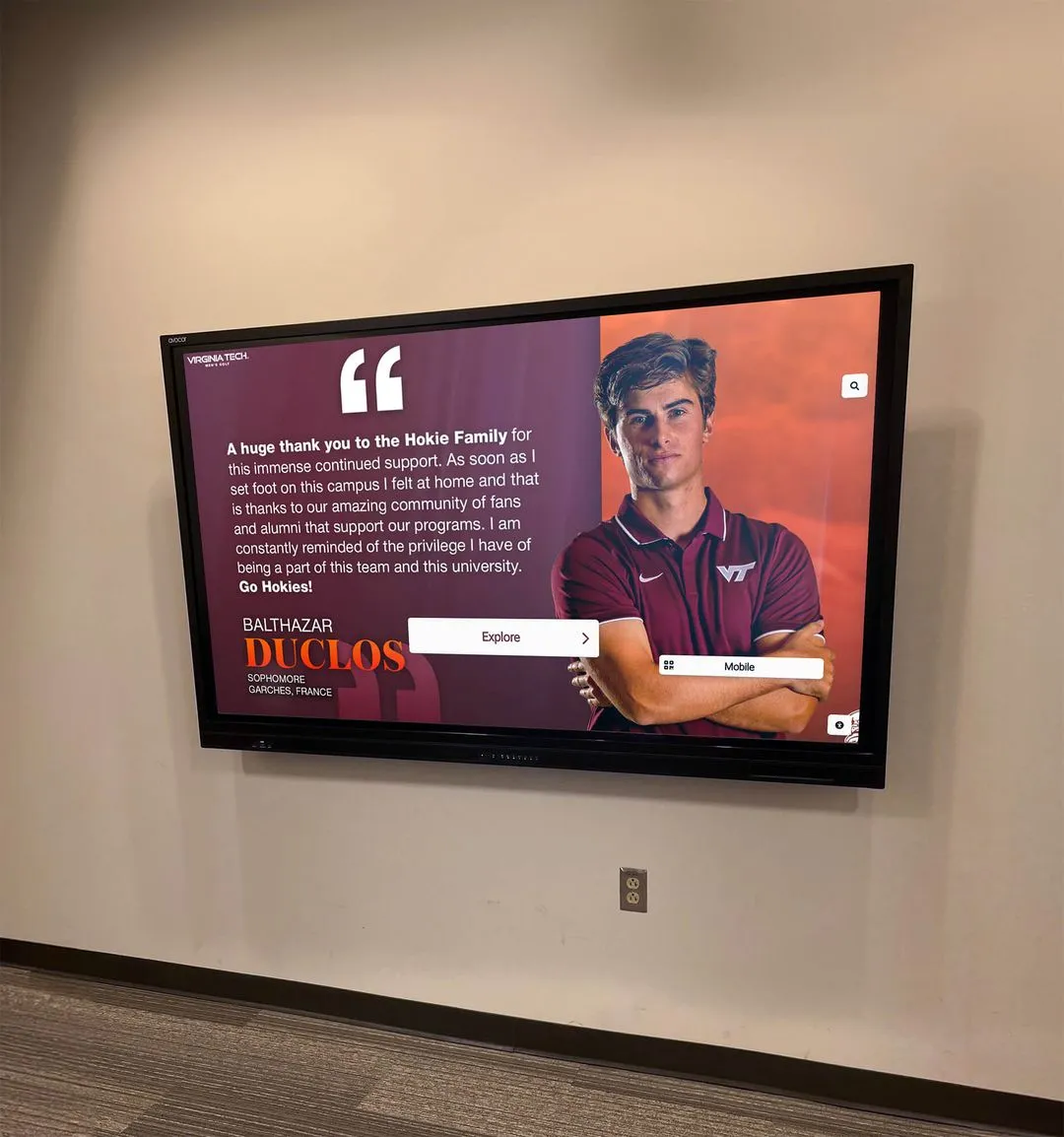
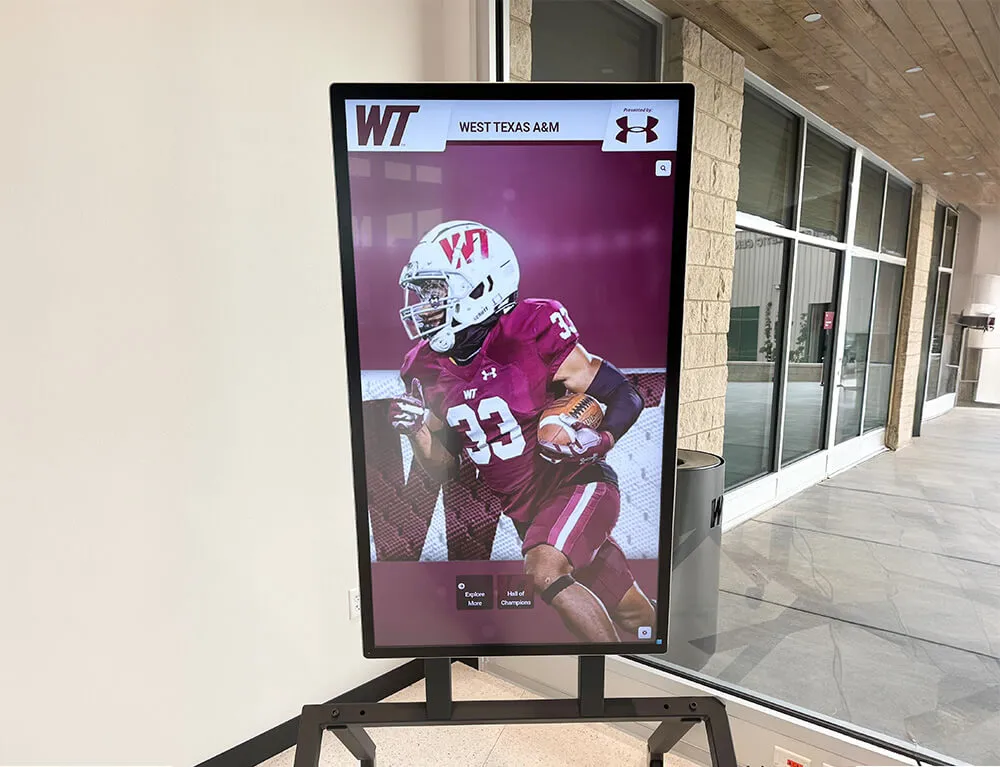
For programs using touchscreen hall of fame displays, this handoff from application to display is particularly clean when the packet was collected with display requirements in mind from the start. Profile fields on the display—name, category, years of affiliation, achievement summary, statistics, photo, and optional video—map directly to the eight required application materials. No second collection round. No delays between induction decisions and display publishing.
If your school is planning award ceremonies that formally mark induction, the application packet also provides the source material for speeches, ceremony programs, and press releases. When the achievement summary is well-written and the statistics are verified at application, the ceremony preparation workload shrinks considerably.
Applying These Standards to Different Recognition Categories
The eight-field framework applies across all major school recognition categories, with category-specific adjustments.
Athletic Hall of Fame: Statistics and records are the primary evidence. Prioritize documented competitive performance data, championship records, and comparative benchmarks. Letters from former coaches and athletic directors carry the most weight.
Alumni Hall of Fame: Post-graduation professional and civic achievement becomes the primary evidence. Equivalent documentation includes professional awards, publications, organizational leadership records, and community impact attestations. Letters from professional peers and community figures are more relevant than letters from former teachers.
Coaches and Contributors: Service duration and program impact replace individual performance statistics. Document number of seasons, win-loss records, program-building achievements, and institutional service contributions. Letters from former athletes and administrative colleagues are particularly valuable.
Whether honoring athletes, alumni, or contributors, the application packet standard remains the same—what changes is which evidence type carries the most weight for each category
Connecting Application Standards to Long-Term Program Health
A standardized application packet does something beyond improving individual review sessions: it creates a consistent archive for the program. Every nominee who advances to committee review—whether inducted or not—has a complete, identically structured packet on file. That archive answers questions that arise years later: Why was this nominee passed over in 2019? What evidence supported the 2016 induction class? What was the original statistical record cited for a nominee whose achievements were later disputed?
Programs without consistent archives are vulnerable to institutional memory loss when committee membership changes. Programs with complete, well-organized application archives can onboard new committee members efficiently, demonstrate program integrity to outside stakeholders, and maintain consistent standards across decades of induction cycles.
Building that archive starts with the application packet. Schools that invest in a clear, required checklist and a completeness gate before review opens will find that the habit compounds over time—each induction cycle adding to a credible, well-documented recognition record that serves the institution long after any individual committee member has rotated off.
For schools exploring the intersection of application processes and recognition display technology, how colleges and schools build long-term athletic recognition programs offers perspective on how display systems and program governance reinforce each other over time.
Frequently Asked Questions About Hall of Fame Applications
How long should the hall of fame application window stay open each year?
Most school programs run a six-to-ten week submission window. Six weeks gives motivated nominators enough time to gather supporting materials, while ten weeks is long enough to accommodate nominators who need time to collect historical documentation for older nominees. Shorter windows produce incomplete packets; longer windows tend to produce last-minute submissions that still arrive incomplete. Set a hard deadline with no exceptions—late submissions create fairness questions and administrative pressure to bend the rules for connected nominators.
Should nominees know they have been nominated before the committee reviews?
Most school programs require or strongly recommend notifying nominees before the review session. The main practical reason: some required materials—current contact information, a high-resolution photograph, and any corrective input on the achievement summary—must come from the nominee or their family, and you cannot collect these without making contact. Notification also allows the nominee to withdraw if personal or institutional circumstances make induction inappropriate at that time. Some programs notify nominees only after selection, but this creates an awkward dynamic when the committee needs additional materials before it can complete the packet.
What should a committee do when a nominated packet is incomplete at the deadline?
Return it with a clear explanation of what is missing and offer one short extension window—typically two additional weeks—for the nominator to supply missing materials. If the packet remains incomplete after the extension, defer the nomination to the next cycle rather than reviewing it as-is. One accommodation is reasonable; allowing perpetually incomplete packets to advance compromises the standard for everyone. The program bylaws should spell out the incomplete-packet policy explicitly so nominators know what to expect before they submit.
How should a school handle nominations for deceased nominees?
The application process for deceased nominees follows the same eight-field structure, with the nominator or a designated family representative supplying materials that the nominee cannot provide directly. Contact information in this case is for the family representative rather than the nominee. The achievement summary should note the nominee’s death date. Photo and media materials may need to come from family archives or institutional records. For historical nominees from the institution’s early decades, some gaps in documentation are expected and should be acknowledged in the packet rather than glossed over.
Can a nominee resubmit if the committee does not select them?
Yes, and most programs explicitly allow resubmission in subsequent cycles. Build a resubmission policy into your bylaws that specifies the waiting period (one cycle is standard), whether the original packet can be updated or must be resubmitted fresh, and how many times a nominee may be reconsidered before the program considers the record closed. Allowing nominees to strengthen their applications across cycles improves the quality of evidence the committee eventually reviews and prevents qualified nominees from being permanently excluded due to a weak first submission.
Take Your Application Straight to the Display
Rocket Alumni Solutions builds interactive touchscreen hall of fame systems for schools, universities, and athletic programs—with cloud-based profile management that maps directly to the application materials you collect. Complete a well-structured packet once; publish a polished inductee profile without a second round of gathering. See what a full digital recognition system looks like for your institution.
Request Your Free Custom DemoLive Example: Rocket Alumni Solutions Touchscreen Display
Interact with a live example (16:9 scaled 1920x1080 display). All content is automatically responsive to all screen sizes and orientations.