Cum Laude Graduation Requirements: GPA Thresholds at Every Level
- Home /
- Digital Hall of Fame Insights & Resources /
- Cum Laude Graduation Requirements: GPA Thresholds at Every Level

The Easiest Touchscreen Solution




Live Example: Rocket Alumni Solutions Touchscreen Display
Interact with a live example (16:9 scaled 1920x1080 display). All content is automatically responsive to all screen sizes and orientations.
Cum laude graduation requirements represent academic achievement thresholds that distinguish exceptional students through Latin honors recognition at graduation ceremonies nationwide. Students pursuing these prestigious designations—cum laude, magna cum laude, and summa cum laude—earn recognition that appears on diplomas, transcripts, and academic records, signaling to employers and graduate programs that they maintained superior academic performance throughout their educational journey.
Understanding precise GPA requirements for Latin honors proves challenging because thresholds vary significantly across institutions, educational levels, and even academic departments within the same school. A 3.5 GPA might earn cum laude recognition at one university while falling short at another institution with more stringent standards. High schools increasingly adopt Latin honors systems previously reserved for colleges, creating additional variability in requirements and recognition practices.
This comprehensive guide explains cum laude graduation requirements across educational levels, clarifies how institutions establish GPA thresholds for each Latin honors tier, explores strategies students can employ to achieve these distinctions, and examines how modern recognition systems celebrate Latin honors recipients in ways that create lasting visibility for academic achievement.
Latin honors recognition provides meaningful acknowledgment for students who demonstrate sustained academic excellence throughout their educational careers. These distinctions matter because they create tangible differentiation among graduates, appear prominently on credentials reviewed by admissions committees and employers, and establish clear achievement goals motivating students toward consistent high performance across coursework.

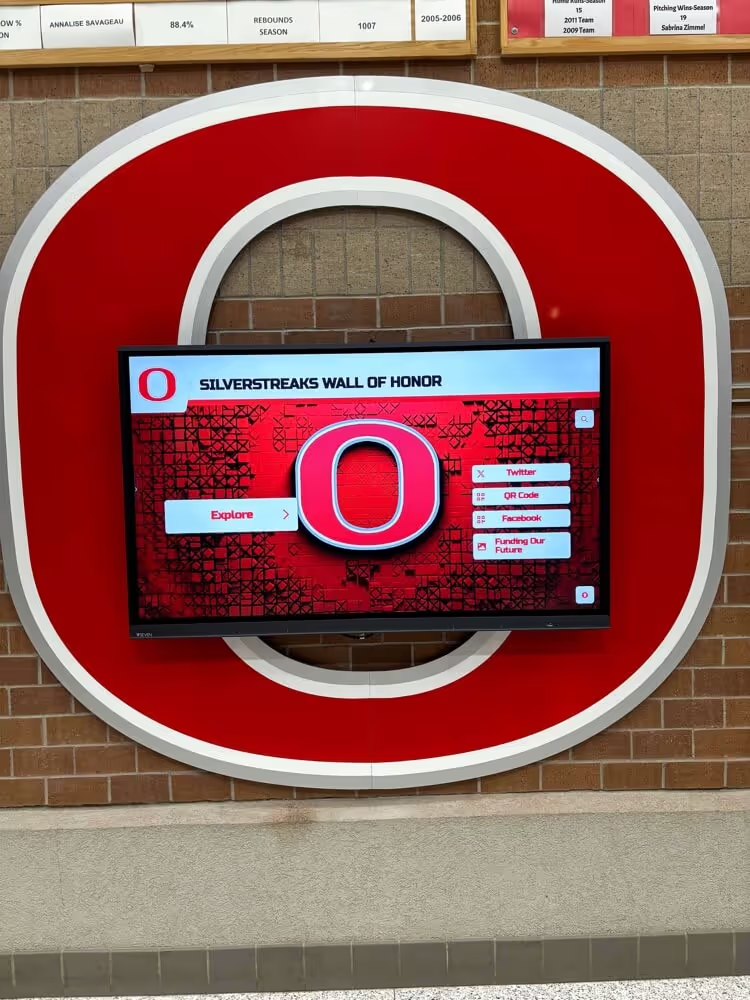
Modern academic recognition displays make Latin honors achievements visible throughout educational communities
Understanding Latin Honors: The Three Tiers
Before examining specific GPA requirements, understanding the three levels of Latin honors and their traditional meanings helps contextualize achievement thresholds.
Cum Laude: “With Distinction”
Cum laude represents the foundational tier of Latin honors, recognizing graduates who achieved notably higher academic performance than typical students but fall below the thresholds for higher honors designations.
Common Cum Laude Characteristics
This entry-level Latin honor typically acknowledges students in approximately the top 20-30% of their graduating class academically. Most institutions establish cum laude GPA thresholds between 3.5-3.69 on a 4.0 scale, though significant variation exists across schools.
Students earning cum laude recognition demonstrated consistent academic competence with primarily A and B grades throughout their programs, maintained performance standards above average peers, completed degree requirements while achieving superior cumulative GPAs, and balanced academic achievement with other commitments and activities.
Magna Cum Laude: “With Great Distinction”
Magna cum laude represents mid-tier Latin honors recognizing substantially higher academic achievement than cum laude while remaining below the highest honors threshold.
Common Magna Cum Laude Characteristics
This intermediate honor typically acknowledges students in approximately the top 10-15% of graduating classes. Most institutions set magna cum laude GPA requirements between 3.7-3.89 on 4.0 scales, creating clear distinction from basic cum laude recognition.
Students achieving magna cum laude demonstrated exceptional academic performance with predominantly A grades, sustained high achievement across diverse coursework and requirements, distinguished themselves academically beyond typical high-performing students, and maintained rigorous academic standards throughout degree programs.
Schools implementing comprehensive academic recognition programs discover that celebrating achievements like Latin honors motivates students toward sustained excellence.
Summa Cum Laude: “With Highest Distinction”
Summa cum laude represents the pinnacle of undergraduate Latin honors, reserved for graduates who achieved the highest academic performance levels within their classes.
Common Summa Cum Laude Characteristics
The most exclusive Latin honor typically recognizes only the top 3-5% of graduates. Most institutions establish summa cum laude GPA thresholds between 3.9-4.0 on 4.0 scales, with many requiring perfect or near-perfect GPAs.
Students earning summa cum laude recognition demonstrated outstanding academic excellence across all coursework, maintained near-perfect or perfect cumulative GPAs throughout degree programs, distinguished themselves as the highest academic achievers within graduating classes, and often completed additional honors requirements beyond GPA thresholds alone.

Digital recognition systems enable schools to celebrate individual academic achievements with professional presentation
High School Latin Honors Requirements
While traditionally associated with college graduation, increasing numbers of high schools now award Latin honors to graduating seniors, creating early recognition for academic excellence.
High School Cum Laude GPA Thresholds
High schools adopting Latin honors systems typically establish the following approximate thresholds:
Cum Laude Requirements
- GPA threshold: typically 3.5-3.69 unweighted or 3.7-3.89 weighted
- Class rank: often top 20-30% of graduating class
- May require completion of minimum honors or AP courses
- Sometimes includes minimum standardized test score requirements
- May require good citizenship and attendance records
Magna Cum Laude Requirements
- GPA threshold: typically 3.7-3.89 unweighted or 3.9-4.19 weighted
- Class rank: often top 10-15% of graduating class
- Usually requires multiple advanced placement or honors courses
- May include extracurricular participation requirements
- Often requires recommendation from faculty or administration
Summa Cum Laude Requirements
- GPA threshold: typically 3.9-4.0 unweighted or 4.2+ weighted
- Class rank: often top 3-5% of graduating class
- May require specific number of AP or IB courses
- Sometimes includes capstone project or thesis requirements
- Often reserved for valedictorian and salutatorian candidates
High schools using academic scholarship requirements as benchmarks often align Latin honors thresholds with major scholarship eligibility standards.
Weighted vs. Unweighted GPA Considerations
High schools face decisions regarding whether Latin honors should be calculated using weighted or unweighted GPAs:
Unweighted GPA Approach
- Treats all courses equally on 4.0 scale
- Favors students with perfect or near-perfect grades
- May discourage enrollment in rigorous coursework
- Creates simpler, more transparent standards
- Easier for students to calculate standings
Weighted GPA Approach
- Awards extra points for honors, AP, IB courses
- Encourages students to challenge themselves academically
- May advantage students with access to more advanced offerings
- Creates more complex calculation systems
- Better reflects academic rigor and challenge

Recognition displays showcase academic achievers alongside athletic and alumni accomplishments
Many high schools adopt hybrid approaches where Latin honors require both minimum weighted GPA thresholds and completion of specified numbers of advanced courses, ensuring recognition acknowledges both achievement and academic rigor.
High School Latin Honors Recognition Practices
Schools celebrating Latin honors graduates typically employ several recognition methods:
Graduation Ceremony Recognition
- Distinction announced during diploma presentation
- Special honor cords, medals, or stoles identifying tier
- Separate seating sections for Latin honors graduates
- Recognition in graduation programs and materials
- Special mentions during commencement addresses
Diploma and Transcript Notation
- Latin honors designation printed directly on diplomas
- Permanent notation on official transcripts
- Documentation in student permanent records
- Verification available for college applications
- Recognition in scholarship and award applications
Visual Recognition Systems
- Names displayed on academic honor walls
- Digital displays featuring Latin honors recipients
- Yearbook special sections for honors graduates
- School website recognition pages
- Social media celebration of achievements
Schools implementing digital leaderboards for academic achievement often extend these systems to showcase Latin honors recipients prominently.
College and University Latin Honors Requirements
College-level Latin honors requirements exhibit even greater variability than high school standards, with each institution establishing its own criteria and calculation methods.
Common College Cum Laude GPA Ranges
Most four-year colleges and universities establish Latin honors thresholds within these approximate ranges:
Cum Laude (With Distinction)
- GPA requirement: typically 3.5-3.69 on 4.0 scale
- Percentile: approximately top 20-30% of class
- Credit hours: usually requires minimum completed at institution
- Good standing: may require no academic probation history
- Completion: must fulfill all degree requirements
Magna Cum Laude (With Great Distinction)
- GPA requirement: typically 3.7-3.89 on 4.0 scale
- Percentile: approximately top 10-15% of class
- Credit hours: often requires higher percentage completed at institution
- May require departmental honors or thesis completion
- Sometimes includes comprehensive exam requirements
Summa Cum Laude (With Highest Distinction)
- GPA requirement: typically 3.9-4.0 on 4.0 scale
- Percentile: approximately top 3-5% of class
- Credit hours: may require substantial majority completed at institution
- Often requires thesis, capstone, or honors program completion
- May include faculty nomination requirements

Interactive recognition systems let communities explore academic achievements and celebrate excellence
Institutional Variability in Latin Honors Standards
Individual colleges and universities employ diverse approaches when establishing Latin honors criteria:
Fixed GPA Thresholds
Some institutions establish predetermined GPA cutoffs that remain consistent across graduating classes:
- Provides clarity and predictability for students
- Creates transparent achievement targets
- May result in varying percentages of graduates earning honors
- Simpler to administer and communicate
- Allows students to calculate standing throughout enrollment
Percentile-Based Systems
Other institutions award Latin honors to fixed percentages of each graduating class:
- Top 5% receive summa cum laude regardless of specific GPA
- Next 10% receive magna cum laude
- Next 15% receive cum laude
- Creates consistent honor distribution across classes
- May result in varying GPA thresholds year-to-year
Hybrid Approaches
Many institutions combine minimum GPA requirements with percentile caps:
- Must meet minimum GPA threshold AND fall within class percentage
- Ensures both absolute achievement and comparative distinction
- Prevents grade inflation from expanding honors recipients
- Maintains prestige through selective recognition
- Balances transparency with exclusivity
Departmental and Program-Specific Variations
Beyond university-wide Latin honors, many institutions offer program-specific recognition:
Departmental Honors Programs
Individual academic departments may establish separate honors criteria requiring higher GPAs within major coursework, completion of honors thesis or capstone project, research presentation or publication requirements, faculty committee approval and recommendations, and comprehensive examinations in field of study.
Students can potentially graduate with both university-wide Latin honors based on overall GPA and departmental honors based on major-specific criteria and requirements.
Professional School Distinctions
Professional programs like law, medicine, and business often use different recognition systems:
- Law schools may use different Latin honors or Order of the Coif
- Medical schools may award Alpha Omega Alpha honor society membership
- Business schools may use Beta Gamma Sigma recognition
- Each maintains separate criteria and selection processes
Institutions creating comprehensive academic recognition systems often celebrate these diverse achievement categories through unified display platforms.
How Latin Honors Requirements Are Calculated
Understanding calculation methodologies helps students strategically pursue Latin honors recognition throughout their academic careers.
Cumulative GPA Calculation Methods
Institutions employ various approaches when calculating the GPA used for Latin honors determination:
All Enrolled Credits
The most comprehensive approach includes every course attempted at the institution:
- Counts all grades including withdrawals and repeats
- Includes electives, general education, and major courses
- Provides complete academic performance picture
- May penalize students who struggled early but improved
- Rewards consistent performance throughout enrollment
Degree-Applicable Courses Only
Some institutions calculate Latin honors GPA using only courses that fulfill degree requirements:
- Excludes remedial or developmental coursework
- May exclude certain elective credits
- Focuses on curriculum relevant to degree completion
- Creates higher average GPAs than comprehensive calculations
- Rewards strategic course selection
Final Semester or Year GPA
A few institutions weight recent performance more heavily:
- May use only junior and senior year grades
- Can allow recovery from freshman year struggles
- Encourages improvement and development
- May not reflect overall academic trajectory
- Less common in contemporary practices
Transfer Credit Considerations
How institutions handle transfer credits significantly impacts Latin honors eligibility for transfer students:
Transfer Credits Excluded from GPA
Most institutions calculate Latin honors using only grades earned at the degree-granting institution:
- Transfer credits count toward degree requirements
- Transfer grades do not factor into cumulative GPA
- May require minimum percentage of credits completed at institution
- Can advantage or disadvantage transfers depending on performance
- Requires strong performance at degree-granting school
Residency Requirements
Institutions typically require students to complete minimum credit hours on campus to qualify for Latin honors:
- Common thresholds range from 45-60 credit hours
- Usually requires final 30-45 credits completed in residence
- Prevents students from transferring after completing easier coursework elsewhere
- Ensures sufficient institutional evaluation of academic performance
- May limit Latin honors eligibility for some transfer students
Students pursuing Latin honors should verify their institution’s specific transfer credit policies early in their academic planning to understand requirements and set realistic goals.

Comprehensive recognition systems celebrate academic achievers alongside alumni and donor contributions
Strategies for Achieving Cum Laude Recognition
Students pursuing Latin honors benefit from systematic approaches and strategic planning throughout their academic careers.
Academic Planning for Latin Honors
Proactive planning increases likelihood of achieving Latin honors thresholds:
Early Goal Setting
Students should research and understand their institution’s specific Latin honors requirements during their first semester:
- Identify exact GPA thresholds or percentile requirements
- Understand calculation methodology and included coursework
- Determine residency and credit hour requirements
- Learn about any additional requirements beyond GPA
- Establish personal achievement targets
Course Selection Strategy
Strategic course planning supports Latin honors pursuit:
- Balance challenging coursework with realistic workload assessment
- Consider weighted GPA advantages when available
- Sequence difficult courses to avoid overwhelming semesters
- Utilize academic advisors for course planning guidance
- Understand grading standards across different departments
Grade Monitoring and Recovery
Consistent performance monitoring enables timely intervention:
- Check grades regularly through student portals
- Calculate cumulative GPA after each semester
- Identify concerning grade trends early
- Seek academic support when performance dips
- Understand grade replacement or forgiveness policies
Schools celebrating students who demonstrate academic achievement worthy of recognition often find that visible honors create motivating goals for underclassmen.
Academic Support Resource Utilization
Successful Latin honors candidates typically leverage available support systems:
Campus Academic Resources
- Tutoring centers for challenging coursework
- Writing centers for paper development
- Academic coaching for study strategies
- Office hours with professors and teaching assistants
- Peer study groups and academic clubs
Time Management and Organization
- Systematic study schedules throughout semesters
- Assignment tracking systems preventing late work
- Balanced workload distribution across weeks
- Adequate preparation time before examinations
- Strategic use of academic calendars

Interactive honor walls create engaging platforms celebrating academic excellence
Building Faculty Relationships
Positive faculty connections support academic success:
- Regular attendance and participation in classes
- Proactive communication about challenging material
- Office hours attendance for clarification and support
- Professional interaction and engagement
- Strong recommendation letter potential for honors programs
Maintaining Consistent Performance
Latin honors recognition rewards sustained excellence rather than sporadic high performance:
Avoiding Grade Fluctuation
Students should aim for consistent performance across semesters:
- Maintaining steady achievement prevents GPA volatility
- Consistent study habits produce reliable results
- Avoiding difficult semester combinations preserves performance
- Building academic momentum through progressive improvement
- Preventing single poor performance from eliminating honors eligibility
Strategic Academic Decisions
Thoughtful choices throughout enrollment support Latin honors pursuit:
- Understanding pass/fail option implications
- Considering course withdrawal timing and impact
- Evaluating study abroad grading conversions
- Assessing internship or practicum grading standards
- Making informed decisions about course overloads
Benefits of Earning Latin Honors Recognition
Understanding the tangible advantages of Latin honors provides motivation for students pursuing these distinctions.
Graduate School Admissions Advantages
Latin honors recognition strengthens graduate and professional school applications significantly:
Admissions Committee Considerations
Graduate programs view Latin honors as indicators of academic capability:
- Demonstrates sustained high performance over years
- Signals ability to handle rigorous academic demands
- Indicates strong work ethic and intellectual capability
- Provides easy differentiation among applicants
- Creates favorable impressions during file review
Competitive Program Applications
For highly selective graduate programs, Latin honors may prove essential:
- Many competitive programs expect honors from top candidates
- Absence of honors may require explanation or compensation
- Honors combined with strong test scores create powerful profiles
- Particularly important for academic and research programs
- Professional schools increasingly consider undergraduate honors
Programs focusing on academic achievement and scholarship preparation help students understand connections between Latin honors and future opportunities.
Employment and Career Benefits
Latin honors provide advantages in competitive job markets:
Resume Differentiation
Honors recognition creates immediate distinction:
- Appears prominently in education sections of resumes
- Signals academic excellence to employers
- Demonstrates achievement orientation and capability
- Provides conversation topics during interviews
- May compensate for limited work experience
Employer Perceptions
Many employers view Latin honors favorably:
- Indicates strong analytical and learning capabilities
- Suggests dedication, persistence, and work ethic
- Demonstrates ability to meet high standards
- Shows competitive performance against peers
- May influence hiring decisions among similar candidates
Industry-Specific Value
Certain fields place particular emphasis on academic honors:
- Consulting firms often screen for honors and high GPAs
- Research positions value demonstrated intellectual capability
- Competitive training programs consider academic records carefully
- Academic and educational careers emphasize scholarly achievement
- Professional services firms may use honors as screening criteria

Modern recognition displays create prominent visibility for academic honors in high-traffic areas
Scholarship and Financial Award Opportunities
Latin honors often unlock additional financial opportunities:
Undergraduate Scholarship Retention
Many merit-based scholarships require maintenance of GPAs aligning with Latin honors thresholds:
- Honors-level performance ensures scholarship retention
- May qualify for increased scholarship amounts
- Demonstrates responsible use of scholarship funding
- Creates eligibility for additional departmental scholarships
- Opens opportunities for competitive national scholarships
Graduate Scholarship Eligibility
Postgraduate funding often considers or requires Latin honors:
- Fellowships frequently expect honors from candidates
- Competitive graduate assistantships favor honors recipients
- National scholarship programs screen for academic excellence
- Professional school scholarships reward undergraduate achievement
- International study grants consider academic records
Alumni Association Recognition
Graduating with honors may create connections with alumni networks:
- Some alumni associations provide special recognition
- May qualify for alumni scholarship or award programs
- Creates networking opportunities with achievement-oriented alumni
- Demonstrates membership in academic excellence community
- May open mentorship or career support opportunities
Personal Achievement and Confidence
Beyond tangible benefits, Latin honors provide intrinsic rewards:
Academic Validation
Honors recognition confirms academic capability and achievement:
- Provides external validation of effort and performance
- Creates lasting pride in educational accomplishment
- Demonstrates ability to achieve challenging goals
- Builds confidence for future academic pursuits
- Offers tangible evidence of intellectual development
Family and Community Pride
Latin honors create shareable achievements:
- Provides meaningful recognition families celebrate
- Creates positive community awareness of achievement
- Offers concrete accomplishment to discuss with supporters
- Demonstrates return on educational investment
- Builds positive legacy within educational institutions
Schools implementing comprehensive recognition programs across academic and athletic achievements create cultures where excellence becomes visible and celebrated.
Recognizing and Celebrating Latin Honors Graduates
Institutions employ various methods to acknowledge and celebrate students achieving Latin honors distinctions.
Traditional Recognition Methods
Established practices for Latin honors recognition include:
Commencement Ceremony Distinctions
Graduation ceremonies incorporate Latin honors acknowledgment through:
- Announcements during diploma presentation
- Special honor cords in gold or discipline-specific colors
- Medallions or stoles indicating honors tier
- Separate procession or seating for honors graduates
- Recognition in printed commencement programs
- Special mentions during administrative remarks
Diploma and Credential Documentation
Official academic credentials permanently record honors:
- Latin honors designation printed on diplomas
- Permanent transcript notation
- Notation in university registrar records
- Verification letters for employers and institutions
- Digital badge or credential options
- Alumni directory honors listing
Print and Publication Recognition
Traditional media celebrate honors recipients:
- Commencement program honor roll listings
- University magazine or newsletter features
- Local newspaper graduation announcements
- Alumni publication recognition
- Department or college honor lists
- Annual report academic achievement sections
Modern Digital Recognition Systems
Contemporary institutions increasingly leverage technology for Latin honors celebration:
Interactive Digital Displays
Advanced recognition platforms enable comprehensive honors acknowledgment:
- Touchscreen kiosks featuring honors graduate profiles
- Searchable databases of Latin honors recipients
- Photos and biographical information for graduates
- Historical archives of honors recipients by year
- Interactive exploration of achievement by major or department
- Permanent installation in high-visibility campus locations
These systems provide continuous visibility compared to brief commencement recognition, create permanent historical records of academic achievement, enable family and community members to find and celebrate graduates, inspire current students through visible examples, and demonstrate institutional commitment to recognizing academic excellence.

Interactive recognition kiosks create engaging platforms where communities celebrate academic achievement
Academic Wall of Honor Installations
Physical displays showcase Latin honors recipients:
- Dedicated academic excellence recognition walls
- Digital screens rotating through honors graduate profiles
- Integration with athletic and other achievement displays
- Professionally designed installations in prominent locations
- Regularly updated content celebrating new graduates
- Photo-based recognition creating visual impact
Social Media and Digital Channels
Institutions celebrate honors graduates through online platforms:
- Social media posts recognizing individual achievers
- Video features highlighting honors recipients
- Website dedicated pages for academic excellence
- Email campaigns celebrating graduation achievements
- Digital yearbook or annual report sections
- Alumni network announcements and profiles
Institutions exploring comprehensive approaches might review various hall of fame and recognition tools available for celebrating achievements across multiple categories.
Building Academic Excellence Cultures
Effective Latin honors recognition contributes to broader cultures valuing intellectual achievement:
Visible Academic Achievement
Prominent recognition creates aspirational examples:
- Makes intellectual excellence visible similar to athletic achievement
- Provides role models for current students
- Demonstrates institutional priorities and values
- Creates peer influence toward academic achievement
- Normalizes high achievement as attainable goal
Motivational Impact on Underclassmen
Seeing Latin honors recognition influences younger students:
- Creates concrete achievement goals to pursue
- Demonstrates that excellence receives meaningful recognition
- Provides examples of successful students to emulate
- Builds understanding of requirements and pathways
- Inspires academic engagement and effort
Alumni Engagement and Giving
Recognizing academic achievement strengthens alumni relationships:
- Honors graduates maintain stronger institutional connections
- Academic recognition creates positive alumni memories
- May influence future philanthropic engagement
- Builds pride in institutional academic reputation
- Creates ambassadors promoting institutional excellence
Communities celebrating multiple achievement dimensions benefit from reviewing comprehensive event and recognition planning approaches that honor excellence across categories.

Integrated recognition displays celebrate both academic and athletic achievements in prominent school locations
Common Questions About Cum Laude Requirements
Students and families frequently ask questions about Latin honors requirements and recognition.
Is cum laude worth pursuing?
Latin honors provide meaningful benefits justifying the effort required to achieve them. The recognition appears permanently on diplomas and transcripts, strengthens graduate school and employment applications, may unlock scholarship and financial opportunities, provides personal validation of academic achievement, and creates lasting pride for students and families.
Students already performing at high levels will find that systematic focus on maintaining honor-qualifying GPAs requires minimal additional effort beyond their existing academic approaches. The marginal difference between good and honors-level performance often reflects consistency and strategic planning rather than dramatically increased workload.
Can you lose cum laude honors after earning them?
Once conferred at graduation, Latin honors typically cannot be revoked except in cases of academic dishonesty discovered after degree conferral. However, students should understand that Latin honors are determined at graduation based on final cumulative GPA—students on track for honors during junior year may fall short if senior year performance declines.
Some institutions calculate preliminary honors eligibility lists but determine final honors recipients only after all grades are submitted and verified at graduation. Students should maintain performance through their final semester to ensure honors eligibility.
Do graduate schools care about cum laude?
Graduate and professional school admissions committees do consider Latin honors as part of holistic application review. Honors provide quick signals about academic capability and sustained performance, may help applications stand out in competitive pools, demonstrate ability to succeed in rigorous academic environments, and complement other application components like test scores and recommendations.
However, honors alone do not guarantee admission to competitive programs—committees evaluate complete profiles including research experience, test scores, recommendations, and other factors. Latin honors strengthen applications but should be viewed as one component of competitive profiles rather than sufficient credentials alone.
What GPA do you need for cum laude?
Specific GPA requirements vary by institution, but common thresholds include:
- Cum laude: typically 3.5-3.69 on 4.0 scale
- Magna cum laude: typically 3.7-3.89 on 4.0 scale
- Summa cum laude: typically 3.9-4.0 on 4.0 scale
Students must verify exact requirements at their specific institution as standards vary significantly. Some schools use percentile-based systems rather than fixed GPAs, awarding honors to top percentages of each graduating class regardless of specific grade point averages.
Can transfer students earn Latin honors?
Most institutions allow transfer students to earn Latin honors, but typically require completion of minimum credit hours at the degree-granting institution. Common requirements include 45-60 credits completed in residence and final 30-45 credits completed on campus before graduation.
Transfer students should verify their institution’s policies early in enrollment to understand requirements and plan accordingly. Because transfer grades typically do not factor into the GPA used for Latin honors calculation, transfer students must demonstrate honors-level performance in coursework completed at their degree-granting institution.
Institutions celebrating achievements might explore ideas from guides covering athletic training and student athlete support to create comprehensive recognition approaches.
Conclusion: The Value of Latin Honors Achievement
Cum laude graduation requirements represent challenging but achievable standards that distinguish exceptional students through prestigious recognition appearing permanently on credentials reviewed throughout professional and academic careers. While specific GPA thresholds vary across institutions and educational levels, the fundamental principle remains consistent—Latin honors acknowledge students who demonstrated sustained academic excellence, maintained performance standards significantly above their peers, and balanced intellectual achievement with broader educational and personal development.
Students pursuing these distinctions benefit from understanding their institution’s specific requirements early in their academic careers, developing strategic approaches to course selection and grade management, leveraging available academic support resources, and maintaining consistent performance across their enrollment. The recognition students earn through Latin honors provides advantages extending well beyond graduation day—strengthening applications to graduate programs, enhancing employment prospects, unlocking scholarship opportunities, and creating lasting personal satisfaction in documented academic achievement.
Educational institutions honoring Latin honors graduates through modern recognition systems demonstrate commitment to celebrating intellectual excellence with visibility comparable to athletic and other achievements. Digital displays, interactive platforms, and comprehensive recognition programs ensure that students who dedicated themselves to academic excellence receive acknowledgment that creates lasting impact, inspires current students, and builds cultures where scholarly achievement represents an aspirational goal valued throughout educational communities.
Whether pursuing cum laude, magna cum laude, or summa cum laude recognition, students should view Latin honors as meaningful goals worthy of the sustained effort required to achieve them—distinctions that validate academic capability, create tangible competitive advantages, and provide evidence of intellectual development that benefits students throughout their educational and professional journeys.
Celebrate Academic Excellence with Modern Recognition Systems
Ready to create a comprehensive academic recognition program that celebrates Latin honors graduates and other academic achievers in your educational community? Modern digital recognition platforms make it possible to showcase student excellence through engaging, permanent displays that inspire current students and honor accomplished graduates.
Rocket Alumni Solutions specializes in interactive touchscreen recognition systems designed specifically for schools and universities. Our platforms enable you to create beautiful, searchable displays featuring Latin honors recipients alongside athletic achievements, distinguished alumni, and other accomplishments—building cultures where academic excellence receives the visibility and celebration it deserves.
Discover how interactive recognition technology can transform how your institution celebrates academic achievement. Contact our team to explore custom solutions tailored to your community’s unique needs and recognition goals.
Live Example: Rocket Alumni Solutions Touchscreen Display
Interact with a live example (16:9 scaled 1920x1080 display). All content is automatically responsive to all screen sizes and orientations.