



When a school asks an inductee or their family to submit a photo for the athletic hall of fame, what they receive varies widely: a cell phone snapshot, a 30-year-old 4×6 print, a high-resolution team headshot, or an image watermarked by a commercial photographer. Without a written photo standard in place, every submission creates a decision point—and without consistent decisions, the profile wall ends up a patchwork of styles, resolutions, and sizes that undermines the credibility of the recognition itself.
Athletic hall of fame photo requirements exist to solve this problem before it starts. A published spec sheet tells families what to submit, gives staff clear criteria for what to accept or request again, and ensures that every photo the program archives is usable not just for today’s display but for future formats—digital touchscreen walls, online searchable archives, printed programs, and donor recognition boards—that the school may not have built yet.
This guide covers the complete set of specifications, conventions, and decisions a school needs to formalize its inductee photo standard, from file format and resolution through composition rules, naming conventions, rights clearance, and historical photo handling.
Most schools that handle inductee photos informally for years—and many do—only discover the gap when they begin moving profiles online or installing a digital display. At that point, half the archive is in unusable formats and the other half is inconsistent in presentation. Establishing photo requirements before publication, or before the first display upgrade, is the work that prevents that problem.

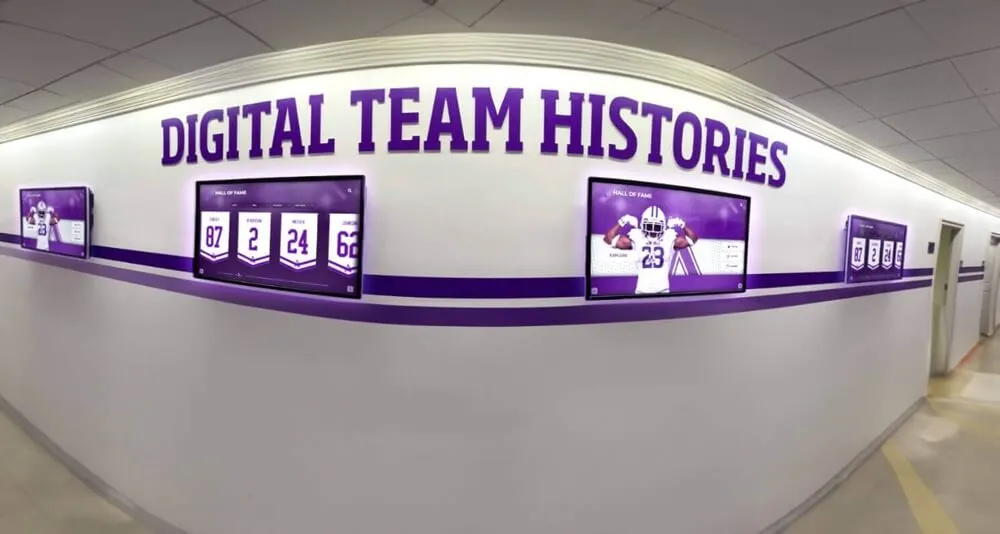
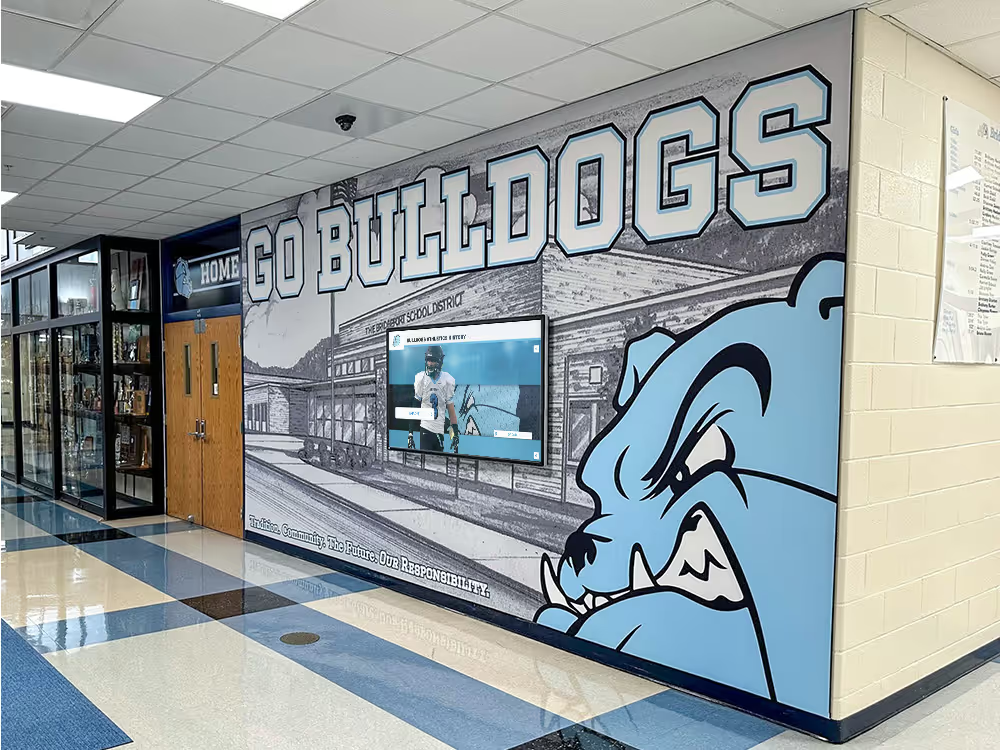
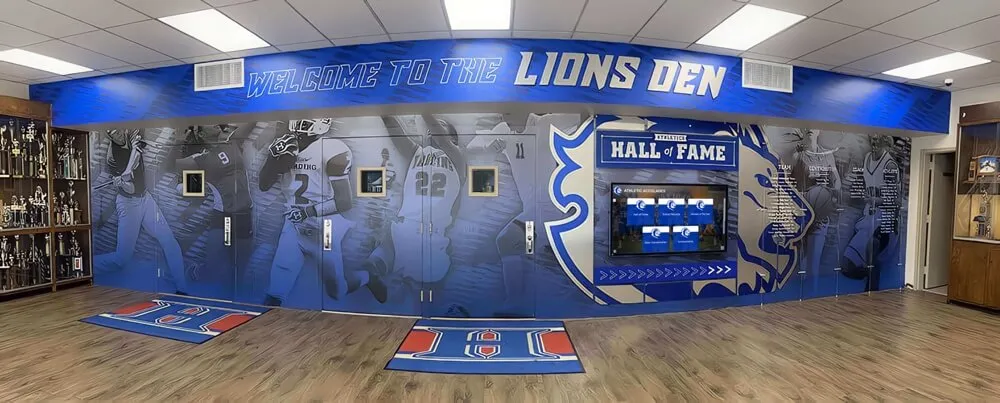
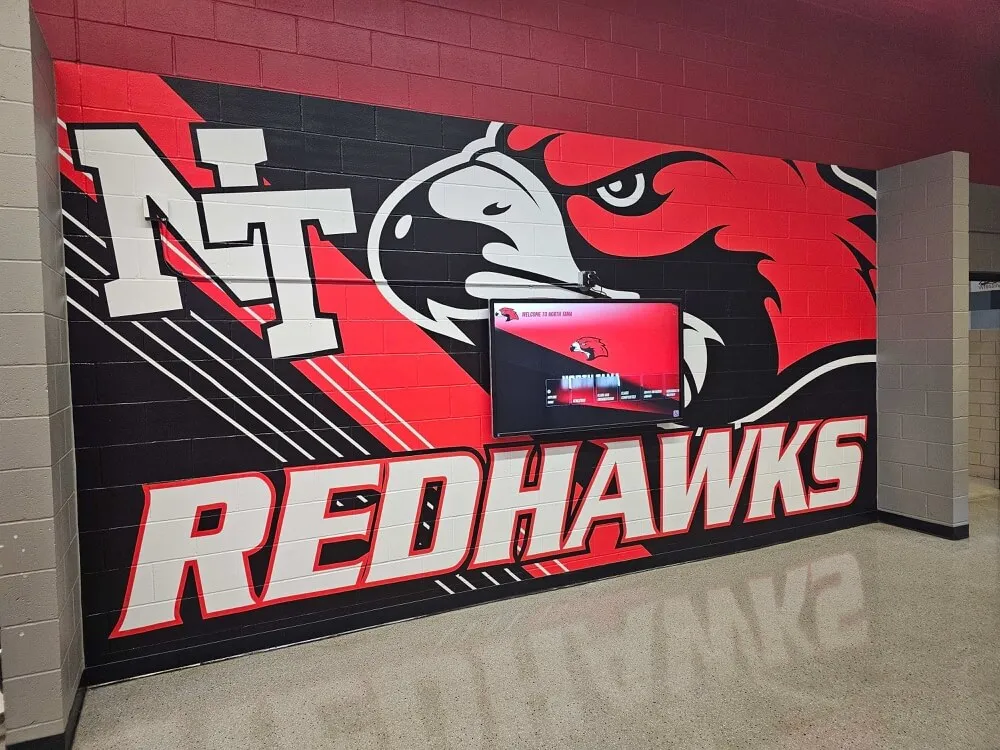
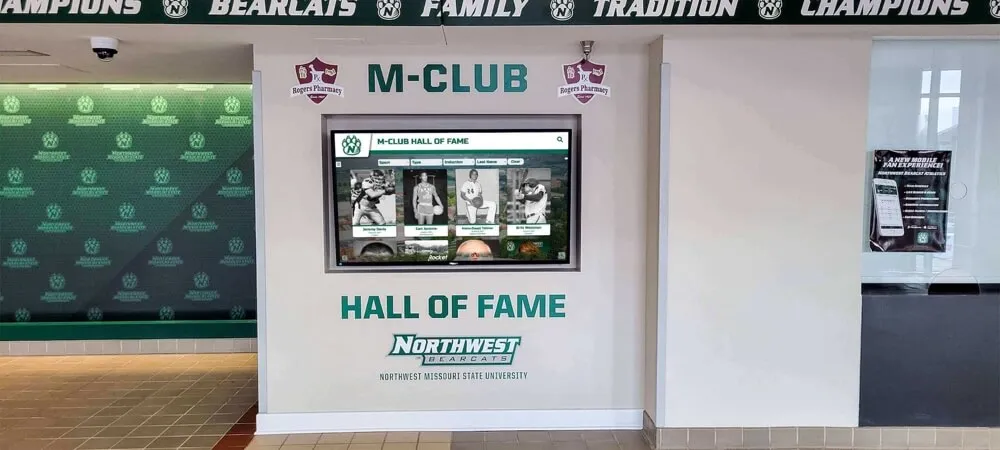
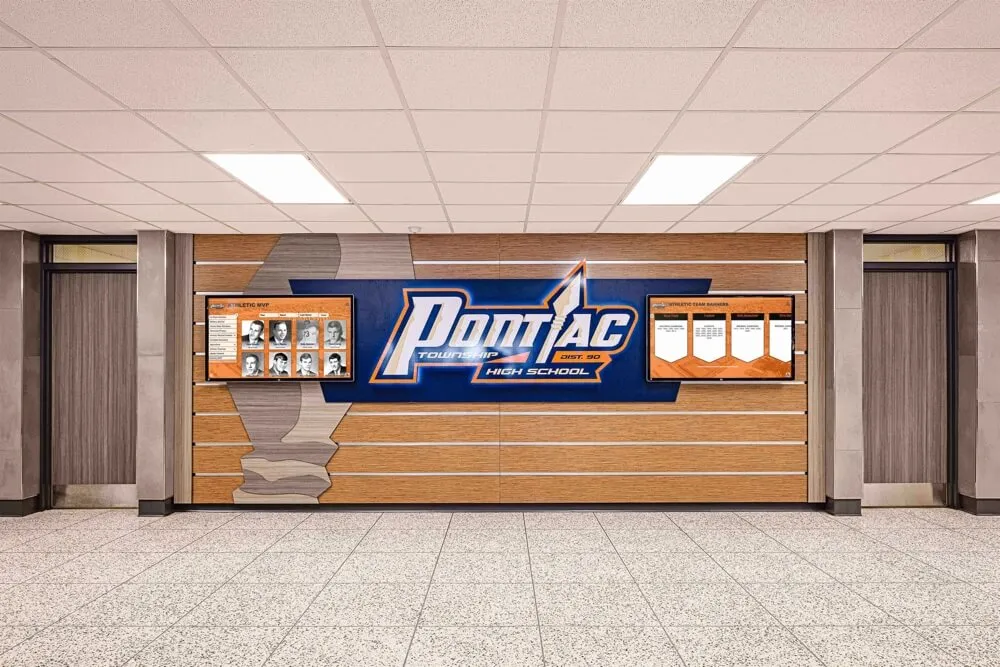
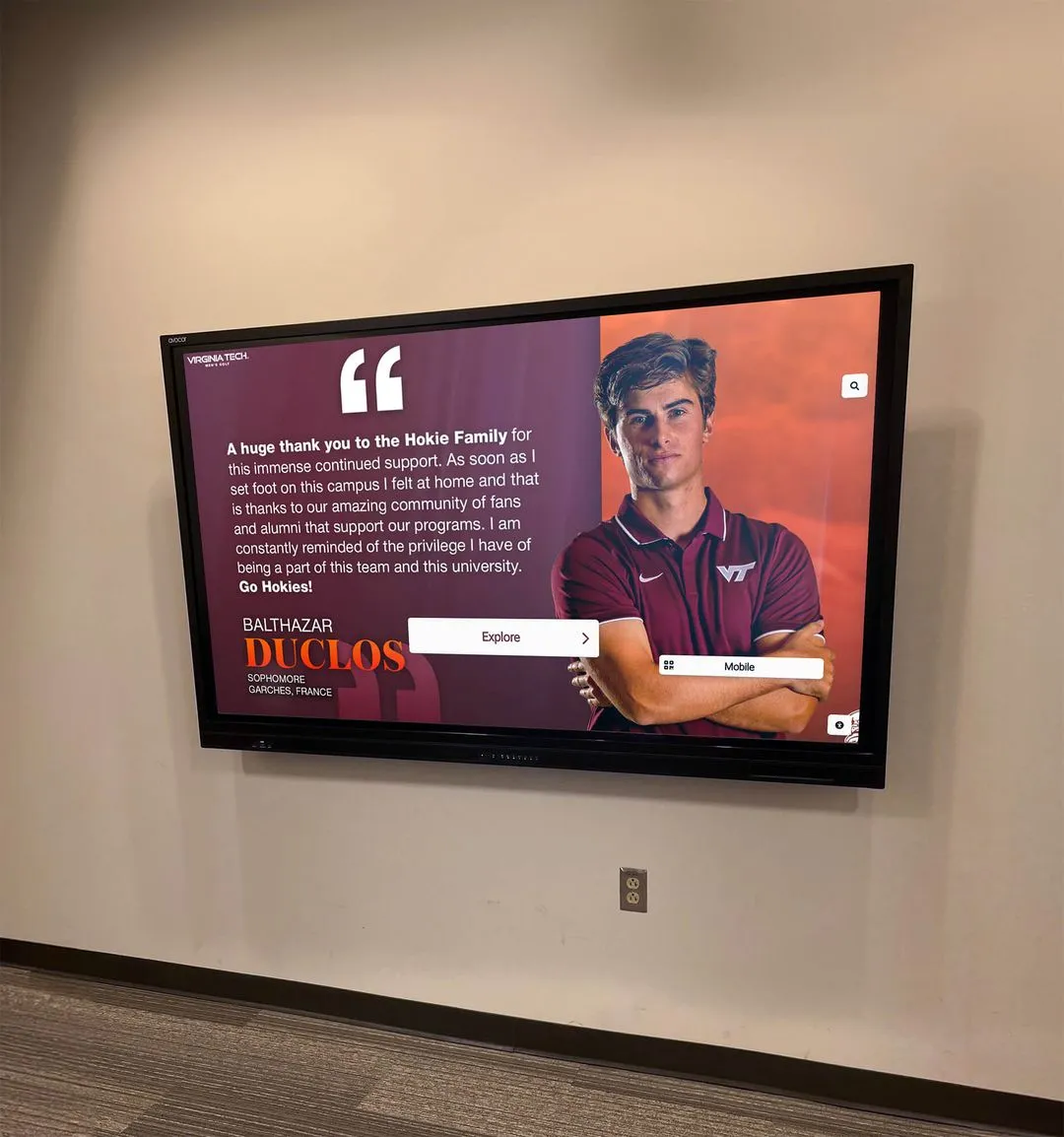
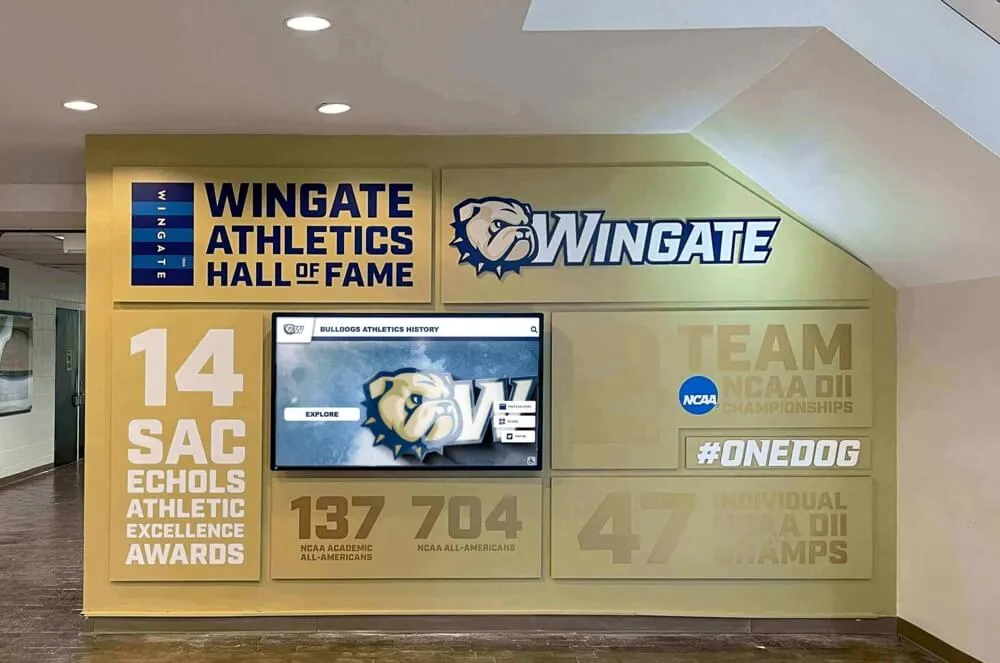
A digital hall of fame display with consistent portrait cards depends on receiving photos that meet a defined standard before the first inductee profile goes live
Program Snapshot: Photo Specification Reference
Use this table as a quick-reference checklist for inductee photo submissions. Detailed guidance for each row follows in the sections below.
| Specification | Minimum Requirement | Recommended Standard |
|---|---|---|
| File format | JPEG (.jpg) | JPEG for web delivery; TIFF for archival storage |
| Resolution (web display) | 72 PPI | 96–150 PPI at final display size |
| Resolution (print) | 200 PPI at print size | 300 PPI at print size |
| Minimum pixel dimensions | 800 × 800 pixels | 1500 × 1500 pixels or larger |
| Color mode | RGB | RGB (sRGB color profile) |
| Maximum file size | None (archive originals uncompressed) | Compress to ≤ 2 MB for web delivery copies |
| Background | No requirements if solo subject | Neutral, non-distracting; solid or blurred |
| Framing | Subject visible from chest up | Head and shoulders with consistent padding |
| Photo type | Any clear, current likeness | Professional headshot or official team photo |
| File naming | No spaces in filename | lastname-firstname-inductionyear.jpg |
| Rights clearance | Verified before publication | Signed release on file |
Section 1: Why Consistent Photo Standards Matter
Photo standards are a governance decision before they are a technical one. A school that accepts any image in any format is making a choice—and the cost of that choice compounds with every inductee added to the program.
Visual consistency builds program credibility. A hall of fame profile page where every photo is framed the same way, lit similarly, and rendered at consistent resolution reads as an institutional record. A page where photos vary in size, composition, and quality reads as an assembled collection of whatever was available. The photographs communicate what level of care the program applies to recognition itself.
Display readiness requires forward planning. A photo that looks acceptable as a 200-pixel thumbnail on a web listing may not hold up as a large-format portrait on a touchscreen display or printed recognition board. Photos accepted without minimum resolution requirements now become replacement projects later. When schools move to searchable digital archives and recognition platforms, the photo archive is the first asset audited.
Archival durability protects the record. Athletic records span decades. A photo properly archived as a high-resolution TIFF with a structured filename and documented source can be reformatted, reprinted, and repurposed thirty years from now. A low-resolution JPEG with a filename like IMG_4872.jpg and no documented origin is an asset with an unknown shelf life.
Rights clearance prevents legal exposure. Publishing a photograph online without confirmed rights is not a theoretical risk for schools—it is a practical one. Commercial photographers retain copyright by default unless a written agreement says otherwise. Family-provided photos may have been taken by a professional who sold prints but not digital rights. Getting rights questions right during the photo intake process is easier than addressing them after an image is live on a public-facing website.

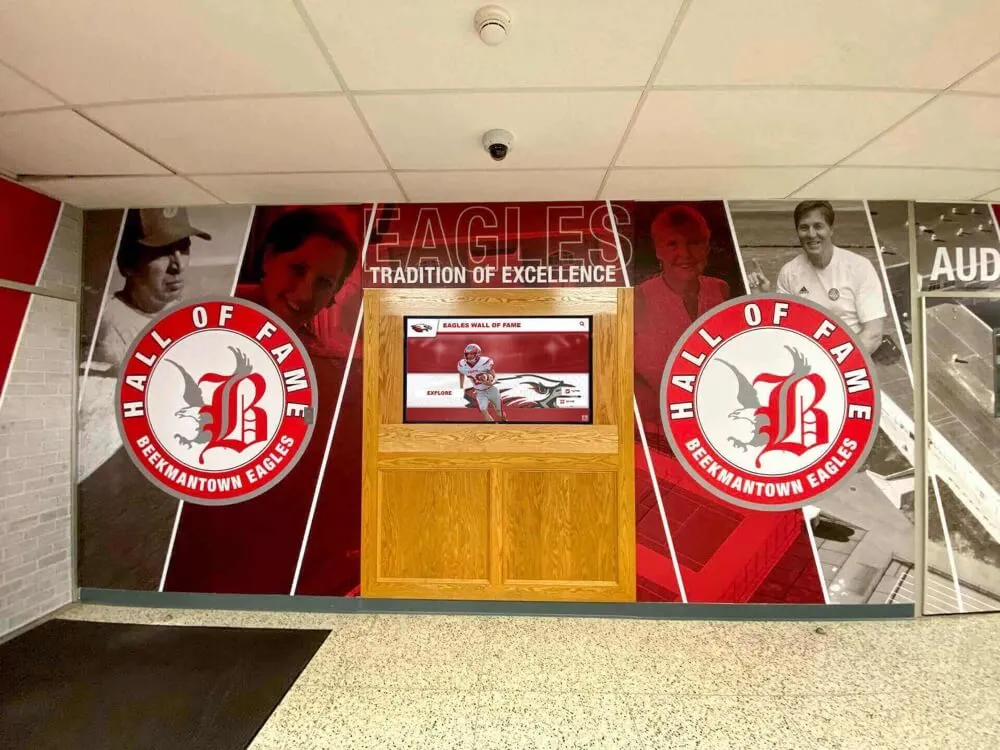
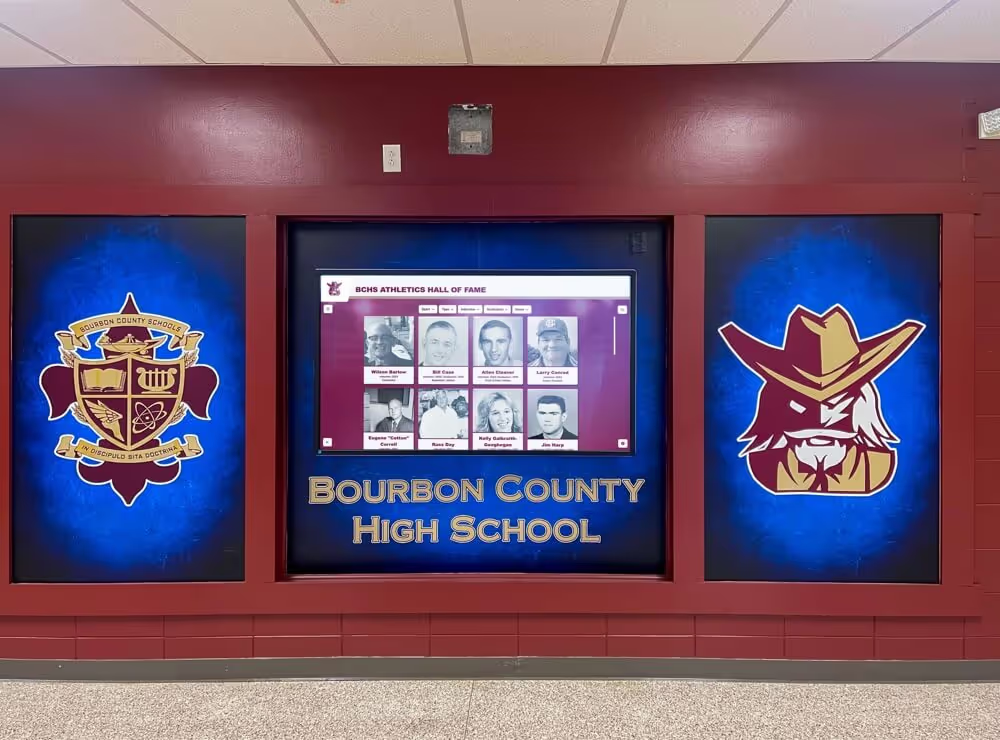
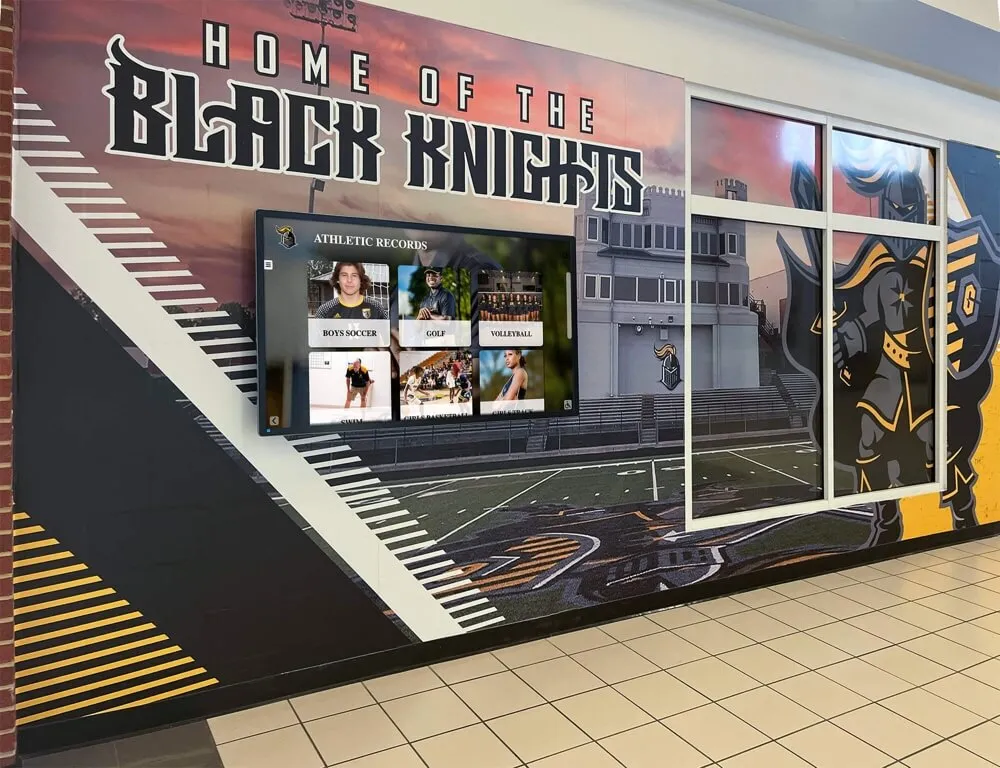
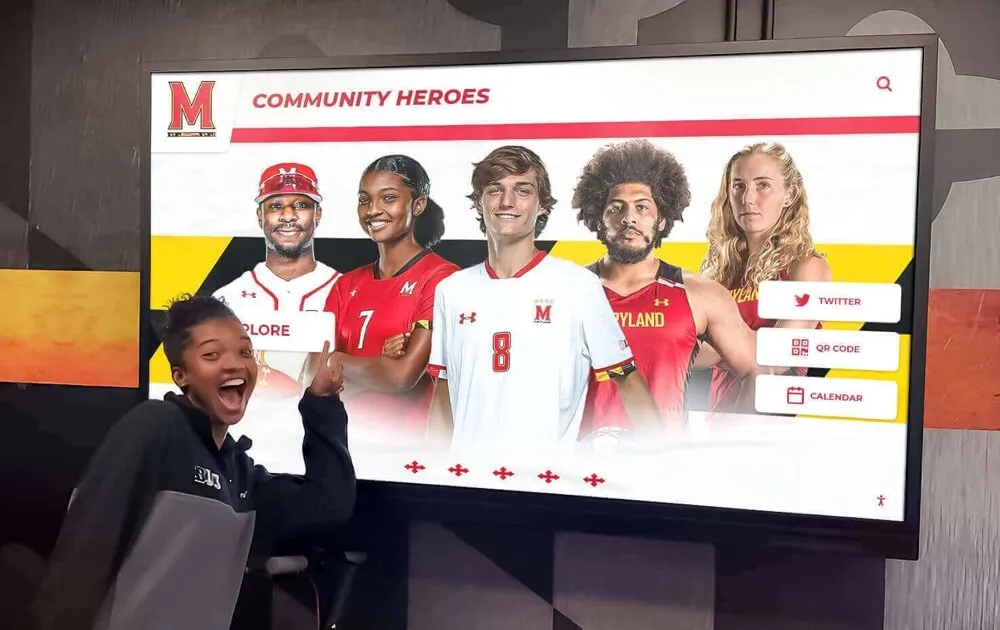
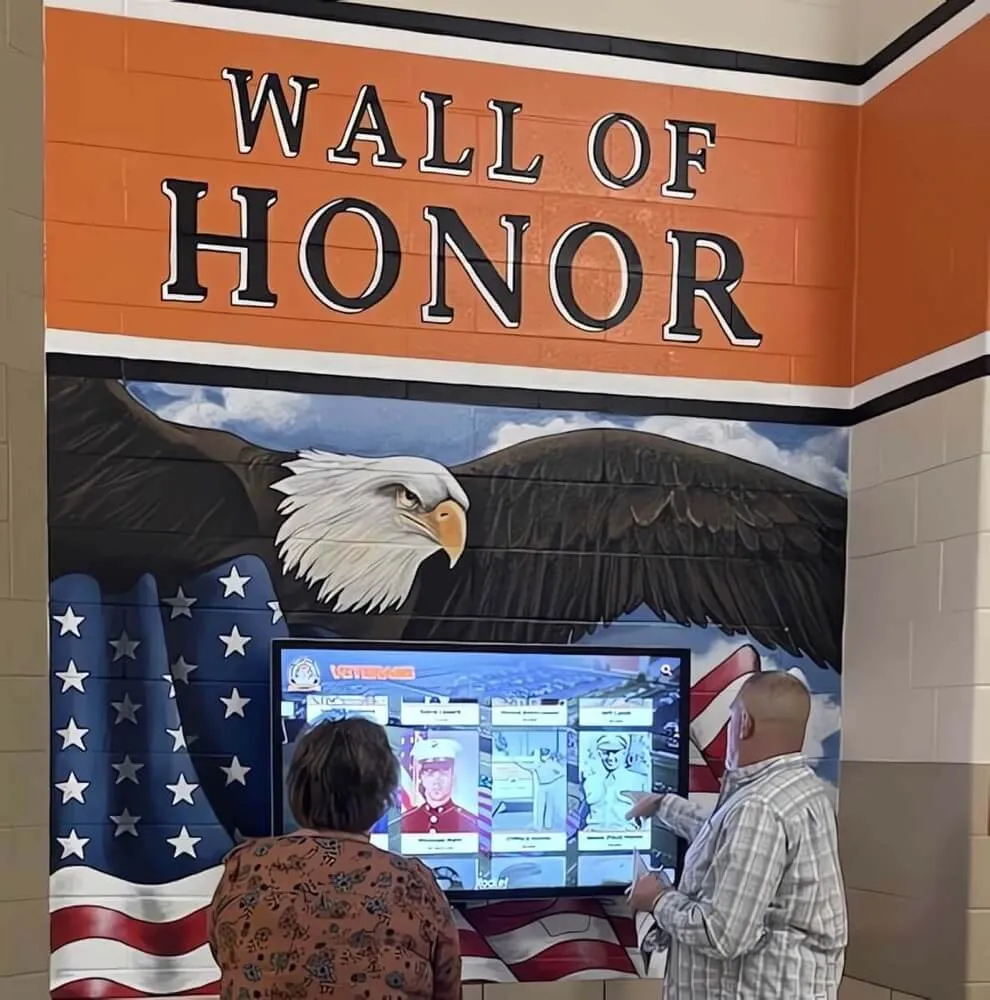
Consistent framing and presentation across portrait cards—whether for alumni athletes or current inductees—depends on standardized photo requirements at the collection stage
Section 2: Technical Specifications
These are the specific parameters that determine whether a submitted photo is usable for all display contexts the school is likely to need.
File Format
JPEG (.jpg) is the standard delivery format for web and most digital display contexts. It is widely compatible, compresses efficiently, and is the format most families and photographers will submit.
PNG (.png) is acceptable when the original has no background or uses transparency, and is preferable when the photo will be composited into a designed layout. PNG files are larger than JPEGs at equivalent quality.
TIFF (.tif) is the archival standard. TIFF files are large and not suitable for web delivery, but they are lossless—every copy is identical to the original. Schools building serious archives should store a TIFF master for every inductee photo, even if the source was a JPEG, by retaining the highest-quality original received rather than converting up.
WebP is an emerging web format with better compression than JPEG at equivalent quality. If your display platform accepts WebP, it can reduce page load times without sacrificing visual quality.
Avoid: BMP, GIF, HEIC (the iPhone default format), or files delivered from cloud platforms without proper export. HEIC files are not universally compatible and require conversion before use.
Resolution and Pixel Dimensions
Resolution is the most misunderstood specification in photo collection. The number that matters is pixel dimensions—the actual pixel count of the image—not DPI/PPI metadata, which is an embedded tag that can be changed without affecting image quality.
Minimum pixel dimensions: 800 × 800 pixels is a baseline floor. At this size, a photo is usable as a web thumbnail and a small digital display card. It is not adequate for large-format print or a prominent touchscreen portrait tile.
Recommended pixel dimensions: 1500 × 1500 pixels or larger. At this size, the photo handles all web display contexts and most standard print sizes (5×7, 8×10) without visible degradation. For digital walls of fame displaying portrait images at large size, 2000 × 2000 pixels or larger is preferable.
Print context: For any context where the photo will be printed—a plaque, a program, a lobby display board—the minimum is 300 PPI at the intended print size. A 1500-pixel-wide image prints cleanly at 5 inches wide (1500 ÷ 300 = 5). It does not print cleanly at 10 inches without visible softness.
If submitters ask how to check their image size: on a current smartphone, a photo taken with the main camera is typically 12 megapixels or larger (4032 × 3024 pixels), well above the minimum. Older digital camera photos may be smaller. Scanned prints depend entirely on the scanning resolution—more on that in Section 6.
Color Mode
All inductee photos should be submitted and stored in RGB color mode (specifically, the sRGB color profile where possible). This is the standard for screens and web display.
CMYK is the standard for offset printing. If photos will be sent to a professional printer for a large-format display or publication, the printer will typically request CMYK files or handle conversion. Do not ask inductees or families to submit CMYK photos—most will not know what this means, and consumer cameras do not produce CMYK files.
Black and white photos should be stored as grayscale or converted from a color original where possible. Grayscale retains tonal detail without the color artifacts that can appear in aged photographs.
File Size
There is no minimum file size requirement—a photo can be 15 MB and that is fine for archival storage. For web delivery copies (not the master archive file), compress to 2 MB or under using a tool like Squoosh, Photoshop’s Save for Web, or ImageOptim. Uncompressed originals should always be retained separately.
Section 3: Photo Composition Requirements
Specification for composition defines what the photo shows and how it is framed—criteria the submitter controls before taking the photo and criteria the school uses to evaluate what arrives.
Framing Standard
The most consistent hall of fame photo collections use a head-and-shoulders frame as the standard for primary inductee portraits. This means:
- The top of the frame sits approximately one inch of visual space above the top of the subject’s head
- The bottom of the frame sits at approximately mid-chest level
- The subject is centered horizontally, or nearly so
- The subject’s eyes are in the upper third of the frame
Action photos are valuable secondary images—an athlete mid-play, in competition, or in a defining career moment—but they are generally not appropriate as the sole profile photo. Action photos are often partially obscured, motion-blurred, or composed for journalism rather than portrait display. Programs that want to feature action photos should collect a standard portrait in addition.
Full-body photos work well for some display contexts (a full-height standing portrait in a lobby display, for example) but are inconsistent when mixed with head-and-shoulder shots in the same profile grid. If full-body photos are accepted, specify them as supplemental rather than primary.
Background Guidelines
A neutral, non-distracting background is the standard that holds across eras and contexts:
- Preferred: Solid color, blurred environment, or school facility background (gym, field) that reads clearly as the subject’s athletic context
- Acceptable: Team photo background, natural outdoor setting without distracting elements
- Avoid: Busy indoor scenes, casual social settings, commercial venue backgrounds, or photos cropped from group shots where the crop edge is visible
A photo taken against a wall of lockers reads very differently from one taken in front of a plain background or the school’s athletic facility. Background choice signals the formality and institutional character of the recognition program.
Lighting
Even, front-facing lighting without harsh shadows or strong backlighting is the standard:
- The subject’s face should be evenly lit without shadows obscuring one side
- Backlighting—where a window or bright light source sits behind the subject—creates silhouettes rather than portraits
- Direct flash from a phone camera often creates flat, harshly lit images; diffused natural light or a soft studio light source produces better results
- Outdoor photos in open shade (not direct sunlight) are typically well-lit without additional equipment
For historical photos, lighting quality is outside the school’s control. The standard applies to new photos collected going forward.
Expression and Attire
Most programs do not prescribe expression formally, but professional composure—a neutral or positive expression that reads as institutional recognition rather than a casual snapshot—is consistent with the tone of a hall of fame profile.
Attire recommendations should reflect the program’s standards:
- Team uniform or school athletic attire is appropriate and contextually relevant
- Formal or business-casual attire is common for non-athlete inductees such as coaches and contributors
- Casual clothing is acceptable if it is the only available photo, but programs should specify whether uniform or formal attire is preferred for new photos
Section 4: File Naming and Organization Conventions
File naming is the detail that makes archives functional rather than merely present. A file named IMG_4872.jpg requires a human to open it to identify it. A file named henderson-emily-2024.jpg is self-describing.
Recommended Naming Convention
lastname-firstname-inductionyear.jpg
Examples:
smith-james-2023.jpgrodriguez-maria-2019.jpgobrien-patrick-2024.jpg
Rules:
- All lowercase
- Hyphens instead of spaces or underscores
- No special characters
- Use induction year, not birth year or graduation year, to reflect the program record
- If a program collects both a portrait and an action photo, distinguish them:
smith-james-2023-portrait.jpgandsmith-james-2023-action.jpg
Folder Structure
A simple folder structure keeps photos findable:
/hall-of-fame-photos/
  /masters/            ← Full-resolution originals
  /web-delivery/       ← Compressed copies for online use
  /historical/         ← Scanned archival photos
  /pending/            ← Received, not yet approved
Even a flat folder with consistent naming is better than a disorganized collection. The key requirement is that anyone responsible for the program can find any inductee’s photo without asking someone else.
Section 5: Image Rights and Permissions
Publishing a photograph online places it in a context where rights questions are consequential. Schools are not immune from copyright claims, and inductee profiles on school websites are public-facing content.
Who Owns the Photo
The photographer owns the copyright unless there is a written agreement stating otherwise. This is true regardless of who paid for prints.
School-employed photographers working in the course of their employment typically produce work owned by the school as work-for-hire—but this depends on the employment agreement.
Yearbook photos are typically licensed for yearbook use; using them on a public website or digital display is a separate use that may or may not be covered by the original contract.
Family-provided photos are usually taken by someone in the family (and thus owned by that person) or by a commercial photographer. A parent who hands over a print does not necessarily transfer digital publication rights.
Rights Clearance Process
For photos submitted by inductees or families, the simplest clearance mechanism is a single-sentence written statement in the submission form:
“I confirm that I have the right to grant [School Name] permission to publish this photograph in its athletic hall of fame, including on the school’s website, digital displays, and printed recognition materials.”
This documents that the submitting party represented they had the right to grant permission. It protects the school in the most common scenario.
For commercial photographer photos, ask the submitting family to contact the photographer and obtain a written release for institutional publication use. Many photographers will grant this at no cost for an educational institution’s non-commercial recognition program.
Stock photos should never be used as inductee photos. A profile image needs to depict the actual inductee.
For programs building broader recognition environments—such as game-day athletic facility experiences where inductee recognition is visible across multiple venues and formats—documenting rights at the point of collection prevents problems across every downstream use.
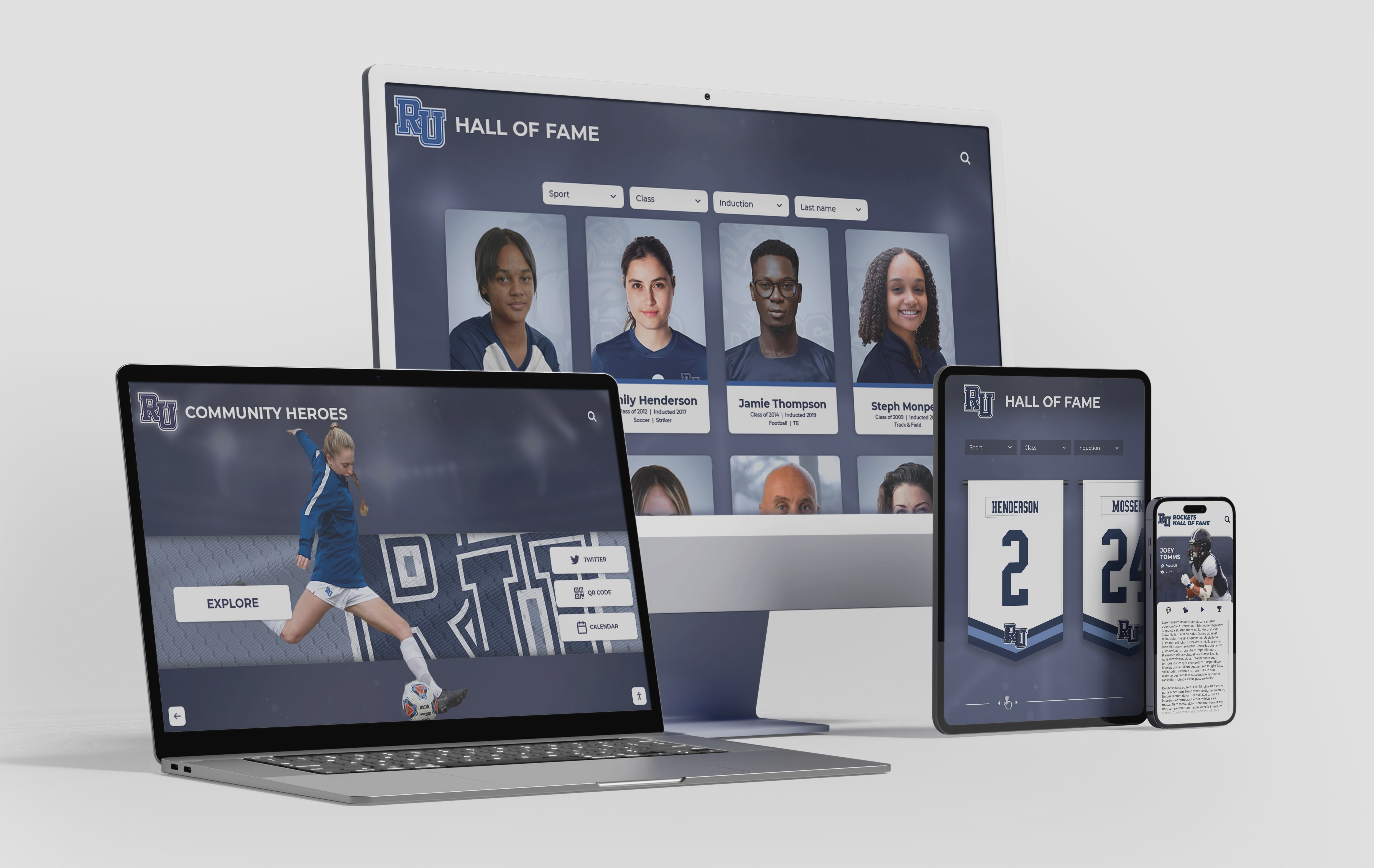
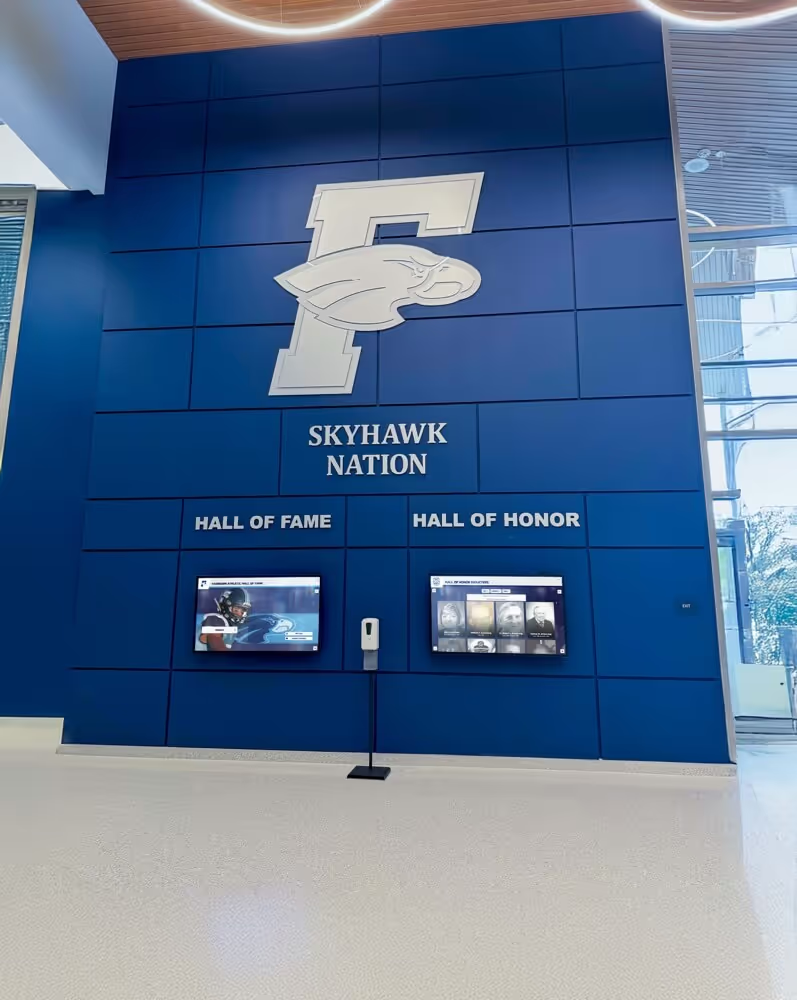
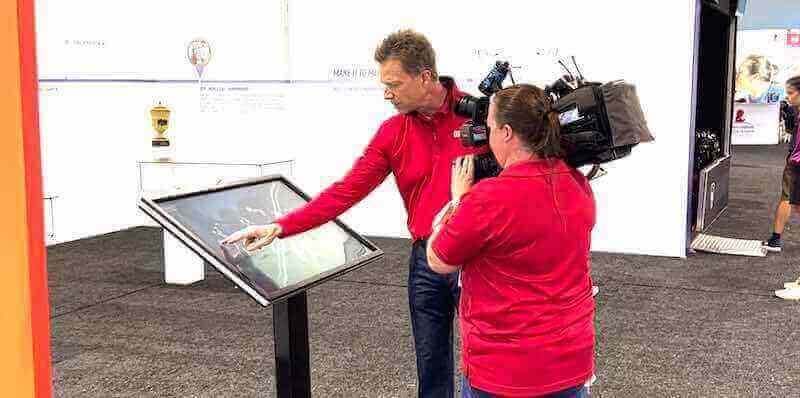
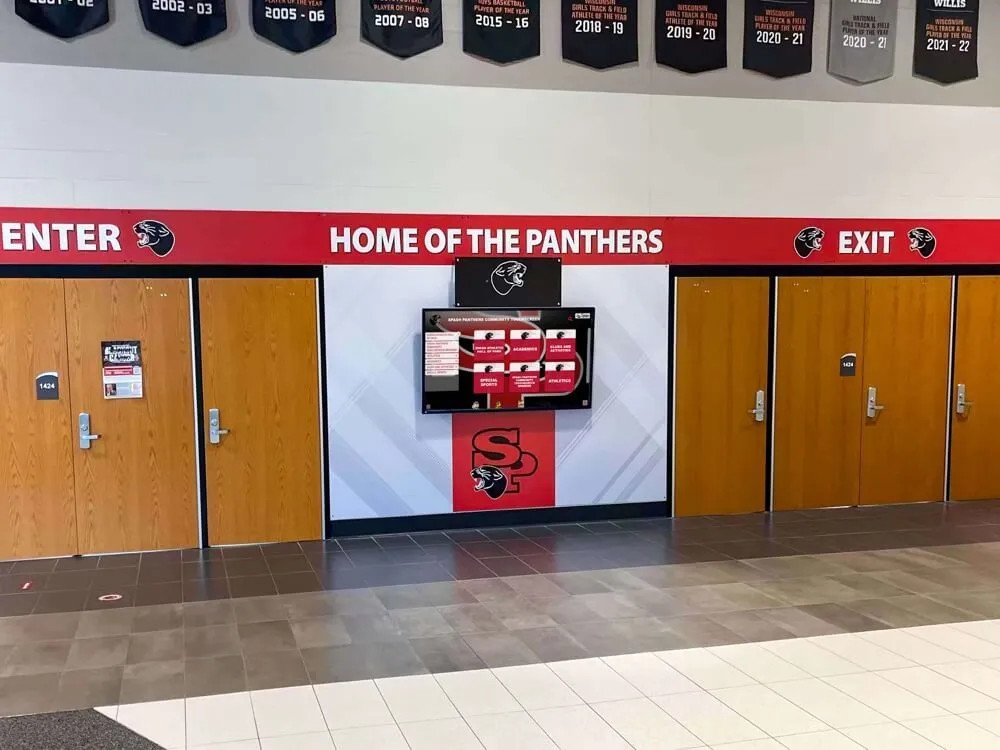
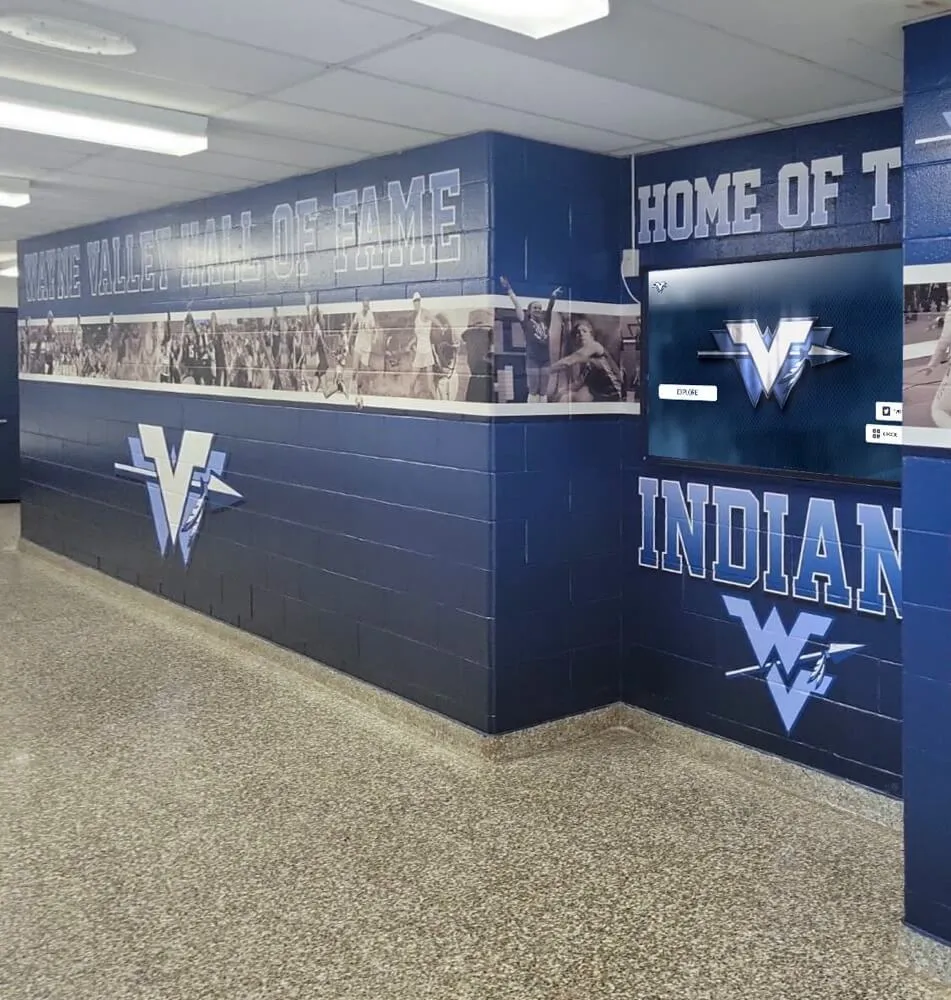
An inductee profile viewed on multiple devices places different demands on photo resolution and framing—standards that hold across contexts require planning before photos are collected
Section 6: Historical Photos—Digitizing and Adapting Legacy Images
Many athletic hall of fame programs span decades of inductees, which means some portion of the photo archive consists of printed originals, yearbook photos, film scans, or early digital files that predate modern resolution standards.
Scanning Printed Photos
A printed photo digitized at adequate resolution is a usable archive asset. The general standard:
| Print Size | Minimum Scan Resolution | Result at Screen Display |
|---|---|---|
| 4 × 6 inch | 600 DPI | ~2400 × 3600 pixels — adequate for most display contexts |
| 3 × 5 inch | 600 DPI | ~1800 × 3000 pixels — adequate for most display contexts |
| Wallet size (2 × 3 inch) | 1200 DPI | ~2400 × 3600 pixels — adequate with high-quality scan |
| Contact sheet or small print | 1200 DPI minimum | Quality depends heavily on original print quality |
Scanning at 300 DPI preserves the print at approximately its original visual size. Scanning at 600 DPI doubles the pixel count, providing more room to crop or display at larger sizes.
Flatbed scanners produce better results than phone camera scans for printed photos. Flatbed scanning eliminates parallax distortion, provides even lighting, and supports the print properly. If the school does not own a flatbed scanner, most office supply stores offer scanning services.
Restoration and cleanup of historical photos—removing scratches, correcting fading, adjusting exposure—should be handled conservatively. Minor cleanup to make a photo usable is appropriate. Significant alterations to a historical photograph change the record. Note any restoration work in the photo’s documentation.
Handling Yearbook Photos
Yearbook photos are a common source for historical inductee images. Before using them:
- Confirm the school retains the rights to use yearbook photos for this purpose
- Note the yearbook year in the photo documentation so the image can be contextualized
- Scan from a physical yearbook rather than a photocopy if possible—photocopies introduce additional generation loss
For programs preserving full-season athletic records alongside inductee profiles, the yearbook photo collection often serves as an entry point for the broader archive project.
Documenting Photo Sources
Every photo in the archive should have an associated record noting:
- Source (who provided the photo; yearbook year if applicable; photographer name if known)
- Rights status (who holds rights; whether a release is on file; or “school-owned” as applicable)
- Date of original photo (year, approximate if exact date unknown)
- Original format (print, digital, yearbook)
This documentation lives outside the image file itself—in a spreadsheet, database, or CMS field—and makes the archive auditable when rights questions arise.
Section 7: Display Context Requirements
Inductee photos do not live in a single context. A well-built program uses the same photo assets across multiple surfaces, and each surface has slightly different requirements.
Online Profiles and Searchable Archives
For web publication, photos are typically displayed at 200–600 pixels wide in profile card views, with the ability to enlarge. Requirements:
- Format: JPEG or WebP for delivery; PNG if transparency is needed
- Delivered dimensions: 1000 × 1000 pixels minimum for a profile card that can enlarge cleanly
- Color mode: RGB / sRGB
- File size: Under 500 KB for profile card delivery; higher-resolution versions available on enlarge
Consistent aspect ratio (typically 1:1 square or 3:4 portrait) across all profile photos prevents layout shifts and ensures card grids display uniformly. Many CMS platforms for hall of fame programs will crop photos to a specified ratio automatically—confirm what ratio your platform uses before specifying the submission standard.
Touchscreen Walls of Fame and Digital Displays
Large-format digital display surfaces—interactive touchscreen hall of fame installations and lobby kiosk systems—display inductee photos at sizes substantially larger than a web thumbnail.
For portrait tiles on a 55-inch or 65-inch touchscreen display, an inductee portrait may render at 400–800 pixels wide on screen but at high pixel density. Requirements:
- Minimum pixel dimensions: 1500 × 1500 pixels for standard portrait display
- Preferred: 2000 × 2000 pixels or larger for 4K display contexts
- Format: JPEG or PNG depending on platform requirements; confirm with display platform documentation
- Avoid uploading compressed copies: Upload the highest-resolution available and let the platform generate delivery copies
The platform underlying the hall of fame display will specify exact requirements. Use those specs as the ceiling; the requirements in this guide represent the floor.

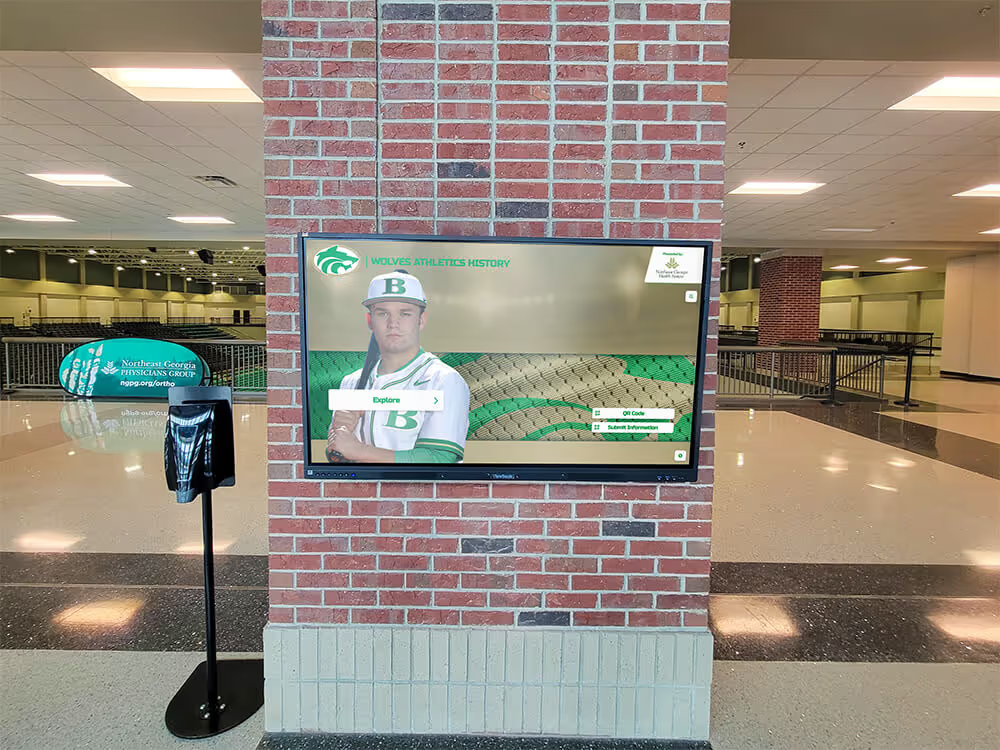
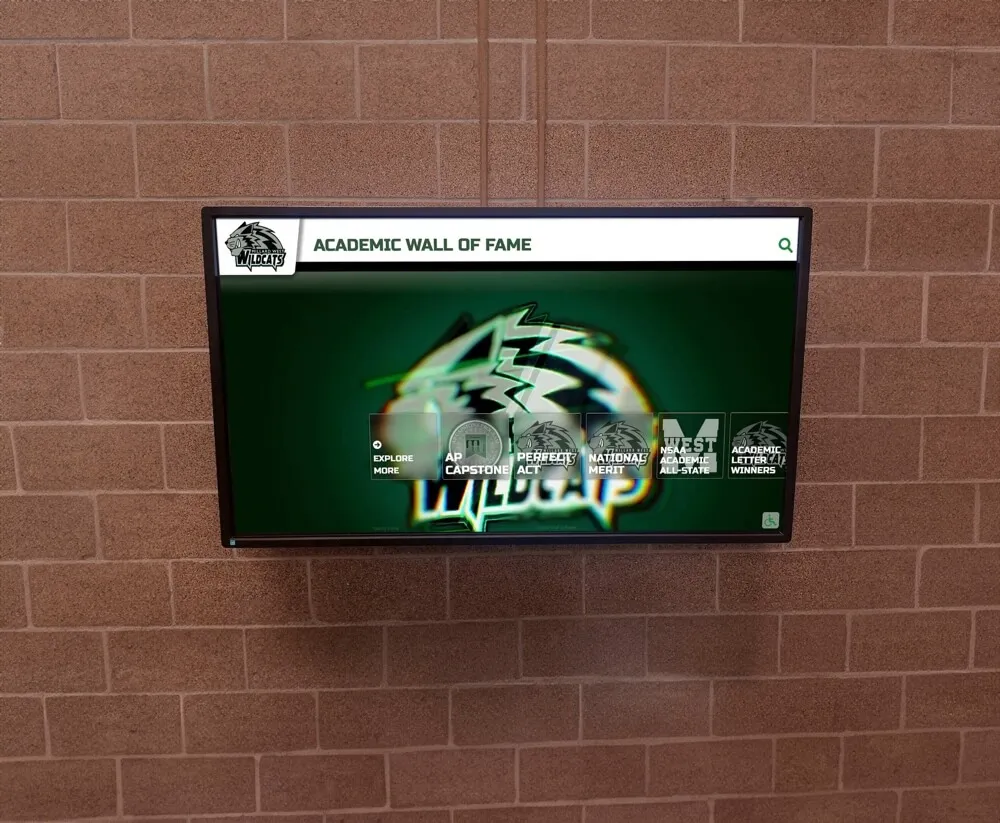
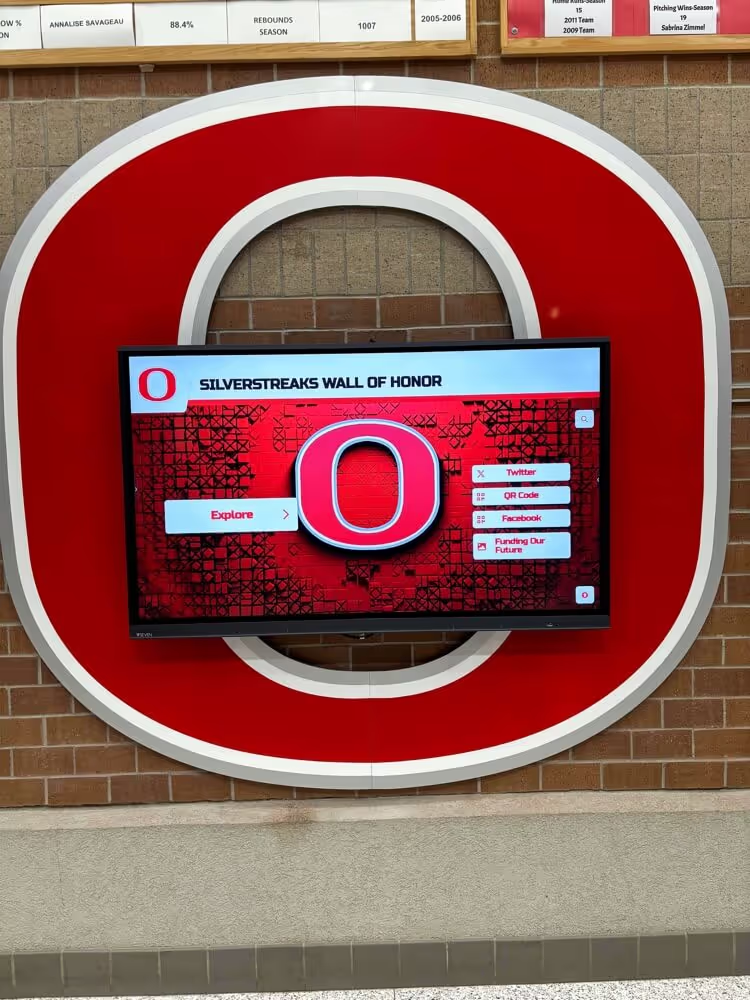
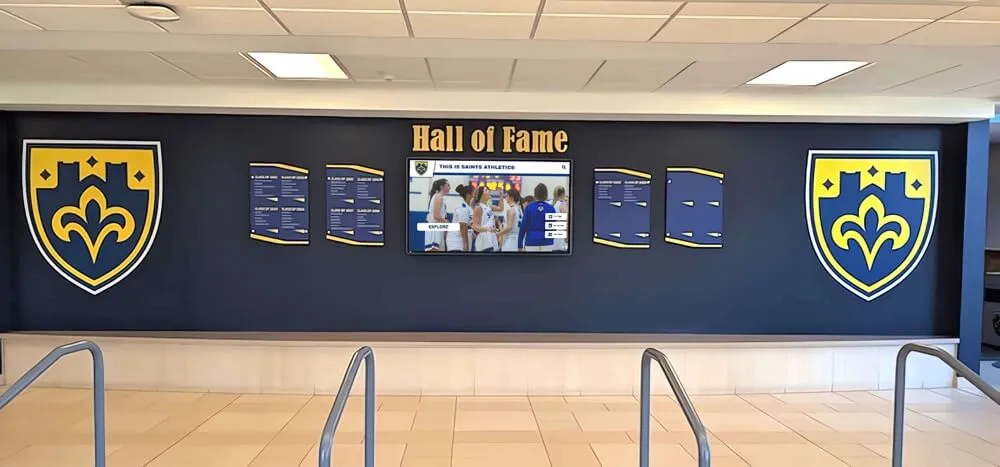
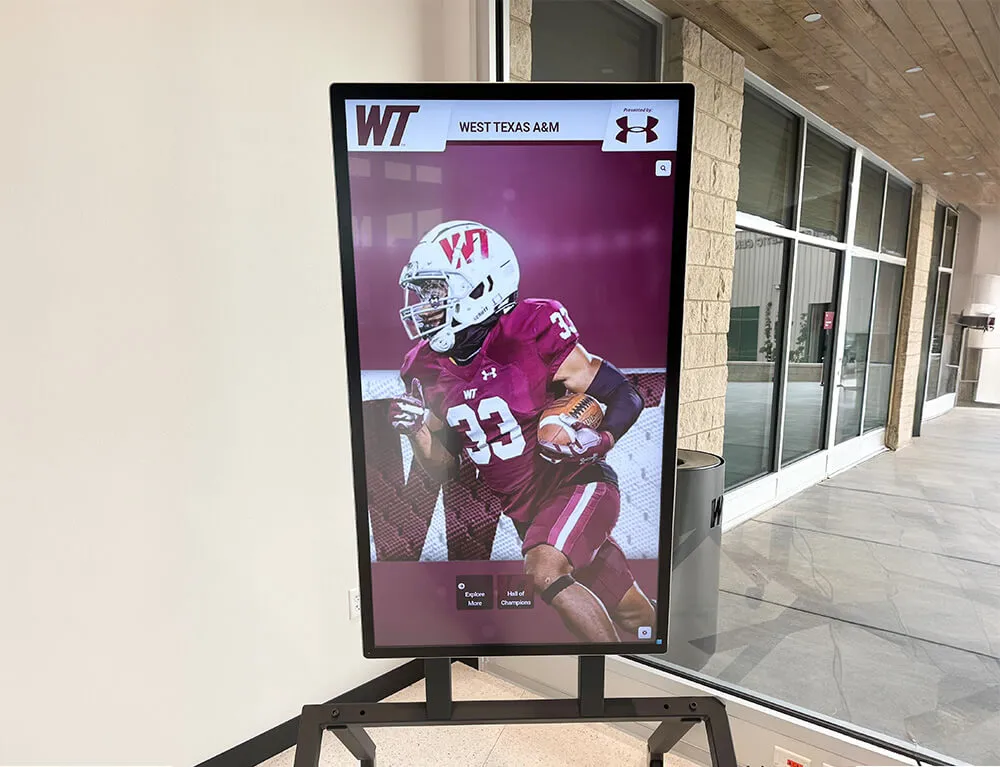
Touchscreen hall of fame displays render inductee portraits at large sizes—photos that meet minimum pixel requirements before upload produce profiles that hold up at display scale
Print Programs and Ceremonial Materials
For printed use—induction ceremony programs, lobby display boards, plaques—300 PPI at the intended print size is the standard:
- A 2 × 2 inch print requires 600 × 600 pixels at 300 PPI
- A 4 × 4 inch print requires 1200 × 1200 pixels at 300 PPI
- A 5 × 7 inch print (portrait orientation) requires 1500 × 2100 pixels at 300 PPI
Photos submitted at the 1500 × 1500 pixel minimum cover the 4×4 print standard. Photos at 2000+ pixels cover the 5×7 standard. If your program produces large-format print recognition boards at 18×24 or larger, collect photos at 2400 × 2400 pixels or larger.
Work with your print vendor to confirm requirements before finalizing specs. A vendor experienced with athletic facility signage and recognition display standards can specify exactly what their equipment requires for the formats your program uses.
Donor and Sponsor Recognition Integration
When hall of fame profiles appear on the same platform as donor recognition, sponsor walls, or broader community recognition programs, photo consistency matters across categories. A recognition board that places inductee photos, donor portraits, and sponsor logos in the same visual field requires a unified photo standard across all content types.
Schools building multi-category recognition programs—spanning athletic inductees, academic achievers, and school spirit traditions and community-building recognition—should apply the same photo specifications across every category that will display portrait photos, rather than maintaining separate standards that eventually need reconciliation.
Section 8: Inductee Photo Submission Checklist
A checklist sent to inductees, families, or staff responsible for photo collection reduces back-and-forth and ensures submissions arrive meeting the standard.
Checklist for Inductees and Families
Photo content:
- Photo shows the inductee clearly as the primary subject
- Expression is appropriate for a formal recognition profile
- Background is neutral or school-athletics context
- Attire is appropriate (team uniform, athletic gear, or formal/business attire per program guidelines)
- No watermarks, text overlays, or decorative filters
Technical requirements:
- File format is JPEG or PNG
- Pixel dimensions are at least 1500 × 1500 pixels (check via phone photo app → image details)
- File size is at least 1 MB (compressed social media versions are typically too low quality)
- File name follows the convention:
lastname-firstname-inductionyear.jpg
Rights:
- Photo was taken by a family member, school photographer, or commercial photographer
- If taken by a commercial photographer, a written permission statement has been obtained
- Submitter has completed the rights confirmation statement in the submission form
Checklist for Staff Receiving Submissions
On receipt:
- Pixel dimensions verified (minimum 1500 × 1500 pixels)
- File format is JPEG or PNG (not HEIC, BMP, or other incompatible format)
- Rights confirmation statement is on file
- Photo renamed per naming convention
- Original filed in /masters/ folder; web-delivery copy compressed and filed in /web-delivery/
Before publication:
- Photo reviewed for quality (resolution, lighting, composition) by designated reviewer
- Inductee or authorized family member has reviewed the profile draft including photo
- Approval documented per program governance process
For programs that have established formal governance structures, the photo review step fits within the broader inductee profile approval workflow that ensures every profile meets program standards before it goes live.
Building a Photo Standard Your Whole Program Can Follow
A photo standard does not need to be complex to be effective. Many programs operate successfully on a one-page requirements document distributed at the time of induction notification, a simple naming convention, a submissions folder, and a rights confirmation checkbox in the submission form.
The programs that struggle are not those with simple standards—they are those with no standards at all, collecting whatever arrives and publishing as quickly as possible. The photograph is the first visual element every viewer encounters on an inductee’s profile. It signals whether the program treats recognition as an institutional record or as an informal collection. Getting the photo right is getting the first impression right.
Athletic hall of fame programs that anchor their visual identity in consistent, well-specified inductee portraits create archives that serve the institution across format changes, display upgrades, and the decades of inductions to come. When a school transitions from a physical display to a digital wall of fame, or from a static website to an interactive touchscreen installation, the photo archive either enables that transition or becomes its biggest obstacle.
Programs building recognition environments meant to last treat photo standards as a foundation, not an afterthought. The same attention to detail that drives athletic program excellence and skill development on the field extends to the institutional records that document that excellence for future generations.
Put Your Photo Standard Into a Display Built to Showcase It
Rocket Alumni Solutions builds interactive digital hall of fame displays for schools that take inductee recognition seriously. The platform accepts your photos, stores originals, generates display-optimized copies automatically, and presents inductee portraits with the consistency your program's standard requires—across touchscreen lobby installations, searchable online archives, and multi-device web profiles. Request a free custom demo and see what your inductee photos look like on a display built for them.
Request Your Free Custom DemoEvery inductee in your athletic hall of fame has earned recognition that reflects the quality of their contribution. A clear photo standard ensures that the first thing visitors see—their portrait—is worthy of the achievement it represents.